Overbooking a 30-room motel loses money unless more than 3.9% of bookings vanish on arrival day
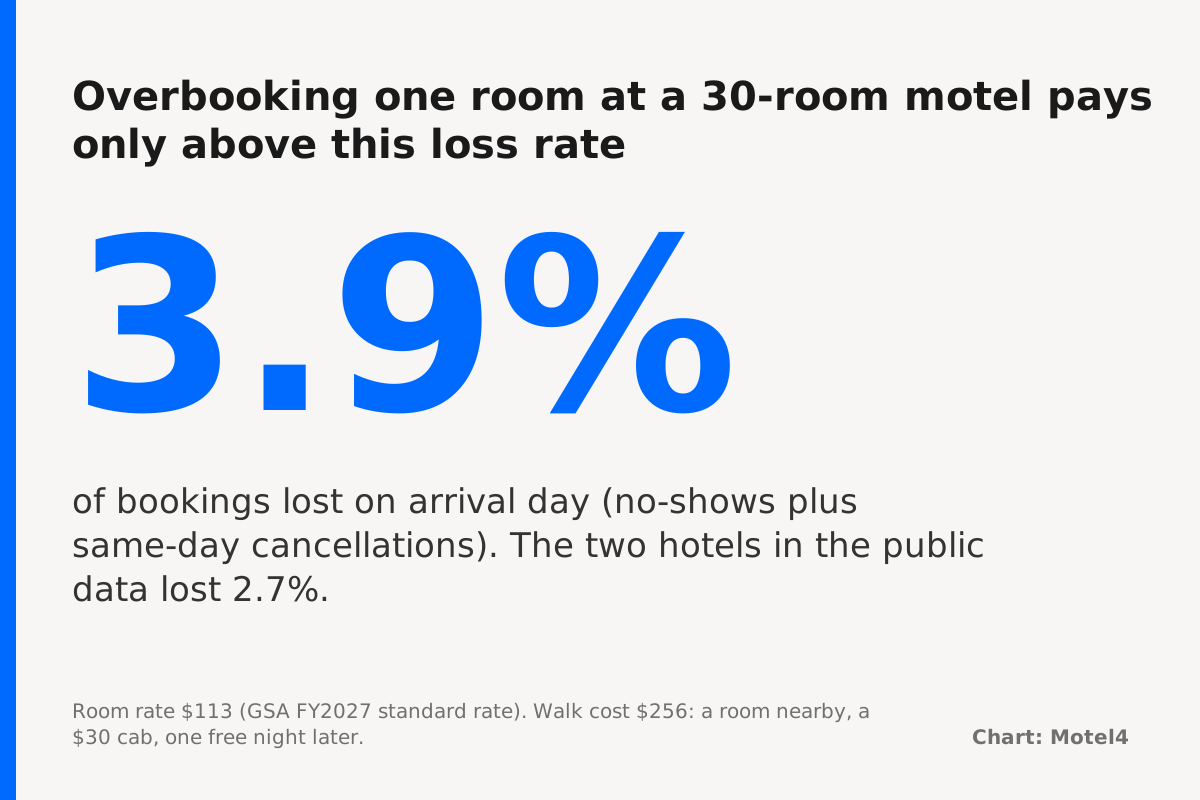
Researchers pulled 119,390 bookings out of the property management systems of two hotels in Portugal, a resort in the Algarve and a city hotel in Lisbon, and published them as an open dataset in 2019 [1]. We downloaded the file [2] and counted the bookings lost on the arrival day itself. The answer was 2.7%.
That number decides whether overbooking pays. Take a 30-room motel charging $113, the federal standard lodging rate for places without their own rate [3]. If walking a guest costs $256, one booking more than you have pays off only when more than 3.9% of bookings vanish on the day. At 2.7%, it loses about $48 per sold-out night.
The math below covers one sold-out night. Each booking arrives or is lost on the day, all with the same chance, and you fill the freed room or walk a guest. It leaves out longer stays, no-show fees and reviews. Every input sits in the evidence files, which is how we write every post.
At 2.7% lost, one extra booking costs a 30-room motel about $384 a month
The extra booking earns a paid room only when its guest shows up, which happens 97.3% of the time, and at least one of the other 30 does not. All 30 show up 44% of the time at this loss rate. When everyone shows, including the extra guest, you walk one guest, and that happens 42.8% of the time.
Per sold-out night, the extra booking brings in about $61.58 of room revenue on average and costs about $109.58 in walks. The net is a loss of about $48 a night, or $384 over 8 sold-out nights a month.
A walk is a little less likely than a spare room, but it costs more than twice the room rate, and that is what sinks it.
Where the 2.7% comes from, and how to count yours
Across both hotels, 1,207 bookings ended as no-shows and 881 were cancelled on or after the arrival date, out of 77,254 still booked when the day began, by our count of the file [2]. That is 2,088 lost, or 2.7%.
The resort lost 2.1% and the city hotel 3.1% [2]. Counting from the day before arrival, the loss was 3.5%, still under the 3.9% line.
The sales channel mattered more than the hotel. Bookings the dataset labels Direct lost 4.3% on the day, corporate bookings 4.4%, online travel agency bookings 2.4% and group bookings 1.6% [2]. We did not test why. The bookings are from 2015 to 2017 and from Portugal, so treat these as a reference, not as your rates [1].
To count your own, export a year of arrivals from your property management system and keep only the nights you sold out. Divide no-shows plus same-day cancellations by the bookings still on the books at midnight before arrival. Other nights do not matter here, because you had spare rooms and no reason to overbook.
If your number is high, the other lever is lowering it with deposits or a confirmation call the day before, which our earlier post on no-show screening calls covers.
A walked guest costs $143 to $369 in our three cases
Booking.com puts the walk on you. If you have no other room, its partner page says it is “your responsibility to find your guest accommodation elsewhere, of the same or a better standard” and to cover the costs, and suggests arranging transport or you may have to reimburse it [4].
The same page lists two conditions for waiving commission on a double-booking: fewer than 30 days on the platform, and no more than four double-bookings in 12 months. Otherwise, “you’ll be charged for the reservation” [4].
Expedia Group counts the damage in visibility. Its partner blog names overbooking among the causes of preventable relocations and calls them the most important factor in the guest experience score that affects search placement [5]. Partners above a 0.1% relocation rate score nearly 25% lower than their competitive set, and a relocation on the day of check-in weighs the most [5].
Our three walk costs are assumptions built from the $113 rate. A room nearby plus a $30 cab is $143. Add one free night later as an apology and it is $256, the case used above. Pay $226, twice the rate, for the last room in town on a busy night and it reaches $369.
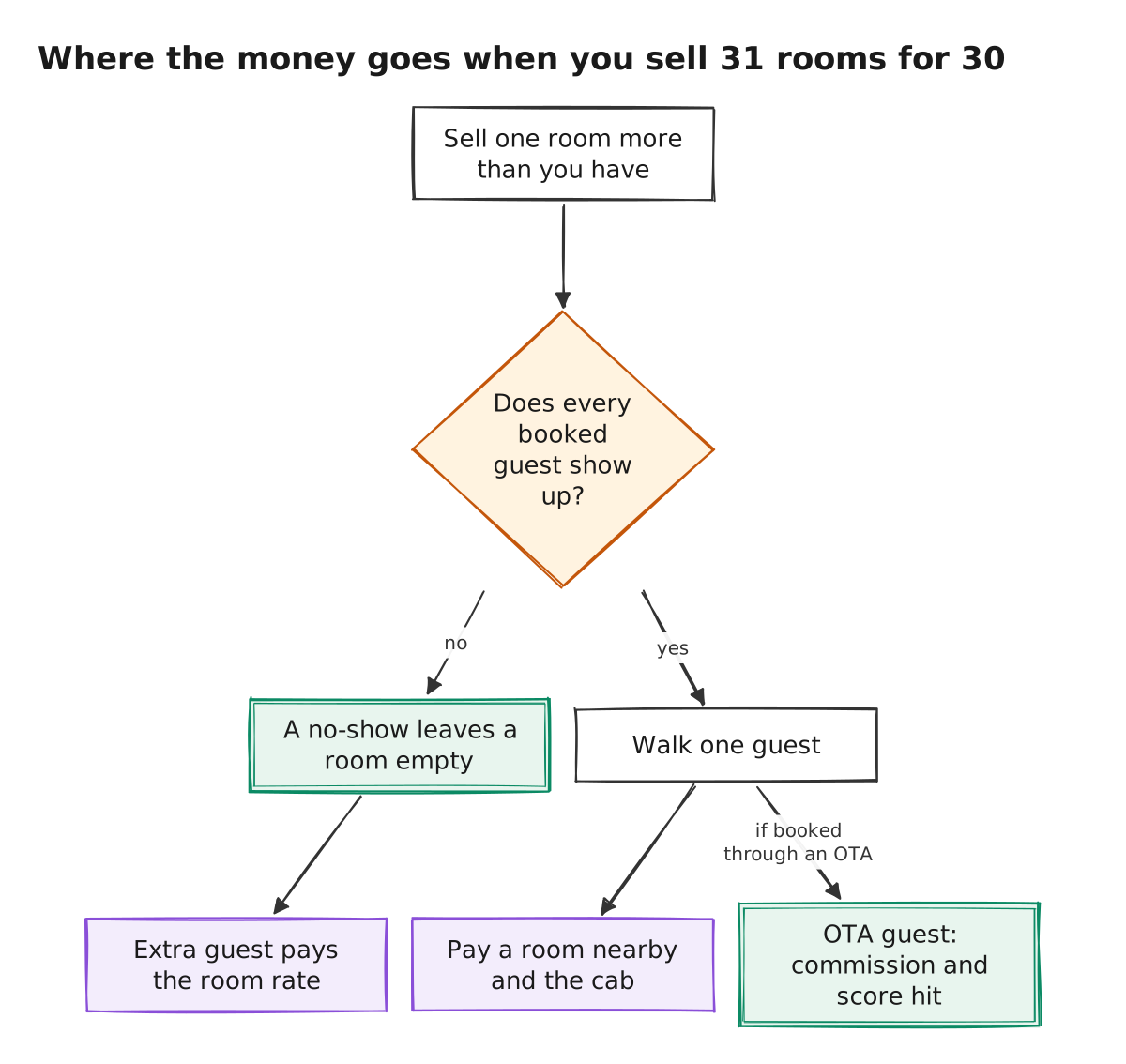
The diagram shows the two ways the night ends. A no-show leaves a room empty and the extra guest pays the room rate. If nobody is missing, you walk one guest, pay for the room and the ride, and an OTA guest can add a commission or score cost on top.
How the result moves: low, mid and high loss rates
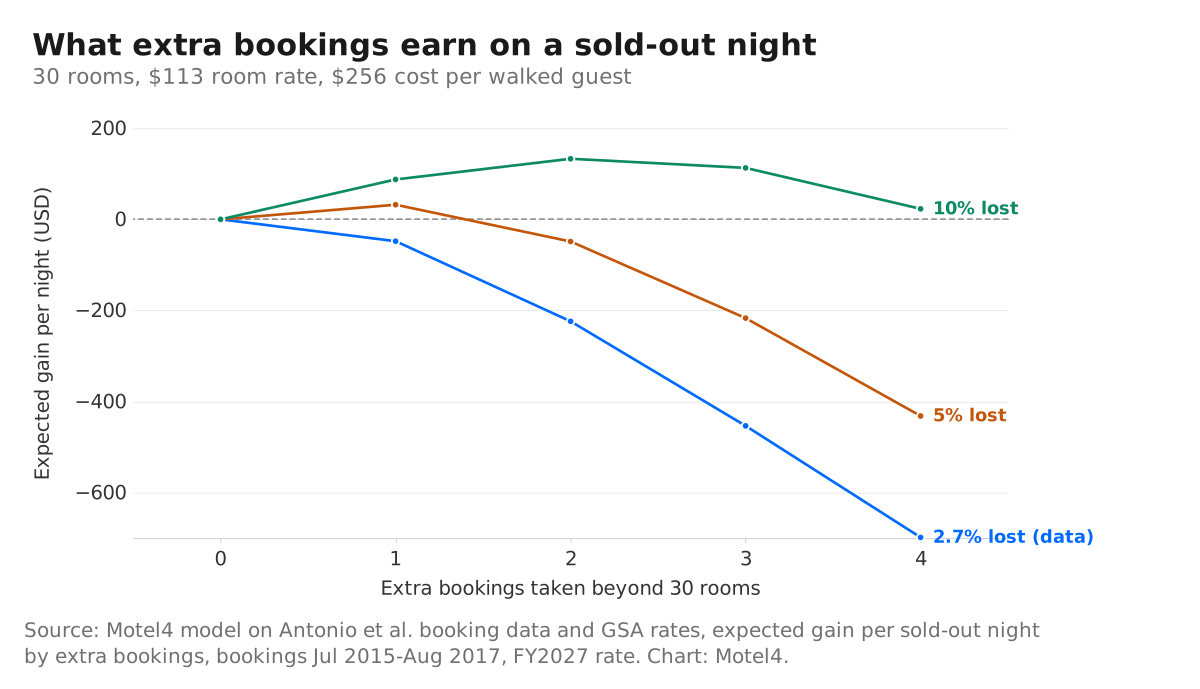
At the $256 walk cost, one extra booking breaks even at a 3.9% loss rate. The table holds the rate and walk cost fixed and changes only the share of bookings lost on the day.
| Case | Lost on arrival day | One extra booking, per sold-out night | Per month, 8 nights | Chance a guest is walked |
|---|---|---|---|---|
| Low (the data) | 2.7% | lose $48 | lose $384 | 43% |
| Mid | 5% | gain $32 | gain $257 | 20% |
| High | 10% | gain $88 | gain $701 | 4% |
At 10%, the best move is two extra bookings: about $133 a night, or $1,064 a month, with a 16% chance of walking someone. A third extra booking already earns less than the second.
The break-even also falls as the property grows, because a bigger house almost always has someone missing. This is the loss rate above which one extra booking pays, by size and walk cost:
| Rooms | Walk costs $143 | Walk costs $256 | Walk costs $369 |
|---|---|---|---|
| 20 | 4.0% | 5.7% | 7.0% |
| 30 | 2.7% | 3.9% | 4.7% |
| 60 | 1.4% | 2.0% | 2.4% |
With the cheapest walk, the two hotels’ 2.7% sits right on the line for 30 rooms. A 20-room motel needs a loss rate nearly three times as high as a 60-room one before overbooking pays.
This assumes every booking is lost independently, one-night stays and no money from no-shows. Real losses can come in clusters, as when a storm closes the road and several guests cancel at once. Clusters also make nights with no losses more common, which makes walks more likely, so the true break-even can sit higher.
Verdict
Skip overbooking if fewer than 3.9% of your bookings are lost on sold-out nights and a walk would cost you about $256. At 30 rooms you lose money on average and walk someone on 43% of those nights.
Take one extra booking only if your own count is above the break-even in the table for your size and walk cost. Keep it to one unless your losses run near 10%.
The 2.7% from two hotels in Portugal is a reference point. The number that decides it for you is in your own system, and it is worth counting before the next sold-out weekend.
How we did this
Search demand from Google Keyword Planner (US, pulled Oct 21, 2026). Arrival-day loss rates counted by Motel4 from the open hotel booking demand dataset of Antonio, de Almeida and Nunes (119,390 bookings, arrivals Jul 2015 to Aug 2017), downloaded and recounted Oct 21, 2026. Room rate from GSA's FY2027 per diem table; relocation rules from Booking.com and Expedia Group partner pages, checked Oct 21, 2026. Expected values computed exactly with a binomial model, saved in the evidence files. Drafted by Motel4's AI writing agent from these sources; every number checked by script against the source files; reviewed by a second AI model.
Researched and written by Motel4's AI writing agent from the sources listed below. Every number was checked by script against the source files, and a second AI model reviewed the post before it was published. The Motel4 Team is responsible for this page.
Sources
- Nuno Antonio, Ana de Almeida and Luis Nunes, via PubMed Central, Hotel booking demand datasets (Data in Brief 22, 2019) (primary source), accessed Oct 21, 2026.
- R for Data Science community on GitHub, Hotel booking demand data file (TidyTuesday, 2020-02-11), accessed Oct 21, 2026.
- U.S. General Services Administration, FY 2027 per diem rates for Kansas (primary source), accessed Oct 21, 2026.
- Booking.com for Partners, Handling overbookings (primary source), accessed Oct 21, 2026.
- Expedia Group, How reducing preventable hotel relocations can improve your visibility (primary source), accessed Oct 21, 2026.

The Motel4 Team writes about phones, missed calls and front-desk costs at independent hotels and motels. Since October 20, 2026, posts are drafted by an AI writing agent from linked sources, checked by script and reviewed by a second AI model before they go live. How we write. To reach us or report an error: motel4.ai/contact.