For a motel, ADA website compliance starts with what the booking page says about accessible rooms
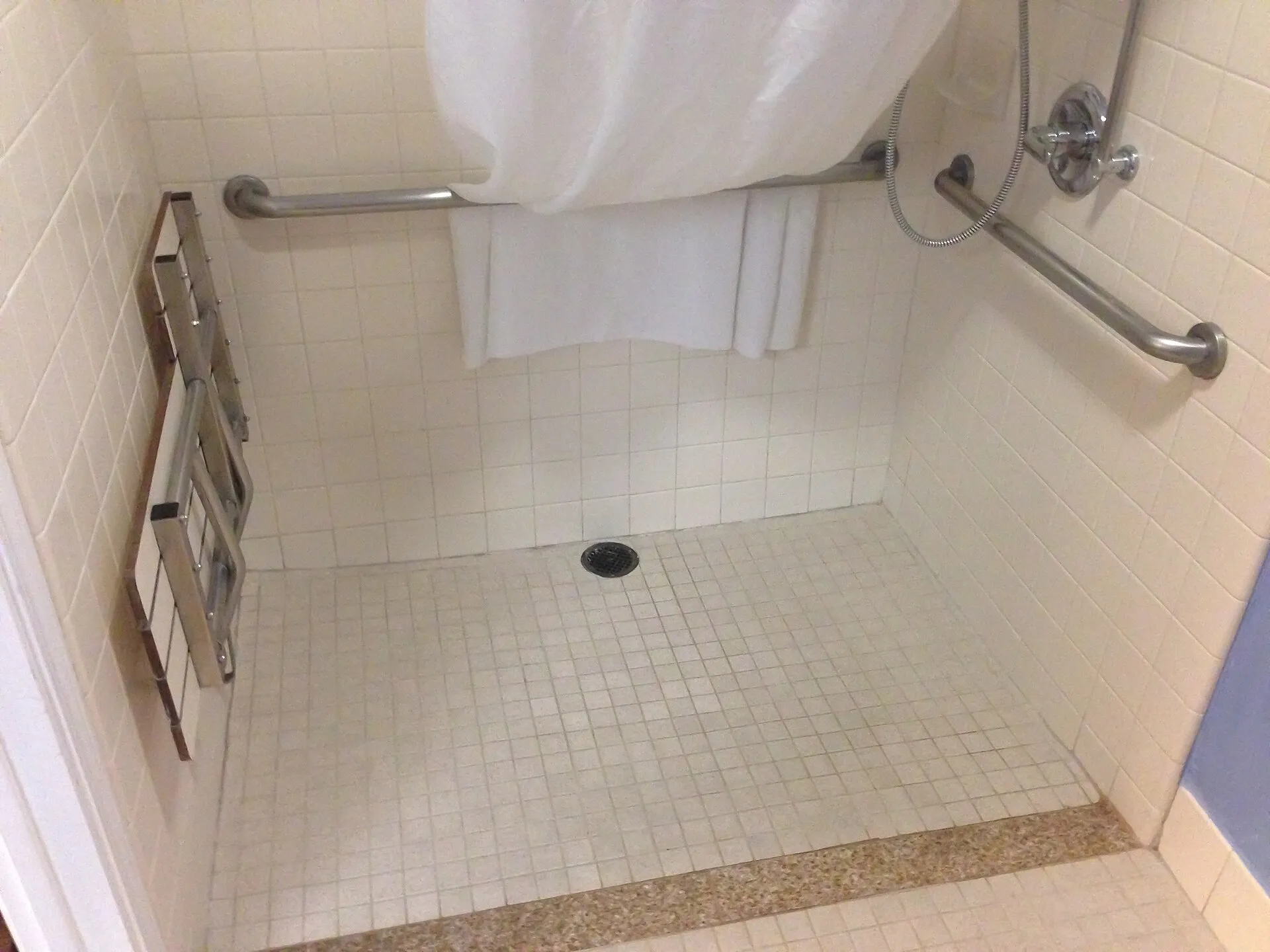

In December 2023 the Supreme Court dismissed Acheson Hotels v. Laufer, a tester’s suit claiming that a Maine bed and breakfast’s website lacked the accessibility information a federal rule requires. In a separate opinion, Justice Clarence Thomas noted that the plaintiff, a self-described tester, had filed over 600 lawsuits against hotels in the previous five years [1].
Her claims rested on one federal rule written for lodging, 28 CFR 36.302(e), which says what any reservation channel must tell guests about accessible rooms [1]. Search interest points elsewhere. In our Keyword Planner pull of Oct 21, 2026, “ada website compliance” drew about 5,400 US searches a month and “wcag compliance” 4,400, against about 10 for “ada hotel reservation requirements”.
Testers sue hotels over what the booking page leaves out
Justice Thomas described the method. From her home in Florida, the tester searched hotel websites for missing accessibility information, sued when she found a gap, and often offered to settle at once for $10,000 in attorney’s fees plus corrective action [1]. Her complaint about the Maine inn also said 13 third-party booking sites, Expedia among them, carried no accessibility information for it [1].
The Court never ruled on whether such testers may sue. Three federal appeals courts had said she lacked standing and three said she had it; the case ended as moot after she dropped her pending suits [1]. Thomas called her standing “a recurring question” and named other reservation-rule testers [1].
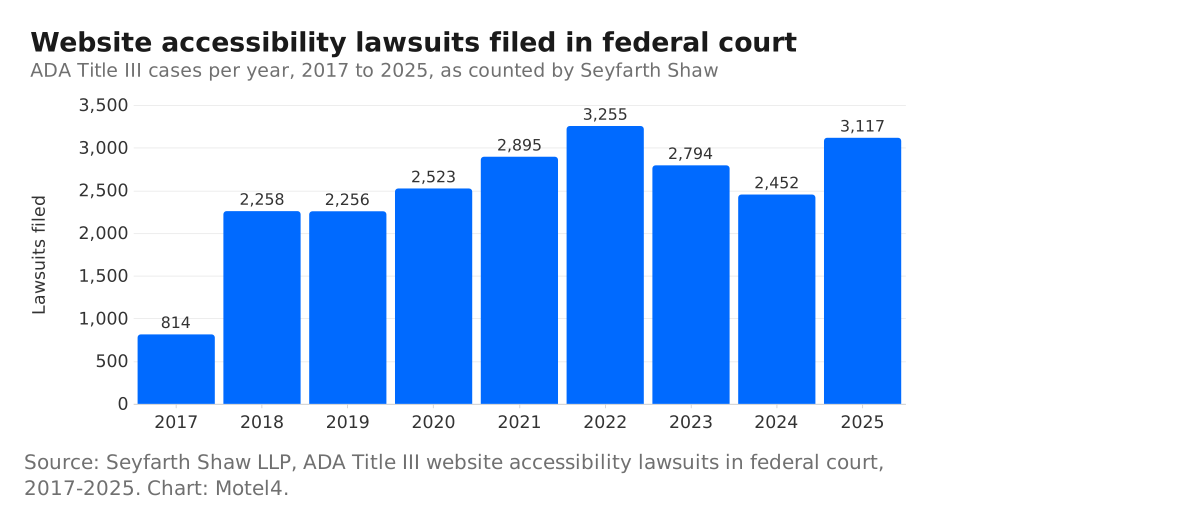
Website suits in general are climbing again. Seyfarth Shaw, a law firm that tracks ADA Title III cases, counted 3,117 website accessibility suits in federal court in 2025, up 27% from 2,452 in 2024 and 36% of all 8,667 Title III suits that year [2]. New York led with 1,021, then Florida with 961 and Illinois with 585 [2].
No federal rule sets a web standard for a private motel
The Justice Department, which enforces the ADA, lists hotels, inns and motels among the businesses whose online services the law covers [3]. Its 2022 guidance also says the department has no regulation setting out detailed web standards, and that businesses can currently choose how they make their online services accessible [3].
It names the Web Content Accessibility Guidelines (WCAG) and the federal Section 508 standards as helpful guidance [3]. The same page now carries a notice that its guidance documents have no legally binding effect [3].
The one federal rule that names a version covers governments. A 2024 Justice Department rule requires state and local government websites and apps to meet WCAG 2.1, Level AA, with compliance dates now set at April 26, 2027 and April 26, 2028, depending on population [4]. It applies to state and local governments, not to private hotels [4].
For the booking engine itself, the department’s own list is short: text alternatives on room photos, enough color contrast, labels and clear error messages on booking forms, keyboard access and captions on video [3]. It adds that automated checkers and overlays “need to be used carefully,” because a clean report does not mean everything is accessible [3].
The reservations rule covers the phone, the website and third parties
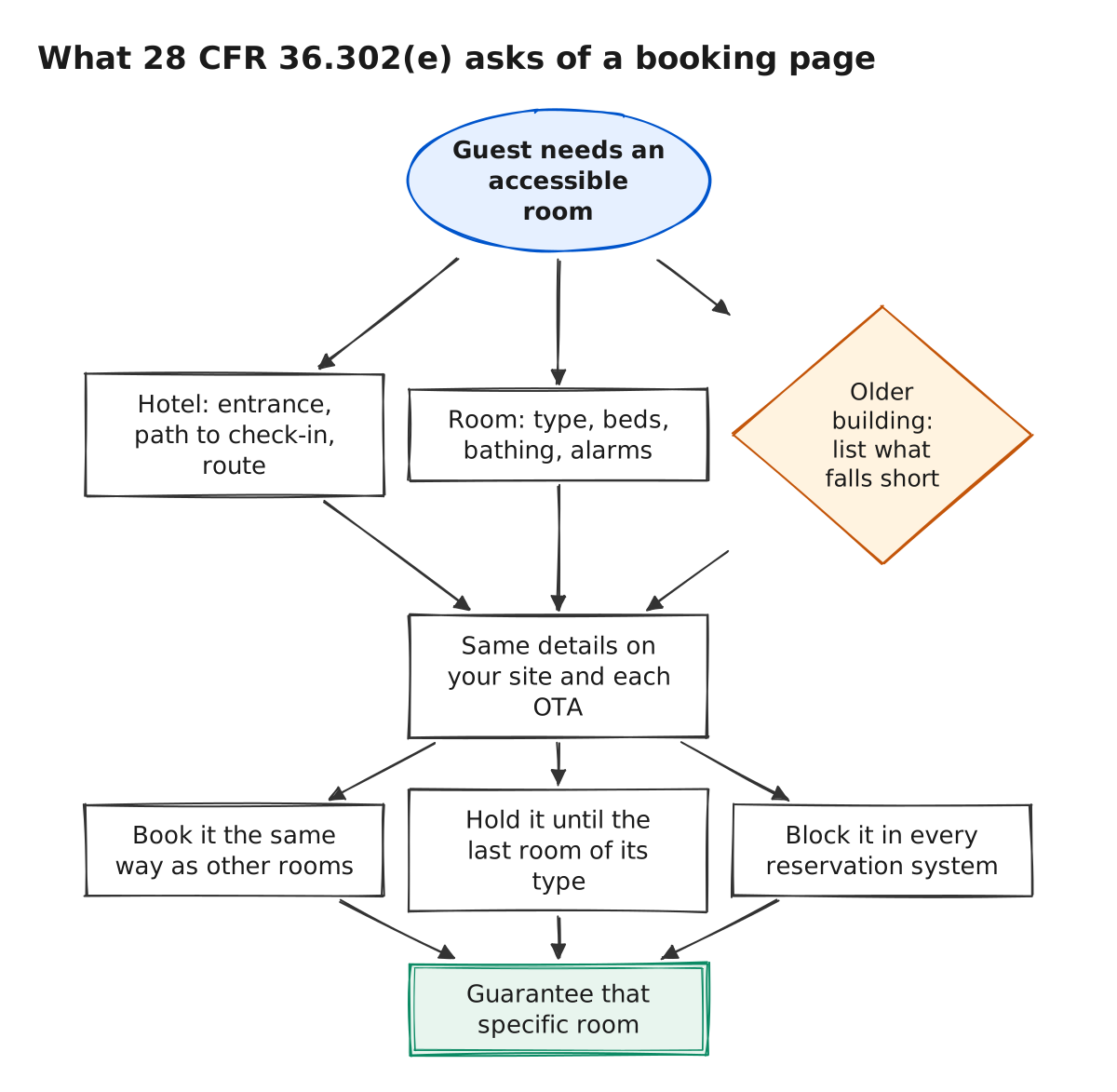
Section 36.302(e) binds whoever owns, leases or operates a place of lodging, for reservations made by any means, including by telephone, in person or through a third party [5]. It has applied to reservations made since March 15, 2012, and the eCFR text dated Oct 19, 2026 still carries it [5]. It sets five duties [5]:
- Take bookings for accessible rooms during the same hours and in the same manner as other rooms.
- Identify and describe accessible features in enough detail that a guest can judge, without help, whether a room meets their needs.
- Hold accessible rooms until every other room of that type has been rented.
- Reserve a requested accessible room and block it in every reservation system.
- Guarantee the specific accessible room that was booked.
The last three do not apply to units the operator does not own or substantially control [5]. The department’s guidance says guests should be able to book accessible rooms “with the same efficiency, immediacy, and convenience” as anyone else, and that you may ask for the same deposit you ask of other guests [6].
Read together, a site that sells standard rooms instantly but tells wheelchair users to call is hard to square with “same manner.” That is our reading of the text, so test it against your own booking flow.
The phone counts as a channel too. The guidance says staff on site or at a reservations center should be able to give more detail, such as the room and bathroom layout, shower design and grab-bar locations [6]. Motel4 sells an AI phone receptionist, so we have a stake in that sentence, but it reads the same for a night clerk.
Describe each accessible room in words a guest can judge
The rule does not list fields; the department’s guidance gives a floor [6]. For a hotel built to the 1991 ADA Standards, it may be enough to say the hotel is accessible and give four facts for each accessible room [6]:
- The general type of room.
- The size and number of beds, such as two queen beds.
- The type of accessible bathing, such as a roll-in shower.
- The communication features, such as alarms and visual notification devices.
Older properties need more. The guidance asks for the accessible entrance, the path to check-in and the route to the room, plus any feature that falls short, stated as a fact: “door to guest room measures 30 inches clear” [6]. A guest with a narrow wheelchair may still book that room. A guest told nothing cannot judge it.
Bed count belongs in the basics. The guidance notes that many guests with disabilities travel with family or a personal care assistant and need a room with at least two beds [6].
In practice that is one short block of text per accessible room. Put it on the room’s page in your booking engine, beside the photos. Keep the same details on your site and each OTA, word for word, and add the lines to your hotel phone script templates so whoever answers can read them out.
Send the same details to each OTA you sell through
A hotel that sells through third-party booking sites must make reasonable efforts to offer accessible rooms through at least some of them, and must give those sites the information about its accessible features [6]. If it does and a site still fails to show it, the guidance says the hotel will not be responsible [6].
That makes your records the defense. Keep the dated text you sent to each OTA and a screenshot of the extranet fields you filled. The tester’s complaint about one Maine inn listed 13 booking sites [1], and a motel on six channels has six listings to check.
The duty to block a booked accessible room in every system exists to stop double-booking across channels, the guidance says [6]. A channel manager that pushes one inventory count to every OTA is built for that job; extranets updated by hand can leave a gap between a booking and the block.
We could not confirm how many of the 3,117 website suits in 2025 named hotels or motels, because Seyfarth does not break its count out by industry and leaves out state courts [2]. Thomas also noted that the ADA gives private plaintiffs no damages [1]; the money in these suits is attorney’s fees. This post reads federal documents and is not legal advice, so check your state’s law with counsel.
Verdict
Do the booking-page fix first if any accessible room on your site or an OTA lacks its bed, bathing and alarm details. It is the rule written for lodging, it covers every channel, and the fix is text you already know [5][6]. Choose a WCAG review of the booking engine next if most bookings come through your own site, starting with the department’s list of forms, contrast and alt text [3].
One change to watch: in a September 2025 notice, the Justice Department said it intends to review its Title III regulations on a timetable listed as “To Be Determined” [7]. Until a new rule is final, 36.302(e) is the text a tester will quote.
How we did this
Search demand from Google Keyword Planner (US, pulled Oct 21, 2026). Rules read on Oct 21, 2026 from 28 CFR 36.302 in the eCFR, the Justice Department's Title III regulations and guidance, its 2022 web guidance and its fact sheet on the 2024 Title II web rule. Lawsuit counts from Seyfarth Shaw's ADA Title III blog; the Supreme Court opinion via Cornell's Legal Information Institute. Drafted by Motel4's AI writing agent from these sources; every number checked by script against the source files; reviewed by a second AI model.
Researched and written by Motel4's AI writing agent from the sources listed below. Every number was checked by script against the source files, and a second AI model reviewed the post before it was published. The Motel4 Team is responsible for this page.
Sources
- Supreme Court of the United States, via Legal Information Institute, Cornell Law School, Acheson Hotels, LLC v. Laufer, No. 22-429, decided Dec. 5, 2023 (opinion of the Court and Justice Thomas's concurrence) (primary source), accessed Oct 21, 2026.
- Seyfarth Shaw LLP, ADA Title III News & Insights, Federal Court Website Accessibility Lawsuit Filings Bounce Back in 2025, accessed Oct 21, 2026.
- U.S. Department of Justice, ADA.gov, Guidance on Web Accessibility and the ADA (March 18, 2022) (primary source), accessed Oct 21, 2026.
- U.S. Department of Justice, ADA.gov, Fact Sheet: New Rule on the Accessibility of Web Content and Mobile Apps Provided by State and Local Governments (primary source), accessed Oct 21, 2026.
- Electronic Code of Federal Regulations (eCFR), 28 CFR 36.302, Modifications in policies, practices, or procedures (paragraph (e), reservations made by places of lodging) (primary source), accessed Oct 21, 2026.
- U.S. Department of Justice, ADA.gov, ADA Title III Regulations, 28 CFR part 36, with the Department's guidance on section 36.302(e) (primary source), accessed Oct 21, 2026.
- Seyfarth Shaw LLP, ADA Title III News & Insights, DOJ To Re-Examine All ADA Title II and III Regulations on a TBD Timetable, accessed Oct 21, 2026.
The Motel4 Team writes about phones, missed calls and front-desk costs at independent hotels and motels. Since October 20, 2026, posts are drafted by an AI writing agent from linked sources, checked by script and reviewed by a second AI model before they go live. How we write. To reach us or report an error: motel4.ai/contact.