
Why Booking.com Guests Still Call — And How to Convert Them
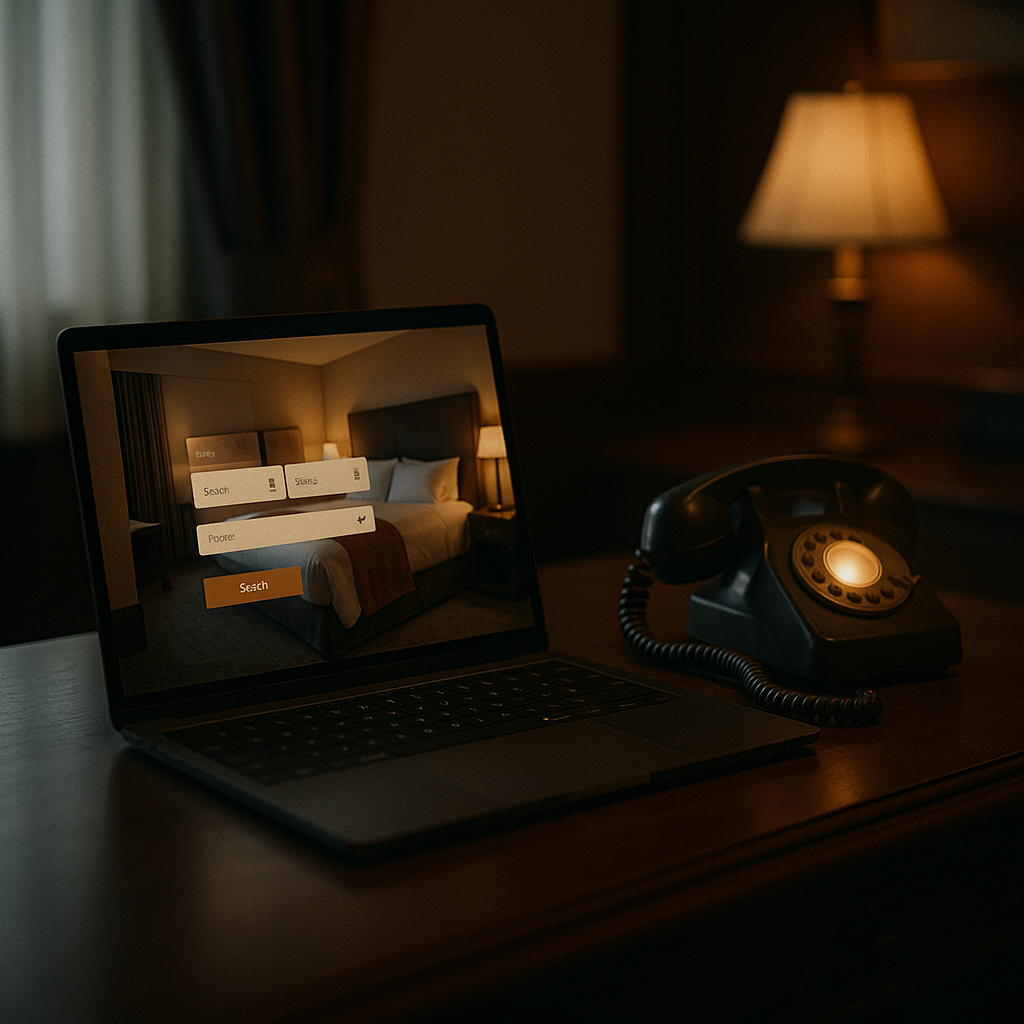
A guest finds your property on Booking.com, reads the reviews, checks the photos, and then calls your front desk instead of booking online. For many independent owners, that call comes at the worst possible time: during check-in, housekeeping turnover, or after hours when nobody is ready to answer properly.
Those calls matter more than most owners realize. They are often high-intent guests who are close to booking, but only if someone picks up, answers clearly, and makes it easy to finish the reservation.
Why guests on Booking.com still pick up the phone
Section titled “Why guests on Booking.com still pick up the phone”Owners sometimes assume that if a guest started on an OTA, they should finish on an OTA. That is not how real travelers behave. Many use Booking.com as a search engine, then call the property to confirm details before they commit.
If you want better Booking.com phone inquiry conversion, you first need to understand why these callers are reaching out.
They want to confirm something the listing does not explain well
Section titled “They want to confirm something the listing does not explain well”Even a strong Booking.com listing leaves gaps. Guests call to ask:
- Is parking free or paid
- Can they check in late
- Are pets allowed
- Is the room on the ground floor
- Is there a microwave, mini fridge, or kitchenette
- Can children stay in the room
- How far is the property from a highway, venue, hospital, or airport
- Whether the area feels safe at night
These are not random questions. They are often the final decision points.
They do not trust the online information completely
Section titled “They do not trust the online information completely”This is especially true for older travelers, road trippers, workers booking last minute, and guests comparing several properties at once. They want a human confirmation that the room type is correct, the property is real, and there will be no surprise at arrival.
If nobody answers, trust drops fast.
They have a special case
Section titled “They have a special case”Guests with early arrivals, after-midnight check-ins, group needs, accessibility questions, or billing requests often prefer a phone call. OTA booking flows are built for standard reservations. The phone is where exceptions get handled.
They are shopping, but they are close
Section titled “They are shopping, but they are close”A phone inquiry is often a buying signal, not just an information request. The guest may already have your property, two competitors, and the OTA app open at the same time. The property that answers first and gives a clear next step often wins the booking.
That is why Booking.com phone inquiry conversion is not just a front-desk issue. It is a revenue issue.
Where these phone inquiries get lost
Section titled “Where these phone inquiries get lost”Most independent properties do not lose OTA-originated calls because demand is weak. They lose them because the call flow breaks down.
Missed calls during busy hours
Section titled “Missed calls during busy hours”A small motel or B&B usually does not have a dedicated reservations team. The same person might be handling check-in, cleaning coordination, guest complaints, and the phone. When the line rings three times during a check-in rush, one or more calls go unanswered.
A missed call from a Booking.com shopper usually does not wait around. They tap the next property.
After-hours calls go to voicemail
Section titled “After-hours calls go to voicemail”A large share of travel planning happens outside standard desk hours, especially for same-day stays and road travelers. If your property sends late-night or early-morning inquiries to voicemail, you are likely losing bookable demand.
Some hospitality call-answer benchmarks suggest missed-call rates can be substantial at small properties, especially after hours.
Staff answer, but do not move the call toward a booking
Section titled “Staff answer, but do not move the call toward a booking”This is the quieter problem. The phone gets answered, the guest’s question is handled, and then the conversation ends without a booking attempt.
Examples:
- “Yes, we allow pets.”
- “Check-in ends at 10, but if you call us we can work with you.”
- “Our king room has a microwave.”
- “You can book online.”
That may be polite, but it does not convert. The guest got information, not a reservation path.
The pricing conversation gets awkward
Section titled “The pricing conversation gets awkward”Many owners worry that if a guest found them on Booking.com, they have to send them back there. Others worry about rate parity, commission issues, or saying the wrong thing. So the staff member avoids the booking conversation entirely.
The result is predictable: the caller hangs up and books somewhere else, either on the OTA or with a competitor.
No one tracks OTA-originated phone demand
Section titled “No one tracks OTA-originated phone demand”Most properties track OTA bookings. Fewer track OTA phone inquiries. That means owners can see commission costs but not the bookings that were never captured because the call was missed, mishandled, or left unresolved.
If you are not logging these calls, your demand picture is incomplete.
What high-converting phone handling sounds like
Section titled “What high-converting phone handling sounds like”Improving Booking.com phone inquiry conversion does not require a scripted sales pitch. It requires a reliable process that answers the guest’s real concern and gives them a simple way to reserve.
Step 1: Answer fast
Section titled “Step 1: Answer fast”Speed matters because OTA-originated callers are often comparing options in real time. A fast answer signals reliability. A slow answer or missed call signals risk.
The goal is simple: every guest reaches a live voice or a consistent automated receptionist that can help immediately.
Step 2: Confirm the key concern clearly
Section titled “Step 2: Confirm the key concern clearly”Do not force the guest to repeat themselves or dig for details. If they ask about parking, pet policy, late check-in, or room layout, answer directly and confidently.
A strong response sounds like this:
“Yes, we do allow late check-in. If you expect to arrive after 10 p.m., we can note that on the reservation and explain the arrival steps.”
That answer reduces uncertainty and sets up the next step.
Step 3: Move naturally to availability
Section titled “Step 3: Move naturally to availability”Once the concern is handled, the next question should be operational, not salesy:
- “What date are you looking at?”
- “How many guests will be staying?”
- “Do you need one bed or two?”
- “Would you like me to check what we have available for tonight?”
This is where many calls either become bookings or fade out.
Step 4: Give the guest a clear booking path
Section titled “Step 4: Give the guest a clear booking path”The guest should not have to guess what to do next. Depending on your setup, that might mean:
- Taking the reservation by phone
- Sending them to a direct booking link
- Texting confirmation details
- Explaining exactly how to complete the booking if the OTA is still their preferred channel
Clarity matters more than complexity.
Step 5: Capture the caller even if they are not ready yet
Section titled “Step 5: Capture the caller even if they are not ready yet”Not every call closes immediately. But a good process still captures value by collecting a name, number, date, and room need. If the guest says they will call back, you should still know what they wanted.
That gives you a chance to follow up, or at least understand what demand you are seeing.
How to turn Booking.com-driven calls into more completed reservations
Section titled “How to turn Booking.com-driven calls into more completed reservations”This is where independent properties can gain ground quickly. You do not need a big call center. You need consistent coverage and a repeatable conversion process.
Cover the hours when guests actually call
Section titled “Cover the hours when guests actually call”Many OTA-originated calls come in when owners are stretched thin: evenings, weekends, and same-day booking windows. Start by looking at:
- When calls are missed
- When voicemail gets used most
- When same-day demand is highest
- When one staff member is juggling too many tasks
If you only improve one thing, improve coverage during those windows.
Build answers for your top 10 conversion questions
Section titled “Build answers for your top 10 conversion questions”Most phone inquiries repeat. Create clear, standard answers for the questions that most often block a booking:
- Late arrival
- Pet policy
- Parking
- Deposit and cancellation terms
- Accessible rooms
- Kitchen amenities
- Extra person fees
- Check-in age requirements
- Truck or trailer parking
- Distance to local landmarks
Consistency helps conversion because guests hear a confident answer instead of hesitation.
Make the handoff to booking easy
Section titled “Make the handoff to booking easy”If your staff or phone system answers questions but does not complete the next step, you still have a leak. The transition should feel direct:
“I do have a queen room available for tonight. I can help you reserve it now.”
or
“I can text you the booking link for that room right now if that is easier.”
Simple language works.
Use an AI receptionist for first response and overflow
Section titled “Use an AI receptionist for first response and overflow”This is one of the most practical fixes for small properties. An AI phone receptionist can answer every call, handle common property questions, collect booking details, and route urgent situations appropriately.
For owners, the value is not novelty. It is consistency.
A good setup can:
- Answer after-hours calls
- Pick up when the desk is busy
- Handle repetitive OTA-originated questions
- Capture caller details
- Support direct booking handoff
- Reduce voicemail dependency
That is especially useful when your property does not have a full-time reservations staff. If you want a clearer picture of the setup, see how it works.
Do not treat OTA callers like low-value leads
Section titled “Do not treat OTA callers like low-value leads”A guest who started on Booking.com is not necessarily “just shopping.” They may be one answered question away from booking a room tonight. Some will still choose to complete the booking on the OTA. That is fine. The point is to keep your property in the running and make the path easy.
Your goal is not to force every OTA caller into one channel. Your goal is to stop losing high-intent calls because nobody was available or prepared.
The ROI of better Booking.com phone inquiry conversion
Section titled “The ROI of better Booking.com phone inquiry conversion”Let’s make this concrete.
Assume a small property receives 120 OTA-originated phone inquiries per month. Not all of those came from Booking.com, but many owners see OTA traffic as a major source of phone questions and booking-intent calls.
Now assume the current call outcome looks like this:
- 20% missed or sent to voicemail = 24 calls
- 80% answered = 96 calls
- Of answered calls, only 25% become bookings = 24 bookings
Now improve two things:
- Missed-call rate drops from 20% to 5%
- Answered-call conversion rises from 25% to 35%
Your updated monthly outcome:
- 5% missed = 6 calls
- 114 answered calls
- 35% conversion = about 40 bookings
That is 16 additional bookings per month.
If your average net room revenue per booking is $110, that is:
- 16 x $110 = $1,760 additional monthly revenue
- About $21,120 annually
If your average stay is longer, your ADR is higher, or your current missed-call problem is worse than this example, the gain can be larger.
Even a smaller lift matters. Say you only recover 8 bookings per month at $95 net room revenue:
- 8 x $95 = $760 monthly
- $9,120 annually
For a small property, that is meaningful money from demand you already had.
There is also the commission angle. If some of these calls can be converted into direct reservations without violating your OTA obligations or rate policies, the margin improves further. Exact savings will depend on your channel mix and commission structure, but OTA commissions commonly fall in the 10% to 20%+ range depending on program and market conditions.
The takeaway is simple: improving Booking.com phone inquiry conversion is often cheaper than trying to generate entirely new demand. The guest already found you. The real issue is whether your phone process helps them book.
A practical system for owners who want fewer missed opportunities
Section titled “A practical system for owners who want fewer missed opportunities”If you run an independent motel, hostel, or B&B, you do not need a complicated reservations operation. You need a simple system that works every day.
1. Audit the last 30 days of calls
Section titled “1. Audit the last 30 days of calls”Look at:
- Total call volume
- Missed calls
- Voicemail volume
- Peak missed-call windows
- Most common questions
- How many calls were booking-related
You are looking for the leaks.
2. Define your must-answer property information
Section titled “2. Define your must-answer property information”Write short, plain-language answers for the questions that affect booking decisions. Keep them current and easy for any staff member or phone system to use.
3. Set your booking handoff rules
Section titled “3. Set your booking handoff rules”Decide what should happen when the guest is ready:
- Reserve by phone
- Transfer to staff
- Send booking link
- Capture callback details
If this part is vague, conversion drops.
4. Cover overflow and after-hours
Section titled “4. Cover overflow and after-hours”This is where many owners recover the most revenue fastest. If your team cannot answer every call, put a consistent system in place. For many small properties, that means using an AI receptionist to cover the desk when staff are busy or off duty.
5. Review conversion monthly
Section titled “5. Review conversion monthly”You do not need enterprise analytics. Start with a simple monthly scorecard:
- Calls answered
- Calls missed
- Booking-related calls
- Bookings from phone inquiries
- Top unanswered questions
- Peak loss periods
That alone can change behavior.
FAQ: Booking.com phone inquiry conversion
Section titled “FAQ: Booking.com phone inquiry conversion”Why do guests call if they already found us on Booking.com
Section titled “Why do guests call if they already found us on Booking.com”Because they are looking for reassurance, clarification, or help with a special case. Many guests use OTAs to discover properties, then call before booking if something is unclear.
Should we try to move every Booking.com caller to a direct booking
Section titled “Should we try to move every Booking.com caller to a direct booking”No. The goal is to convert the inquiry, not force one channel. Some guests will still prefer to book through the OTA. What matters is that your property answers quickly, provides clear information, and gives them an easy next step.
What questions most often block a phone booking
Section titled “What questions most often block a phone booking”Usually practical issues: late check-in, parking, pets, room layout, cancellation terms, child policies, and accessibility. These are often the final details guests need before they book.
How do we improve conversion without hiring more front desk staff
Section titled “How do we improve conversion without hiring more front desk staff”Start by reducing missed calls and standardizing answers. Many small properties use an AI phone receptionist to cover overflow and after-hours calls, collect booking details, and answer common questions consistently.
How can we measure whether phone inquiry conversion is improving
Section titled “How can we measure whether phone inquiry conversion is improving”Track missed calls, answered calls, booking-related calls, and bookings that came from phone inquiries. Compare those numbers month over month. Even basic tracking will show whether your process is getting better.
If OTA-driven calls are slipping through because the desk is busy or closed, that is fixable. pricing shows what it costs to put consistent phone coverage in place without adding full-time staff.