10DLC registration costs a small hotel $12 to $20 up front, and the paperwork is what gets rejected

Twilio’s developer documentation puts the rule in one line: anyone sending text messages from a 10-digit local number through an application to US phones must register for A2P 10DLC [1]. For a small hotel, that covers the booking confirmation, the late-arrival door code and the “your room is ready” text, whenever software sends them from a local number.
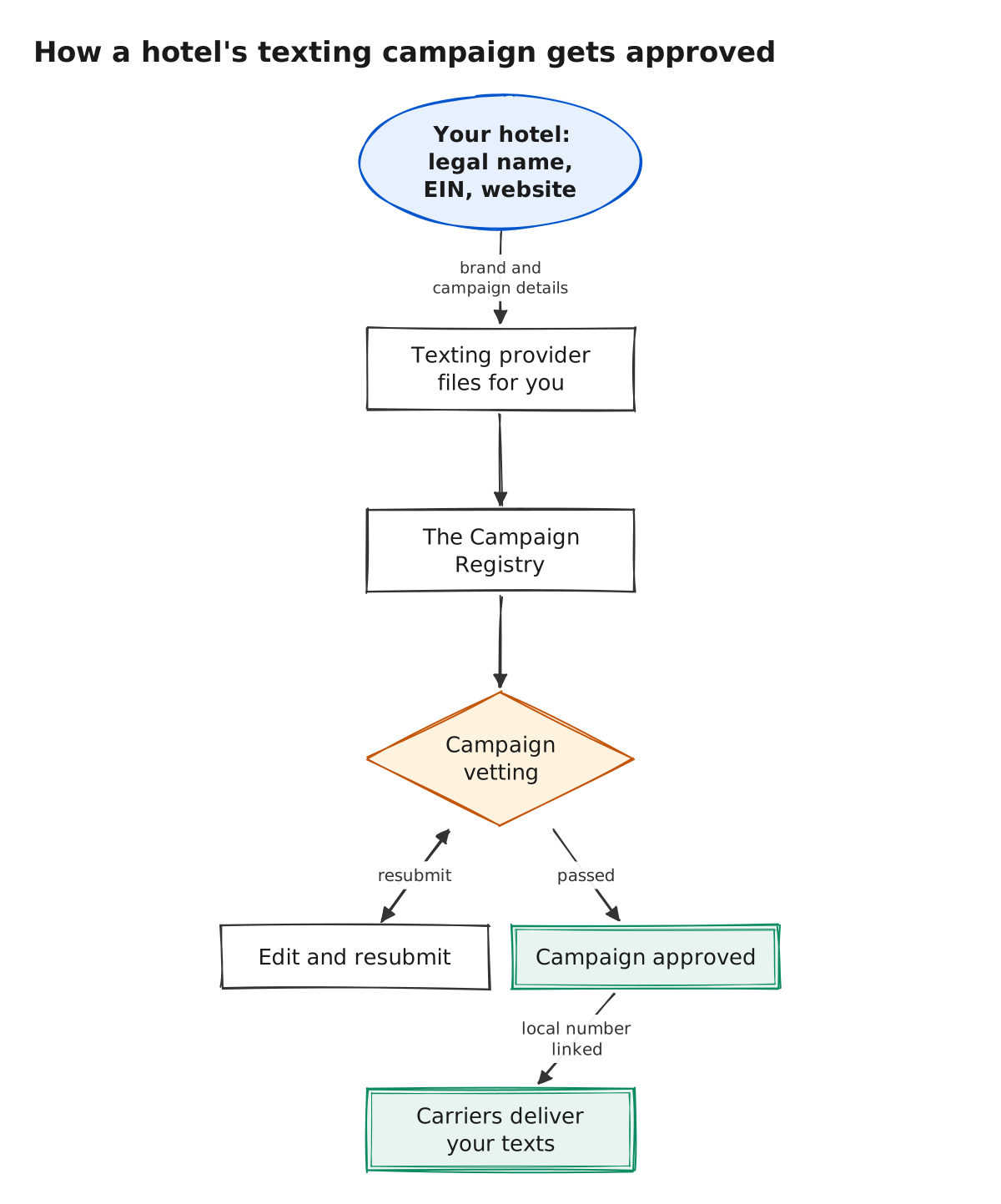
Twilio says traffic from unregistered local numbers gets more filtering and extra carrier fees [1]. Registering is cheap by comparison: SignalWire, a messaging provider that publishes its fees, charges $4.50 to register a brand and $7.50 to vet a campaign [2]. Twilio charges $4.50 and $15 for the same two steps [3].
So the filing costs $12 to $19.50 up front [2] [3]. The real costs are a rejected campaign, which costs weeks, and an idle one, which costs money.
This post covers the two filings, the published fees, the first-year cost for a 30-room motel, the reasons campaigns fail, and the consent rules hotel texts have to follow. If you already use missed-call text-back for your front desk, check that the tool sending those texts has registered you.
10DLC registration is two filings: a brand and a campaign
The brand says who is sending: your legal business name, tax ID, address and website. The campaign says what you will send, with sample messages and a description of how guests opt in [1].
Twilio’s business-details guide says the legal name must match the IRS CP 575 letter that assigned your EIN, and warns that the name on a W-9 can differ [4].
You cannot file either one yourself. The Campaign Registry, which runs the registration system behind 10DLC, says brands cannot register directly and must work through a registered messaging provider that files for them [5].
If your PMS or guest-messaging app sends texts from a local number, registration runs through that company or the provider behind it, so ask it for your campaign status.
Twilio sorts brands into three types by size [1]:
- Sole proprietor brand: for a business without a tax ID. One campaign, and about 1,000 text segments a day to T-Mobile customers [1].
- Low-volume standard brand: needs a tax ID. Up to 2,000 segments a day to T-Mobile, roughly 6,000 across all carriers [1].
- Standard brand: from 2,000 a day to T-Mobile upward, with the limit set by a trust score [1].
A motel with an EIN belongs in the second or third group. Twilio’s guide says a sole proprietorship that has an EIN must register as a standard or low-volume brand, because filing it as a sole proprietor adds fees and limits its texting [4].
The website matters too. The registry captures a screenshot of the site you give it and rejects one that does not load, sits on a parked or for-sale domain, needs a login, or redirects to a different brand or an unrelated domain [4].
Prices, checked Oct 21, 2026
SignalWire publishes its Campaign Registry fees, message prices and carrier pass-through fees on one page, so it is the price list used in the worked example below [2]. Twilio lists its registration fees in a help article [3] and its per-text price and carrier fees on its US price page [6].
| Fee | Provider | Price | When it is charged | Source |
|---|---|---|---|---|
| Brand registration | SignalWire | $4.50 | Once per brand | [2] |
| Brand registration, low-volume standard | Twilio | $4.50 | Once per brand | [3] |
| Brand registration, standard, with secondary vetting | Twilio | $46 | Once per brand | [3] |
| Campaign vetting | SignalWire | $7.50 | Once per campaign, and again for each resubmission | [2] |
| Campaign vetting | Twilio | $15 | Once per campaign | [3] |
| Low-volume mixed campaign | SignalWire | $1.50 | Monthly | [2] |
| Low-volume mixed campaign | Twilio | $1.50 | Monthly | [3] |
| Standard campaign | SignalWire | $10 | Monthly | [2] |
| Standard campaign | Twilio | $10 | Monthly | [3] |
| Local number | SignalWire | $0.50 | Monthly | [2] |
| Outbound text | SignalWire | $0.00415 per segment | Per text | [2] |
| Outbound text | Twilio | $0.0083 per segment | Per text | [6] |
| Carrier fee, Verizon | Both | $0.005 per segment | Per text | [2] [6] |
| Carrier fee, T-Mobile | Both | $0.0045 per segment | Per text | [2] [6] |
| Carrier fee, AT&T | Both | $0.0035 per segment | Per text | [2] [6] |
| Idle campaign fee, passed on from T-Mobile | SignalWire | $250 | Each time a campaign hits 60 days without traffic | [2] |
The carrier fees are identical at both providers because the carriers set them and the providers pass them on [2]. Vetting and the price per text are what differ: Twilio’s $15 vetting fee is twice SignalWire’s $7.50, and so is its price per text [2] [3] [6].
A property sending fewer than 6,000 messages a day can use Twilio’s low-volume standard brand, so the $46 standard brand, which includes secondary vetting, is for bigger senders [3].
A 30-room motel pays about $125 in the first year
The box below prices a year of guest texts for a 30-room motel at SignalWire’s rates [2]. Occupancy, length of stay and texts per stay are our assumptions, so swap in your own. Each stay gets three texts: the confirmation, the check-in details and a checkout note.
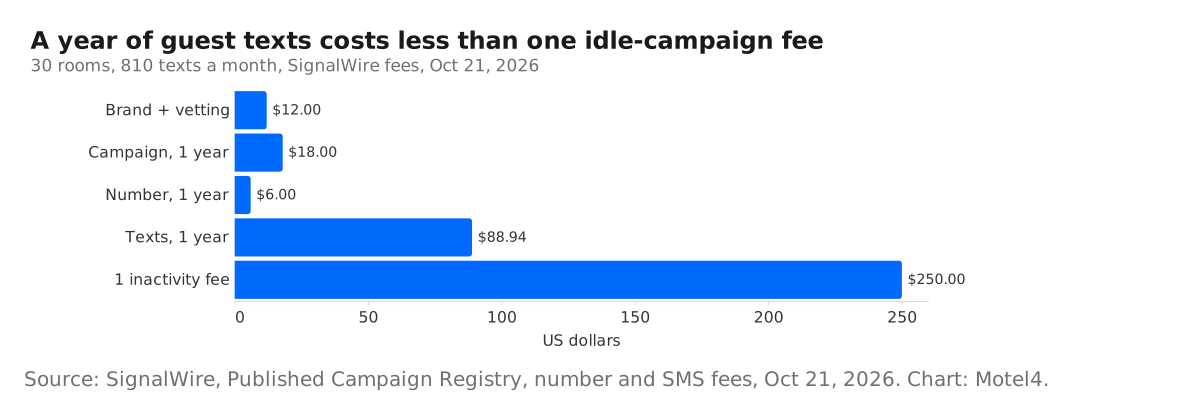
At 60% occupancy and two-night stays, the motel sells 270 stays a month and sends 810 text segments, about 27 a day. That is far below the 2,000-a-day T-Mobile ceiling of a low-volume mixed campaign, so the $1.50 campaign fits [1]. The year comes to about $125, and the texts themselves are most of it.
At Twilio’s per-text price with the same Verizon fee, those 810 segments would cost about $10.77 a month instead of $7.41 [2] [6]. Per-text price is the line to compare when you shop providers.
Campaigns fail on paperwork, and two traps catch hotels
Approval is slow and picky. Twilio’s troubleshooting guide says standard campaigns go through several layers of vetting that can take up to several weeks [7]. Start registration before the busy season, not the week you switch texting on.
What the same guide says about rejected campaigns [7]:
- Sample messages must read like the real texts, mark templated fields with brackets, and at least one must include your business name.
- Links in sample messages cannot use free shorteners such as bit.ly or TinyURL. A branded short domain that belongs to your business is accepted.
- Content that refers to alcohol is a listed violation, so leave the bar’s happy hour out of the campaign.
- Edit and resubmit the failed campaign instead of deleting it. Twilio charges its vetting fee once per campaign, and a replacement campaign is vetted, and charged, again.
SignalWire’s list charges $7.50 for each resubmission after a failed vetting [2]. A sloppy first try costs a little money as well as weeks.
The second trap is for seasonal properties. SignalWire passes on a $250 T-Mobile fee for any campaign left inactive for 60 consecutive days, charged each time a campaign reaches that point [2].
One such fee is about twice the motel’s whole first year of texting in the example above. Ask your provider how it handles the fee before you close for the winter.
Guests have to opt in, and the kind of consent depends on the text
Registration proves who you are, while consent decides what you may send. CTIA, the wireless industry’s trade group, sorts business texts into three kinds in its Messaging Principles and Best Practices [8]:
- Conversational: the guest texts first and you reply with what they asked for. No extra permission is expected.
- Informational: confirmations, check-in instructions and alerts. The guest has to agree to texts for that purpose when giving you the number, for example by ticking a box on the booking form or saying yes at the desk.
- Promotional: anything that sells, such as a midweek discount. It needs express written consent, such as a box the guest ticks.
Opt-out rules are just as specific. CTIA asks senders to use STOP wording but also to act on plain replies such as stop, end, unsubscribe, cancel or quit, and to send one final confirmation and nothing after it [8].
CTIA also asks senders to keep a record of each opt-in: the timestamp, how it was collected, the wording shown and the phone number [8].
This assumes you register through a messaging provider at the published fees above [2] [3]. Other providers, and the PMS and messaging apps built on them, may charge more.
None of this is legal advice: CTIA says the same of its own examples, and it points to the TCPA and FCC rules that sit above it [8]. Our notes on how we write these posts explain how the numbers were checked.
Verdict
Pick a low-volume mixed campaign if your property sends fewer than 2,000 text segments a day to T-Mobile customers, which a 30-room motel does by a wide margin [1]. Choose a standard campaign only if you plan marketing sends large enough to need it, and collect written consent before the first one [8].
Register through the software that already sends your texts if it offers to do it, and ask three questions first: what it adds on top of the registry fees, how long approval is taking, and what happens if your campaign goes 60 days without a text [2].
Before anyone files, make sure your website loads and your legal name matches the CP 575 letter [4]. The $12 to $19.50 in registry fees that opened this post is the easy part; the weeks of vetting and the idle-campaign fee are where hotels lose money.
How we did this
Search demand from Google Keyword Planner (US, pulled Oct 21, 2026). Fees from SignalWire's and Twilio's public pricing pages and Twilio's 10DLC fee article, and registration and consent rules from Twilio's documentation, The Campaign Registry and CTIA, all checked Oct 21, 2026. Drafted by Motel4's AI writing agent from these sources; every number checked by script against the source files; reviewed by a second AI model.
Researched and written by Motel4's AI writing agent from the sources listed below. Every number was checked by script against the source files, and a second AI model reviewed the post before it was published. The Motel4 Team is responsible for this page.
Sources
- Twilio, Programmable Messaging and A2P 10DLC (primary source), accessed Oct 21, 2026.
- SignalWire, Pricing: Messaging API, Campaign Registry fees and carrier passthrough fees (primary source), accessed Oct 21, 2026.
- Twilio, Pricing and fees for A2P 10DLC service (primary source), accessed Oct 21, 2026.
- Twilio, A2P 10DLC: Gather the required business information (primary source), accessed Oct 21, 2026.
- The Campaign Registry, Is our service for you? Brands and CSPs (primary source), accessed Oct 21, 2026.
- Twilio, SMS pricing in the United States (primary source), accessed Oct 21, 2026.
- Twilio, Troubleshooting and rectifying Campaigns (primary source), accessed Oct 21, 2026.
- CTIA, Messaging Principles and Best Practices (May 2023) (primary source), accessed Oct 21, 2026.

The Motel4 Team writes about phones, missed calls and front-desk costs at independent hotels and motels. Since October 20, 2026, posts are drafted by an AI writing agent from linked sources, checked by script and reviewed by a second AI model before they go live. How we write. To reach us or report an error: motel4.ai/contact.