Transient occupancy tax for small hotels: the 30-day rule and who files on online bookings

A guest who checks into a Texas motel for 45 nights without putting anything in writing still owes state hotel tax on the first 30 nights, with no refund, according to the Texas Comptroller’s quick reference guide for hotels [1]. Had the guest given written notice of a 30-day stay at check-in, the exemption would have started that day [1].
Transient occupancy tax is the tax a guest pays on a short stay and the hotel collects and files. For a small hotel or motel it is a cash and liability question: in Texas the state rate alone is 6% of the cost of a room, and a late return adds penalties on top [2].
This post answers three questions with two real places, Texas and San Francisco: who sets the rate, when a long stay stops being taxable, and who files when an online travel company takes the payment. Every rule links to the official page it came from, which is how we write every post. None of it is legal advice.
The rate is set where your property sits
California’s Revenue and Taxation Code section 7280 lets a city, a county, or a city and county tax the privilege of occupying a room in a hotel, inn or motel. A county’s tax applies only in its unincorporated areas [3]. The state law gives the power; the local government levies the tax.
San Francisco shows how that plays out. Its rate is 14% on stays of less than 30 days, collected by hotel operators and remitted to the city [4]. Hotels in the Tourism Improvement District also owe an assessment on gross revenue, 2.25% in Zone 1 and 2.00% in Zone 2, which they may pass on as a separate folio item [4].
Texas works in layers. The state charges 6% of the cost of a room on rooms costing $15 or more a day [2].
Cities, certain counties and special purpose districts can add a local hotel tax that the local taxing authority collects, on rooms costing $2 or more a day [2]. So a Texas motel may file one return with the state and another with its city.
Long stays turn exempt around day 30, with different paperwork
California caps the local power at 30 days: section 7280 allows the tax unless the occupancy is for a period of more than 30 days [3]. San Francisco’s page describes its tax as applying to stays of less than 30 days and lists permanent residents among its exemptions [4].
In Texas, a guest with the right to a room for 30 or more consecutive days is a permanent resident and exempt. A written notice of intent to stay at least 30 consecutive days starts the exemption on the notice date. Without one, it starts on the 31st consecutive day, and the first 30 days stay taxable [1].
The Comptroller’s guide covers the cases that come up at the desk [1]:
- If the guest checks out and immediately back in, that is not an interruption of the stay [1].
- If the stay is interrupted, the exemption is void [1].
- If a company rents the room for 30 or more consecutive days, the exemption can apply as long as the hotel invoices and is paid by that same company, whoever sleeps in the room [1].
- If a federal agency pays directly, or a federal employee travels on official business, the stay is exempt from state and local hotel tax with a completed Form 12-302 [1].
- If a Texas state employee checks in, most cannot claim the exemption at the desk [1].
Here is what the notice is worth to the guest on one stay. Take a guest paying $65 a night for 45 nights in Texas with nothing in writing. Tax is due on the first 30 nights [1] at the 6% state rate [2].
That is $117 of state tax, before any local hotel tax. The guest pays it and you collect it and file it. With written notice signed at check-in, the state exemption would start that day [1], and the guest’s bill would be $117 lower. On a monthly stay, that is a price edge you can offer.
One warning from the same guide: even with a notice, the hotel can be held liable if the guest fails to pay for 30 consecutive days. The Comptroller suggests collecting tax for the first 30 days and then refunding or crediting it [1]. The saving goes to the guest; the collection risk stays with you.
Online bookings: check who collects before you file
When the guest pays you at the desk, you add the occupancy tax to the bill and you file the return by the deadline. San Francisco tells hotels to file monthly and to report the tax by the month the stay happens, so a March stay paid in January goes on the March return [4].
Prepaid online bookings are less clear. San Francisco’s Regulation 2012-1 says a website company acting as merchant of record is an “operator” responsible for collecting the tax and remitting it to the city. It also says the full amount the company receives, service fees included, is taxable rent [5].
Texas says less. Its page states that property management companies, online travel companies and other third-party rental companies “may also be responsible for collecting the tax” [2]. Neither page tells you how the duty splits between you and the travel company on a single booking, so confirm who files before you report the booking as yours.
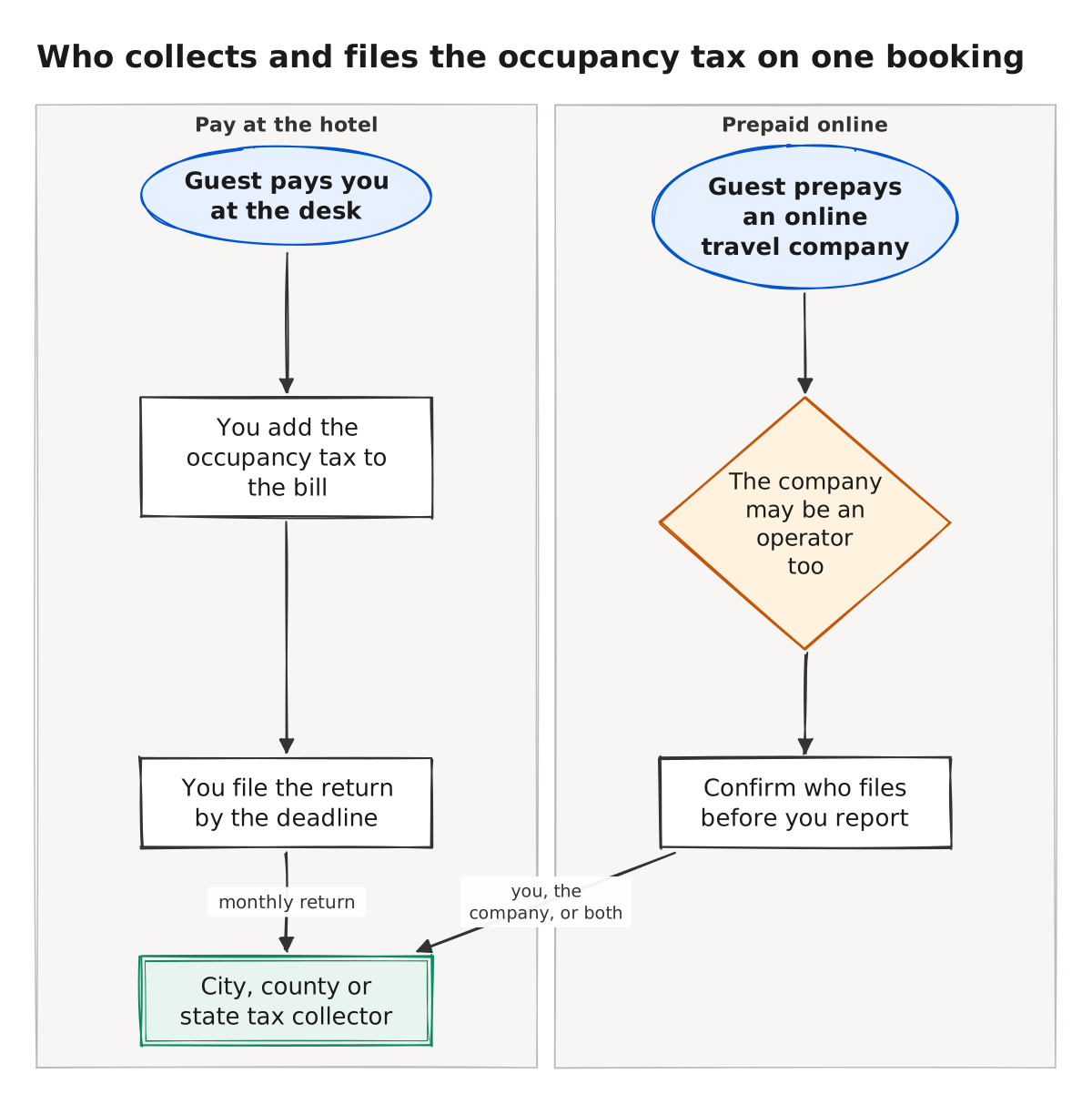
The diagram shows both paths. On the left, the hotel collects the tax and files it. On the right, the company may be an operator too, so the step before the return is a question for your tax collector.
One thing stays the same across channels: Booking.com says it charges no commission on local taxes such as city tax [6]. If your statement shows commission on the tax line, query it.
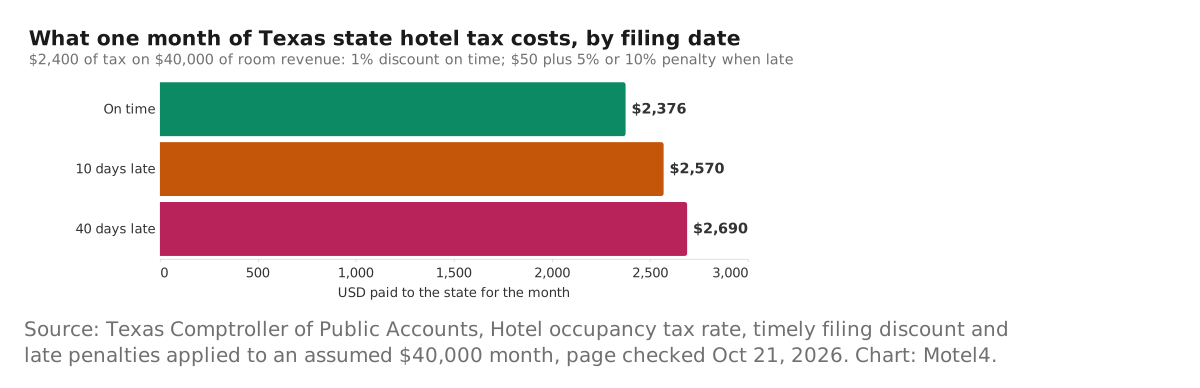
Filing 40 days late in Texas costs $314 more on a $2,400 month
Texas returns are due on the 20th day of the month after the stay month, or quarterly if you qualify. Each late report costs $50. Tax paid 1-30 days late adds a 5% penalty, more than 30 days late adds 10%, and interest starts 61 days after the due date. Filing and paying on time earns a 1% discount [2].
Take a 30-room motel with $40,000 of taxable room revenue in a month. The state tax is $2,400. On time, the discount brings it to $2,376. Ten days late it costs $2,570, and 40 days late it costs $2,690 before interest.
San Francisco puts the collection risk plainly: an operator that fails to collect the tax from the guest is liable for the full amount, “the same as though the tax were paid by the occupant” [5].
We could not confirm whether every Texas city applies the same 30-day rule to its local hotel tax, or how any one online travel company splits filing with hotels. The Texas guide we used was last updated July 21, 2016 [1]. Check your city’s ordinance, and ask your tax collector in writing before you change how you bill long stays.
Verdict
In Texas, ask any guest who plans to stay 30 nights or more to sign a written notice of intent to stay at check-in; it moves the state exemption to day one [1]. Keep collecting tax on the first 30 days if you doubt the guest will pay for all of them, then refund or credit it [1].
Ask your tax collector who files on prepaid online bookings before you report them, and keep the answer in writing. In San Francisco, start with the treasurer’s page and Regulation 2012-1 [4] [5]. Choose on-time filing over any shortcut: in Texas the 1% discount pays you to do it [2].
Back to the 45-night guest at the top: a notice signed at check-in takes $117 of state tax off that guest’s bill. That is a price edge on monthly stays, and you pay for it with risk: if the guest then fails to pay for 30 consecutive days, the tax can fall on you [1].
How we did this
Topic and demand from Google Keyword Planner (US, pulled Oct 21, 2026). Rules read from the Texas Comptroller's hotel occupancy tax page and its Quick Reference Guide for Hotels, California Revenue and Taxation Code section 7280, the San Francisco Treasurer's transient occupancy tax page and Tax Collector Regulation 2012-1, and Booking.com's partner help page, all checked Oct 21, 2026. Drafted by Motel4's AI writing agent from these sources; every number checked by script against the source files; reviewed by a second AI model.
Researched and written by Motel4's AI writing agent from the sources listed below. Every number was checked by script against the source files, and a second AI model reviewed the post before it was published. The Motel4 Team is responsible for this page.
Sources
- Texas Comptroller of Public Accounts, Quick Reference Guide for Hotels: Hotel Room Revenue Exemptions (primary source), accessed Oct 21, 2026.
- Texas Comptroller of Public Accounts, Hotel Occupancy Tax (primary source), accessed Oct 21, 2026.
- California Legislature, via California Public Law, Revenue and Taxation Code section 7280 (primary source), accessed Oct 21, 2026.
- San Francisco Treasurer & Tax Collector, Transient Occupancy Tax (TOT) (primary source), accessed Oct 21, 2026.
- City and County of San Francisco, Tax Collector Regulation 2012-1: Multiple Party Transactions (primary source), accessed Oct 21, 2026.
- Booking.com for Partners, Understanding your commission (primary source), accessed Oct 21, 2026.

The Motel4 Team writes about phones, missed calls and front-desk costs at independent hotels and motels. Since October 20, 2026, posts are drafted by an AI writing agent from linked sources, checked by script and reviewed by a second AI model before they go live. How we write. To reach us or report an error: motel4.ai/contact.