A 30-room motel needs 5 accessible guest rooms under the ADA, and one of them has to do double duty

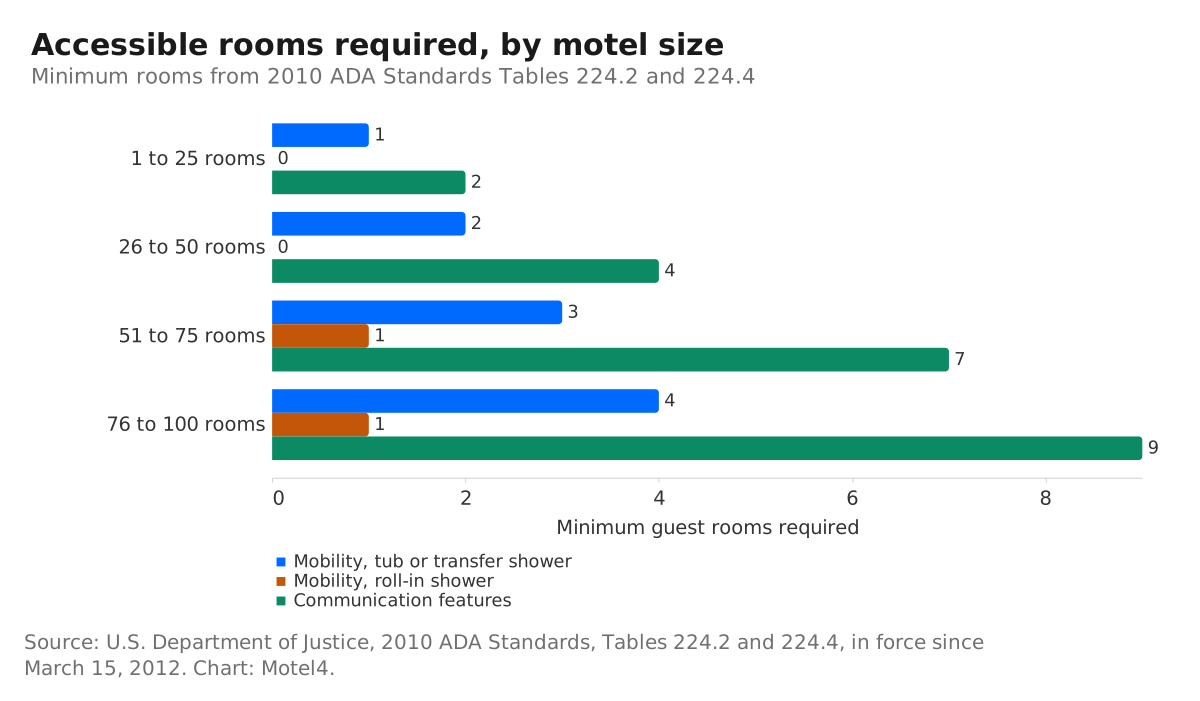
Table 224.2 of the 2010 ADA Standards for Accessible Design gives a motel with 26 to 50 guest rooms a short answer: 2 rooms with mobility features, and neither needs a roll-in shower [1]. Table 224.4 adds 4 rooms with communication features for guests who are deaf or hard of hearing [1][2].
Put together, the ADA compliant hotel room count for a 30-room motel is 5 rooms, because one room is allowed to count twice. Those tables bind you when you build, add or alter guest rooms. A separate rule about how you take bookings covers every reservation you take today, renovation or not.
A 30-room motel needs 5 accessible rooms once the overlap is counted
Count every guest room on the site first. Buildings on one site under the same permit may be counted together when each has 50 or fewer guest rooms, while a building with more than 50 is counted on its own [1]. Then read the two tables.
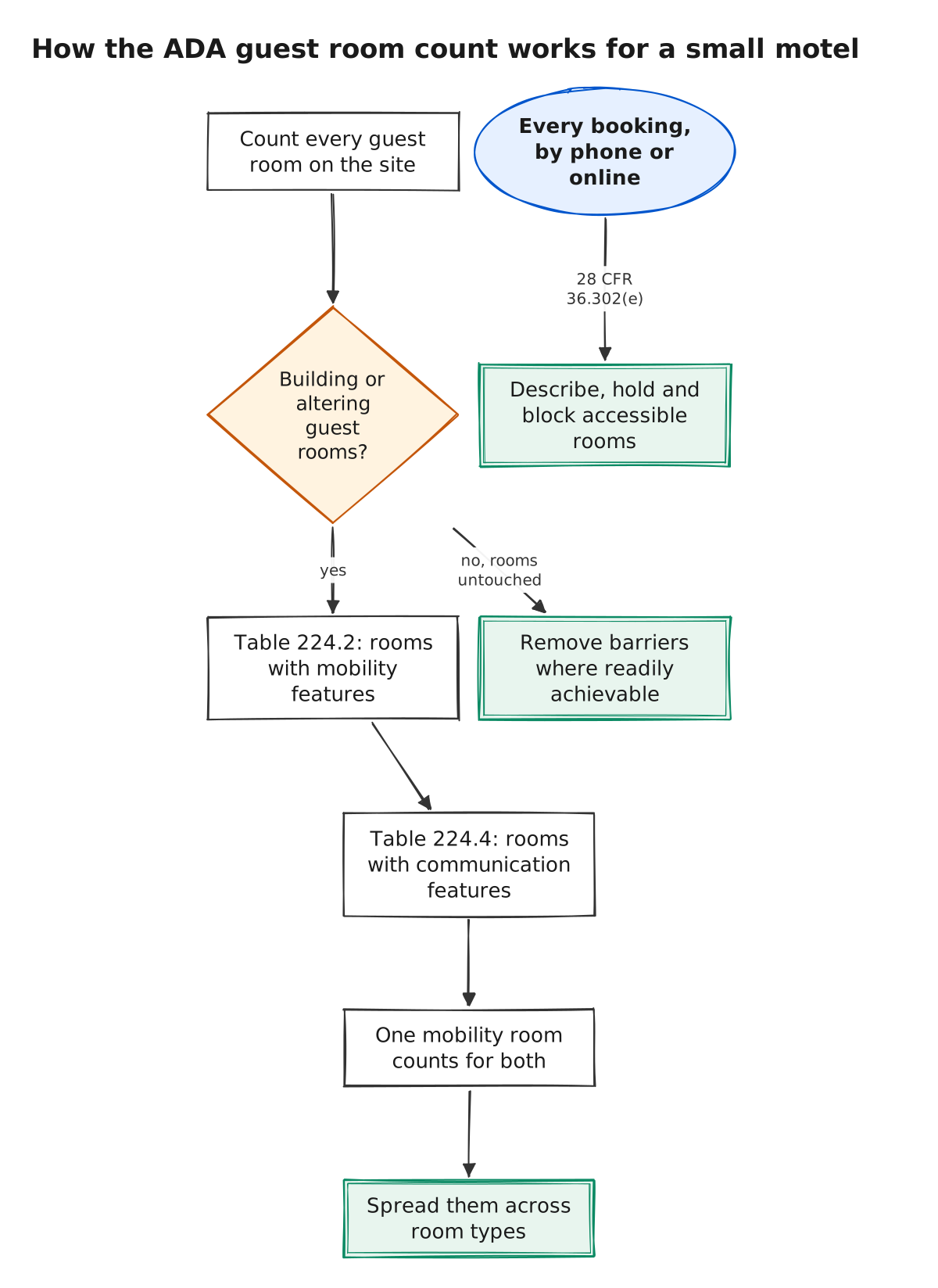
Table 224.2 sets the rooms with mobility features and Table 224.4 sets the rooms with communication features [1]. Section 224.5 then requires at least one of the mobility rooms to carry the communication features as well [1].
The U.S. Department of Justice, which adopted the standards in its ADA regulations, says in its guidance that at least one, but not more than 10 percent, of the mobility rooms can count toward the communication total [2]. Below 101 guest rooms that works out to exactly one room, which is why one mobility room counts for both.
The same arithmetic for four common motel sizes, using the bands in both tables:
| Guest rooms on site | Mobility rooms (with roll-in shower) | Communication rooms | Fewest separate rooms | Source |
|---|---|---|---|---|
| 20 | 1 (0) | 2 | 2 | [1], [2] |
| 30 | 2 (0) | 4 | 5 | [1], [2] |
| 60 | 4 (1) | 7 | 10 | [1], [2] |
| 80 | 5 (1) | 9 | 13 | [1], [2] |
Crossing 50 rooms in new construction is the line to watch: the communication rooms go from 4 to 7 and the first roll-in shower appears [1]. Section 224.5 also asks you to spread them across room types, with choices of room type, bed count and amenities comparable to the rest of the motel [1].
Additions and alterations are counted differently. Section 224.1.1 applies the tables only to the rooms you alter or add, until the property as a whole reaches the new-construction minimum [1]. Renovating 10 rooms means reading the tables for 10 rooms, not for the whole building.
A mobility room needs bed clearance, turning space and an accessible bathroom
Section 806.2 lists what goes into each room with mobility features [1]:
- A clear floor space of 30 by 48 inches on both sides of one bed, set for a side approach, or one such space between two beds [1].
- Turning space inside the room: a 60-inch circle, or a T-shape inside a 60-inch square [1].
- A bathroom with an accessible toilet, sink and bathtub or shower, and vanity counter space comparable to your other rooms [1].
- Accessible living and dining areas, plus any patio or balcony that serves the room [1].
The roll-in shower only arrives at 51 rooms. The U.S. Access Board, a federal agency, explains in its guide to the standards that those required roll-in showers come with a folding seat, while the other mobility rooms get a transfer shower or a bathtub [3]. A standard roll-in shower is at least 30 inches wide and 60 inches deep, with an entry at least 60 inches wide [1].
One rule reaches every new or altered guest room, accessible or not. Section 224.1.2 requires 32 inches of clear width at the doors guests pass through into and inside each room, with shower doors excepted [1].
A communication room signals the door, the phone and the fire alarm with light
Section 806.3 asks for three things in each room with communication features [1]:
- Visible alarms, where the building has an emergency warning system.
- Visible signals for an incoming phone call and for a knock or doorbell, kept separate from the alarm lights.
- A phone with a volume control and an electrical outlet within 48 inches of it, so a guest can plug in a TTY [1].
For an older building the alarm part has an exception. The Justice Department’s guidance says an existing fire alarm system does not have to add visible alarms to altered rooms until the system itself is upgraded or replaced [2]. That exception covers the alarm only, so altered communication rooms still need the door and phone signals [1].
The booking rule covers your phone line as well as your rooms
Since March 15, 2012, 28 CFR 36.302(e) has set five duties for reservations made by any means, including the telephone, in person or through a third party [4]:
- Take bookings for accessible rooms during the same hours and in the same way as any other room.
- Identify and describe the accessible features in enough detail that a guest can judge the room for themselves.
- Hold accessible rooms until every other room of that type is rented.
- Block an accessible room in every reservation system once it is booked.
- Guarantee the specific accessible room that was reserved.
The second duty is where small properties slip. A night clerk, an answering service or an AI line that cannot say whether the room has a roll-in shower or a tub, which side of the bed is clear, or whether there is a visual alarm leaves the guest unable to decide [4]. Write the features down once per room and give the same sheet to everyone who answers.
Motel4 sells an AI phone receptionist, so we have an interest in this part, but the rule reads the same for a person at the desk. Our phone script templates for hotel front desks are a good place to add the sheet, and the hotel call answering checklist is a quick way to see who actually picks up after hours.
An older motel that is not renovating still has two duties
The room counts in Section 224 bind new construction and alterations [1]. For rooms you are not touching, 28 CFR 36.304 asks you to remove barriers where readily achievable, which the regulation defines as easily accomplishable and able to be carried out without much difficulty or expense [4]. Its own list of examples includes installing flashing alarm lights and widening doors [4].
Elements that met the 1991 Standards and have not been altered since March 15, 2012 do not have to be rebuilt to the 2010 Standards [4]. The booking rule, though, has no such carve-out for older buildings [4].
Two federal tax breaks help pay for barrier removal. The Disabled Access Credit covers half of eligible spending between $250 and $10,250, so it tops out at $5,000, for businesses with 30 or fewer employees or revenue of $1 million or less [5]. A separate deduction of up to $15,000 a year is open to businesses of any size, and neither applies to new construction [5]. The credit is claimed on IRS Form 8826 [5].
The two can be used together, and again in any later year with eligible spending. Once spending passes $10,250, the deduction covers what you spent minus the credit [5]. So $12,000 of barrier removal in one year means a $5,000 credit and a $7,000 deduction for a motel that qualifies for both [5].
This assumes you own and run the whole property and take your own reservations. The counts here are federal minimums, your state or city building code may ask for more, and some lodging, such as time shares and town homes, can fall under the Fair Housing Amendments Act as well [1]. Read this as a map of the documents, not legal advice, and check plans with your local building department before you build.
Verdict
Do the count from Tables 224.2 and 224.4 if you are building new rooms, and remember that the overlap only saves one room: a 30-room motel still ends up with 5 [1]. Choose the reservation fix first if your rooms are untouched, because that duty applies to every call you take today [4].
Before the next renovation, keep three things in one place: your room count, the overlap math above and a feature sheet for each accessible room. Then hand that sheet to whoever answers your phone tonight.
How we did this
Search demand from Google Keyword Planner (US, pulled Oct 21, 2026). Rules read on Oct 21, 2026 from the 2010 ADA Standards, the Justice Department's guidance on them and 28 CFR part 36 on ada.gov, the U.S. Access Board's bathing-room guide and the ADA.gov tax incentives page. Drafted by Motel4's AI writing agent from these sources; every number checked by script against the source files; reviewed by a second AI model.
Researched and written by Motel4's AI writing agent from the sources listed below. Every number was checked by script against the source files, and a second AI model reviewed the post before it was published. The Motel4 Team is responsible for this page.
Sources
- U.S. Department of Justice, 2010 ADA Standards for Accessible Design (primary source), accessed Oct 21, 2026.
- U.S. Department of Justice, Guidance on the 2010 ADA Standards for Accessible Design (primary source), accessed Oct 21, 2026.
- U.S. Access Board, Guide to the ADA Standards, Chapter 6: Bathing rooms, accessed Oct 21, 2026.
- U.S. Department of Justice, ADA Title III Regulations, 28 CFR part 36 (primary source), accessed Oct 21, 2026.
- U.S. Department of Justice, ADA.gov, Expanding Your Market: Tax Incentives for Businesses, accessed Oct 21, 2026.

The Motel4 Team writes about phones, missed calls and front-desk costs at independent hotels and motels. Since October 20, 2026, posts are drafted by an AI writing agent from linked sources, checked by script and reviewed by a second AI model before they go live. How we write. To reach us or report an error: motel4.ai/contact.