A 48-hour hotel cancellation policy collects about $79 more per 100 direct bookings than a 24-hour one
At two hotels in Portugal, when a guest cancelled depended on how the booking was made. Three researchers published 119,390 real bookings from a Lisbon city hotel and an Algarve resort, with the date of each cancellation [1]. Among individual guests who paid nothing up front, online-agency bookings were cancelled a median 45 days ahead; direct bookings, 14 days.
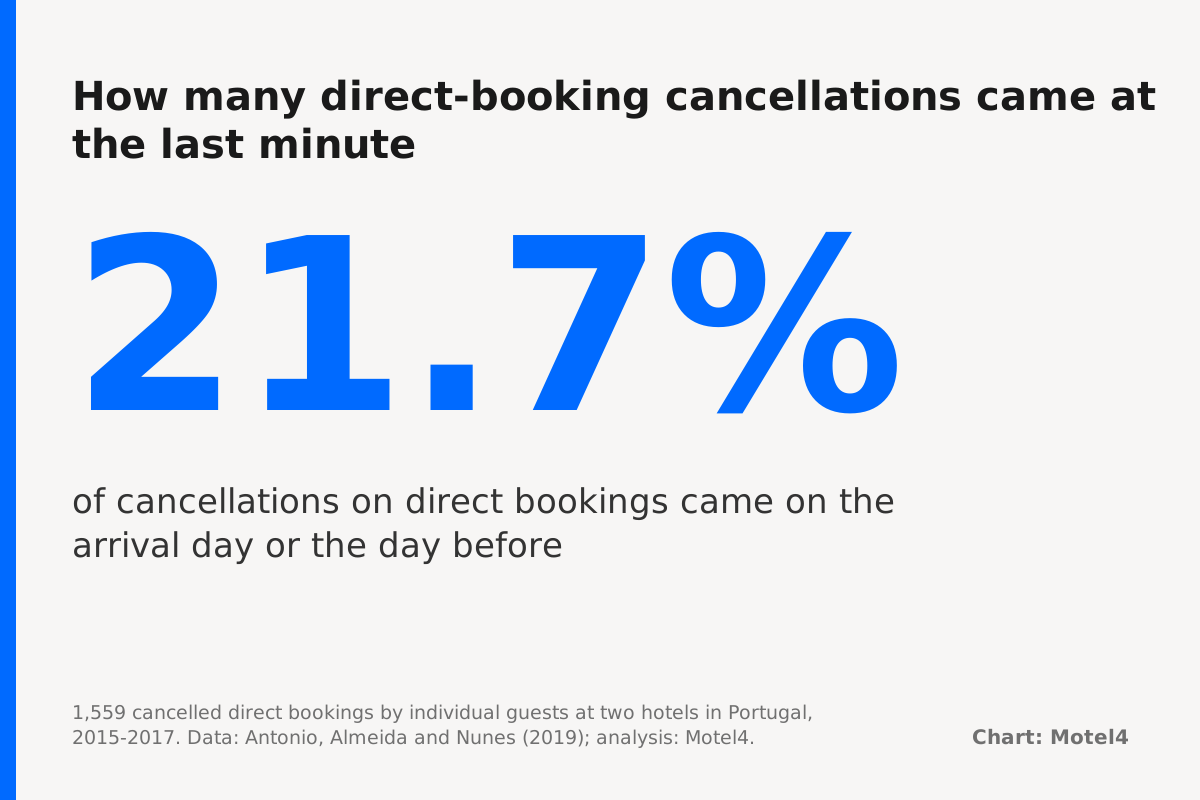
That matters when you write a hotel cancellation policy, because the deadline only charges guests who cancel after it. On direct bookings, a 24-hour deadline would have charged 16.0% of cancellations and a 48-hour deadline 21.7%. On online-agency bookings, the same deadlines would have charged 1.4% and 2.4%.
The math below prices the 24-hour versus 48-hour choice per 100 direct bookings, then shows what longer deadlines and no-shows are worth, with online-agency bookings beside them. It leaves out one thing no public dataset we found can answer: how many guests a stricter policy turns away before they book. How we built these numbers is on how we write.
A 48-hour deadline adds about $79 per 100 direct bookings
Out of 100 direct bookings, 13.8 get cancelled, and 5.7% of those cancellations land on the day before arrival. That is the slice a 48-hour deadline charges and a 24-hour deadline lets go.
At a one-night fee of $100, the slice is worth about $79 per 100 direct bookings, less than one late fee. On online-agency bookings the same change adds about $37 per 100 bookings, because so few agency guests cancel in the last two days. Across all 76,684 bookings we used, agency and direct together, it adds about $48.
Where the inputs come from
The bookings come from the Hotel booking demand datasets, published in Data in Brief in 2019 by Nuno Antonio, Ana de Almeida and Luis Nunes [1]. They cover arrivals from July 2015 to August 2017 at a resort hotel in the Algarve and a city hotel in Lisbon. We downloaded the copy of the file published by the TidyTuesday data project [2].
We started from the 76,684 bookings by individual guests with no deposit. We left out groups, contracts and the 14,587 bookings marked “Non Refund”, because 99.4% of those show as cancelled, which looks like a quirk of the data and not guest behavior.
Most of those bookings came through agents. The data’s market-segment field, where “TA” stands for travel agents [1], codes 66.8% of them “Online TA”, and those online-agency bookings hold 85.2% of the cancellations. Only 11,318 bookings, 14.8%, are coded “Direct”. The data does not say whether a direct booking came by phone, at the desk or on the hotel’s website.
Direct guests cancelled less often and later: 13.8% of direct bookings were cancelled, against 37.7% of online-agency bookings. So the math uses the direct bookings and puts the online-agency numbers beside them. If most of your rooms sell through online agencies, read that column.
The days-before-arrival count is the arrival date minus the date the booking was cancelled [1]. The two hotels were close: 14.7% of the city hotel’s direct bookings were cancelled, against 12.9% at the resort. The fee is our assumption, set at one night for the reason in the card-rules section below.
The hotel cancellation policy deadline matters more on direct bookings
Here is what each deadline would have charged in the same data, at a one-night fee of $100.
| Deadline | Share of direct cancellations charged | Fees per 100 direct bookings | Fees per 100 online-agency bookings |
|---|---|---|---|
| 24 hours | 16.0% | $220 | $53 |
| 48 hours | 21.7% | $299 | $90 |
| 72 hours | 24.8% | $342 | $125 |
| 7 days | 37.8% | $521 | $426 |
| 30 days | 65.9% | $907 | $1,493 |
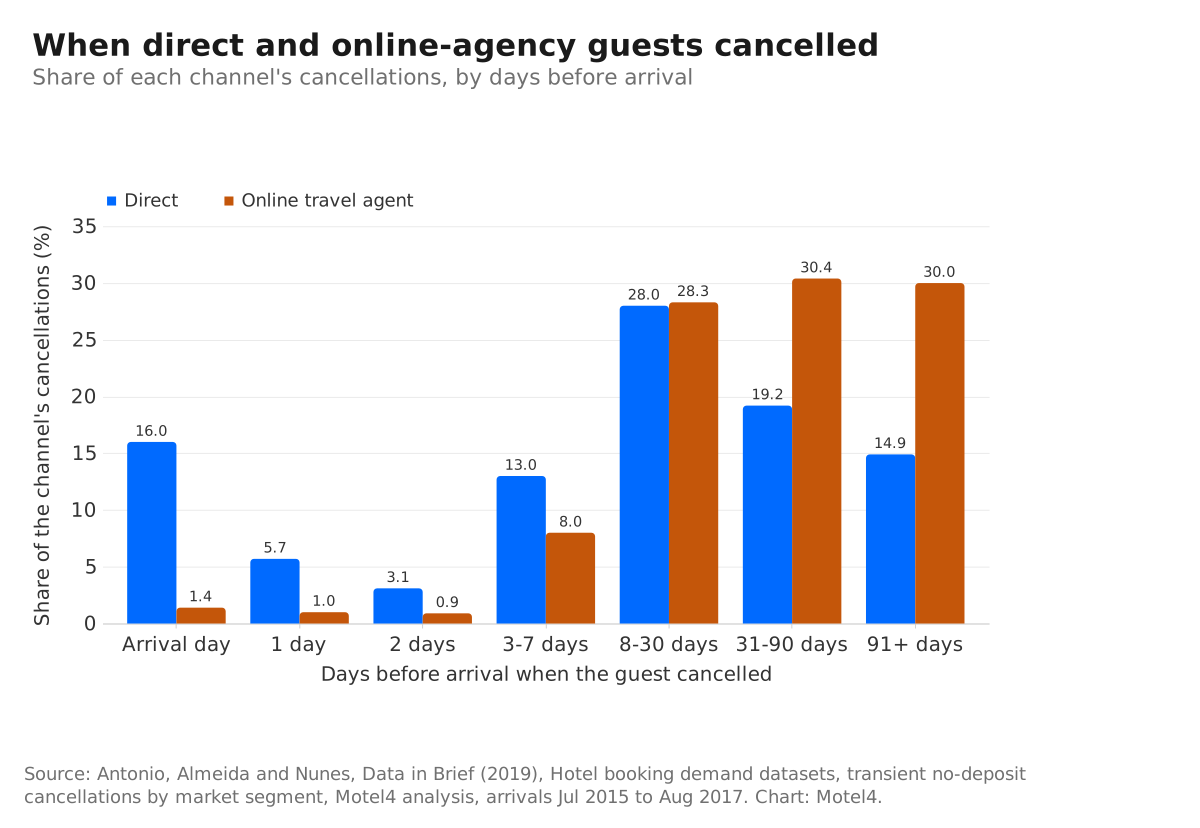
On direct bookings, even a 24-hour deadline charges about one cancellation in six. Moving to 7 days adds about $301 per 100 direct bookings, because 13.0% of direct cancellations fall between three and seven days out. Online-agency guests mostly cancel weeks ahead, so short deadlines collect little from them; a 30-day deadline would charge 39.6% of their cancellations.
Card rules cap what you can charge
Visa’s rules call a booking held with a card but no payment a “Guaranteed Reservation” [3]. To charge on one, you must disclose the reservation conditions when the guest books, and a phone booking needs a written confirmation with those conditions within 24 hours [3]. The guest also gets at least 24 hours after that confirmation to cancel without penalty [3].
You may bill a “No-Show Transaction” only when the guest has not cancelled under the policy you disclosed and has not claimed the room, and you must hold the room for 24 hours after the agreed start time [3].
A no-show billed for more than one day’s accommodation is grounds for the guest’s bank to dispute it [3]. That is why the math uses a one-night fee.
No-shows were 1.6% of direct bookings in the data, worth $163 per 100 bookings at a $100 rate, and 1.0% of online-agency bookings. Every deadline collects that money, as long as the booking carries a card. Calling guests before arrival is one way owners try to cut no-shows; our older post on phone screening before arrival walks through it.
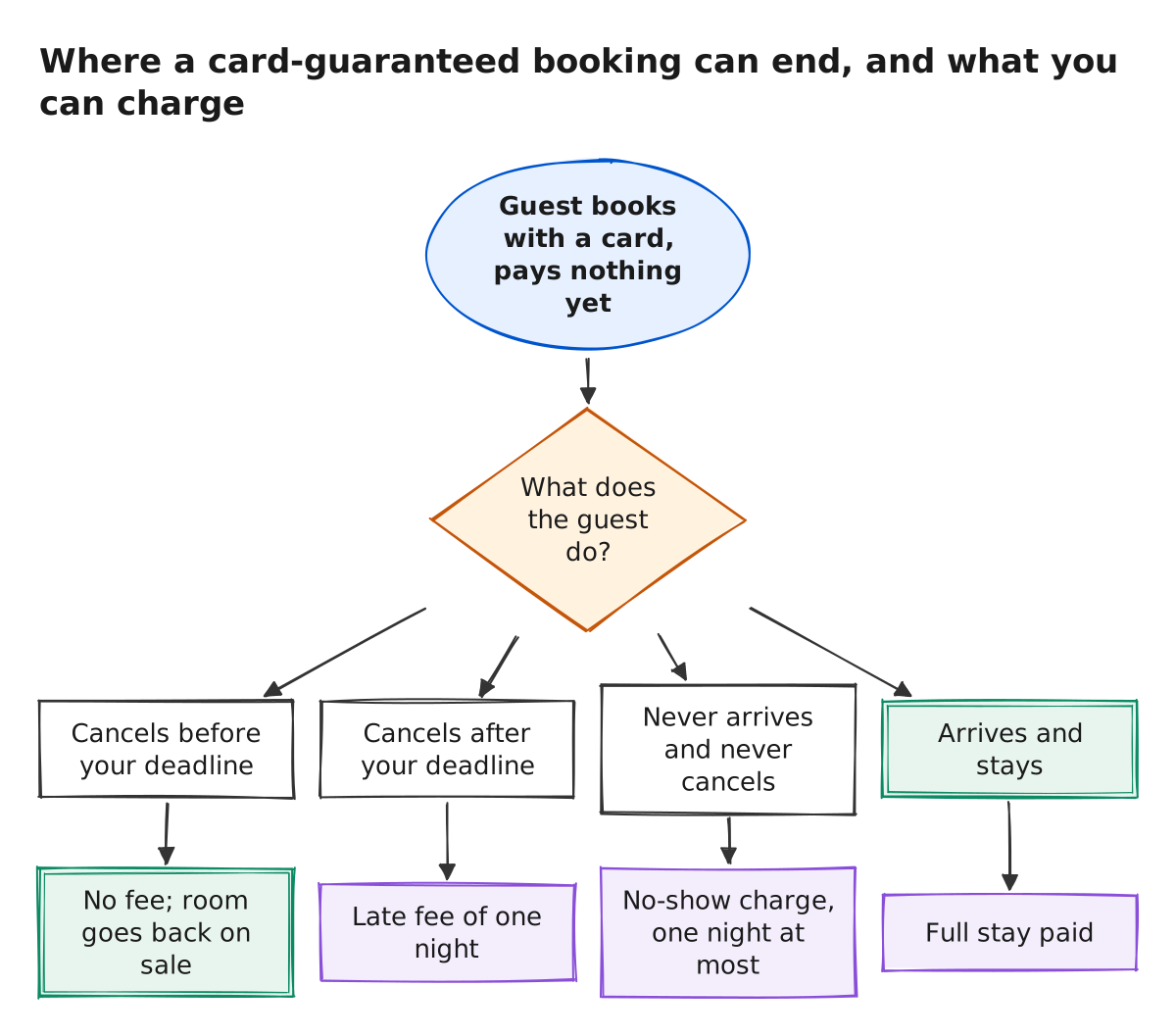
Put together, a card-guaranteed booking can end four ways. A guest who cancels before your deadline pays nothing, and the room goes back on sale. A guest who cancels after your deadline pays a late fee of one night. A guest who never arrives and never cancels pays a no-show charge, one night at most. Everyone else arrives and stays.
How the result moves with your nightly rate
The gain from a 48-hour deadline on direct bookings scales with the fee, so it scales with your rate.
| Case | Nightly rate | Extra fees per 100 direct bookings, 48 vs 24 hours |
|---|---|---|
| Low | $70 | $55 |
| Mid | $100 | $79 |
| High | $150 | $118 |
This assumes your direct guests cancel on the same schedule as direct guests at two Portuguese hotels in 2015-2017, and that every fee you charge is collected.
It also assumes guests keep that schedule when the deadline moves. A guest who knows about a 48-hour deadline can cancel a day earlier and pay nothing, so treat the fee figures as a ceiling; what you get instead is an extra day to sell the room.
The data records the date of each cancellation but not the hour, so we counted a 24-hour deadline as the arrival day and a 48-hour deadline as the arrival day plus the day before. We read Visa’s rules only; other card networks publish their own.
Verdict
Pick a 48-hour deadline if a late cancellation usually leaves your room empty for the night; on direct bookings it charged 21.7% of cancellations against 16.0% for 24 hours. Keep 24 hours if the stricter policy would cost you even one booking per 100, because one lost night at $100 is worth more than the $79 the 48-hour deadline adds.
Use a 7-day deadline for dates that sell out, so guests who cancel in the last week pay; it charged 37.8% of direct cancellations in this data. It still lets anyone who cancels earlier go free. If a cancellation weeks ahead can cost you a guest you turned away, use a prepaid rate for those dates.
Whatever you pick, put it in the written confirmation and take a card. Cancellations in the last day or two leave you the least time to resell the room, and on direct bookings in this data they were 21.7% of cancellations. The median direct guest who cancelled gave 14 days of warning; online-agency guests gave 45.
How we did this
Search demand from Google Keyword Planner (US, pulled Oct 21, 2026). Cancellation timing measured by us from the public Hotel booking demand datasets (Antonio, Almeida and Nunes, Data in Brief, 2019; 119,390 bookings arriving Jul 2015 to Aug 2017), downloaded Oct 21, 2026, and split by the dataset's market-segment field. Card rules from the Visa Core Rules and Visa Product and Service Rules, 18 April 2026 edition. Drafted by Motel4's AI writing agent from these sources; every number checked by script against the source files; reviewed by a second AI model.
Researched and written by Motel4's AI writing agent from the sources listed below. Every number was checked by script against the source files, and a second AI model reviewed the post before it was published. The Motel4 Team is responsible for this page.
Sources
- Nuno Antonio, Ana de Almeida and Luis Nunes, via PubMed Central, Hotel booking demand datasets (Data in Brief, 2019) (primary source), accessed Oct 21, 2026.
- R for Data Science community, TidyTuesday, Hotels data file and readme, TidyTuesday 2020-02-11, accessed Oct 21, 2026.
- Visa, Visa Core Rules and Visa Product and Service Rules, 18 April 2026 (primary source), accessed Oct 21, 2026.

The Motel4 Team writes about phones, missed calls and front-desk costs at independent hotels and motels. Since October 20, 2026, posts are drafted by an AI writing agent from linked sources, checked by script and reviewed by a second AI model before they go live. How we write. To reach us or report an error: motel4.ai/contact.