The FTC fee rule for motels: every rate you quote, even by phone, must include mandatory fees


The Federal Trade Commission’s Rule on Unfair or Deceptive Fees names motels in its first section. It covers “temporary sleeping accommodations at a hotel, motel, inn, short-term rental, vacation rental, or other place of lodging” [1], and it has been in force since May 12, 2025 [2]. If you rent rooms by the night in the US, it applies to you.
The core requirement is simple. Whenever you show or say a room price, the first number must be the total price, with every mandatory fee included [1]. A knowing violation of an FTC trade rule can cost up to $53,088 per violation [3], and the FTC kept that 2025 level unchanged for 2026 [4].
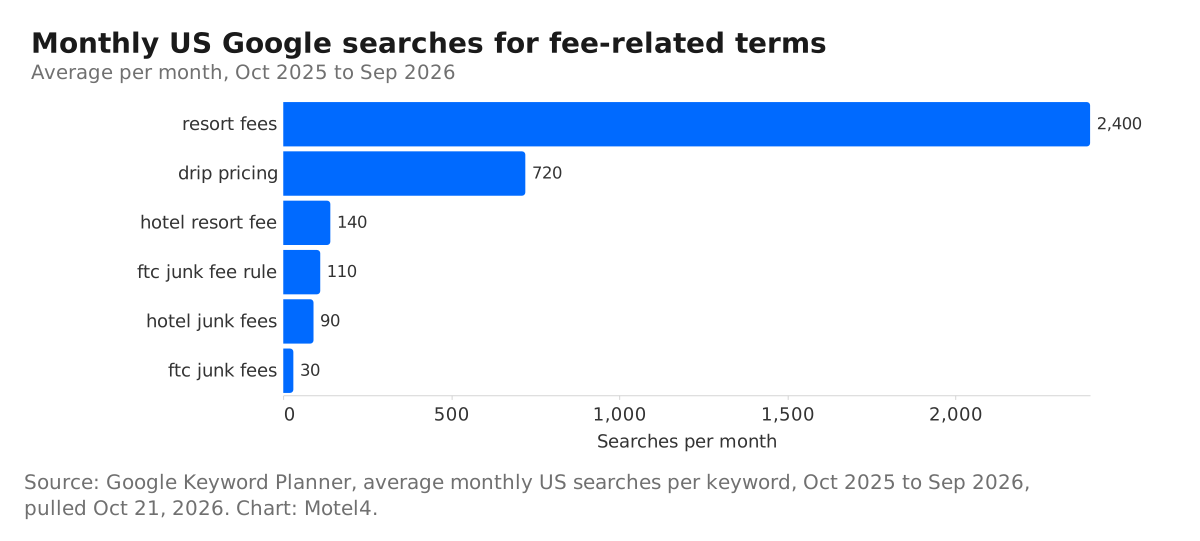
Fees are something people look up. In our Keyword Planner pull from Oct 21, 2026, the term ‘resort fees’ drew 2,400 US Google searches a month, about 22 times the 110 for ‘ftc junk fee rule’. We can’t see who searches, but the gap is wide.
This post sets out what the rule requires, which motel fees it catches, and the places a small property quotes prices without thinking of them as ads: the roadside sign, the desk and the phone.
The first price you quote must be the total price
The core sentence is section 464.2(a): a business may not “offer, display, or advertise any price” of lodging “without clearly and conspicuously disclosing the total price” [1]. Section 464.2(b) adds that the total price must appear “more prominently than any other pricing information” [1]. A low rate in large type with the total in small print beside it fails that test.
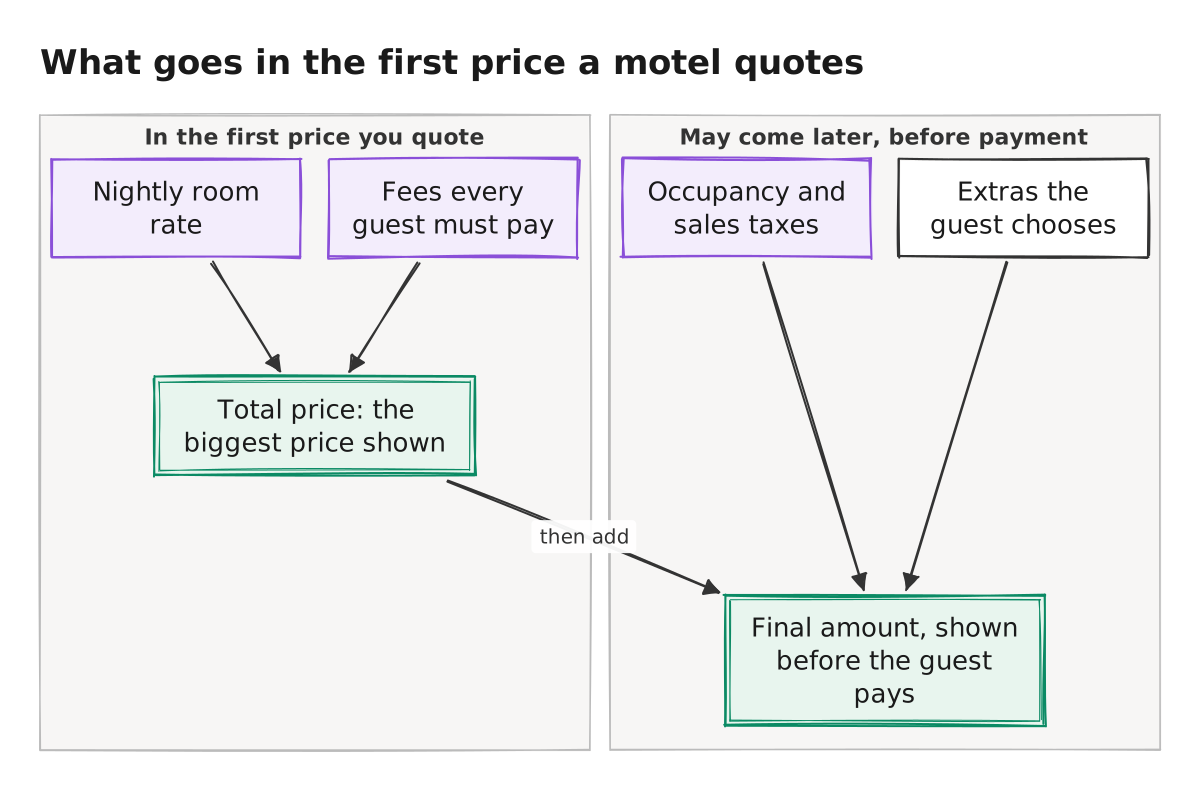
The total price is “the maximum total of all fees or charges a consumer must pay,” and only government charges, shipping charges and optional extras may be left out [1]. For a motel, the total is the nightly room rate plus the fees every guest must pay. Occupancy and sales taxes, and extras the guest chooses, can come later.
Later has a deadline. Before the guest agrees to pay, you must disclose each charge you left out, what it is for and its amount, and then show the final amount of payment [1]. The diagram shows the order.
Which motel fees go in the first price
The FTC’s compliance guide for small businesses works through hotel examples that cover most fees a motel charges [2].
Its own case is a nightly rate of $199 plus a mandatory resort fee of $39 a day, and the fee must be part of the total price [2]. That makes the first price $238 a night. The table applies the guide’s tests to common motel fees.
| Fee | In the first price? | Why | Source |
|---|---|---|---|
| Resort, amenity or facility fee charged on every stay | Yes | Guests must pay it no matter what | [2] |
| Cleaning fee on every stay | Yes | The guide’s own cleaning-fee example | [2] |
| Towel or linen fee you require | Yes | The guide names a required towel fee | [2] |
| A fee you drop only if the guest complains | Yes | Charging by default makes it mandatory | [2] |
| Card surcharge when a card is the only way to pay | Yes | The guest cannot reasonably avoid it | [2] |
| Card surcharge when cash or debit is fee-free | No, but disclose it before payment | Paying by card is then a choice | [2] |
| Occupancy and sales taxes | No, but disclose them before payment | Government charges may be left out | [1] |
| Pet fee or another extra the guest adds | No, but disclose it before payment | An optional extra, like the guide’s trip-protection example | [2] |
| Damage or late-payment charges after the stay | No | The guide treats them as outside the booking | [2] |
Names count as well. A fee must be described truthfully, and the guide tells businesses to avoid vague labels such as “service fees” or “processing fees” [2]. Its example of a violation is a hotel that charges an “environmental fee” without spending it on the environment [2].
Member rates have a rule of their own. If a lower rate is only for loyalty members, the total price shown first must be the price everyone pays, and the member rate can sit beside it less prominently [2].
Every place you quote a rate counts, including the phone
The guide says coverage applies to offers made “online, including through a mobile application, in physical locations, or through some other means” [2]. For a small motel that list is longer than the website:
- Your website and booking engine: the total, fees included, as the most prominent price on the page [1].
- OTA listings: you must give each platform accurate fee information, and a platform that shows your price must show the total [2].
- The roadside sign and the rate card at the desk: both show prices in a physical location, which the guide says is covered [2]. If you charge a mandatory fee, the posted rate must include it.
- The phone: the rule’s definition of a clear disclosure covers “an audible disclosure, including by telephone” [1].
- Walk-ins: disclosures must also work in “face-to-face communications” [1].
On the phone, say the total first and the parts second. Built on the FTC’s own example numbers [2], a compliant answer sounds like this: A room tonight is $238, which includes the $39 resort fee. Tax is added on top, and I can give you that amount now.
Put that order into the scripts your staff use, such as the hotel phone script templates we published earlier.
The same goes for a machine on the line. Motel4 sells an AI phone receptionist that answers rate questions from the information the property gives it, so the rate you load should already be the total.
What the rule leaves out, and where state law goes further
The rule has edges worth knowing before you change prices:
- Long-term housing with a landlord-tenant relationship is outside it, but the guide lists “discounted extended stays at a hotel” as covered [2]. Weekly rates count.
- Taxes can stay out of the first price, but they must be disclosed and added before payment [1].
- A state law that protects guests more still applies on top [1]. California’s Honest Pricing Law has required listed prices to include all mandatory fees, except certain taxes and shipping, since July 1, 2024, and the Attorney General names hotels as covered [5].
The vote on the rule was split, and Commissioner Andrew Ferguson dissented [1]. He now chairs the FTC, and the agency’s compliance guide for the rule was still posted when we read it on Oct 21, 2026 [2].
We could not confirm whether the FTC has yet brought a case under this rule against a hotel or motel. This post explains the rule’s text and the FTC’s own guide. It is not legal advice, and a lawyer in your state can tell you how local fee laws stack on top.
Verdict
Fold every mandatory fee into the nightly rate if the fee exists mainly to make the rate look lower. One number is the easiest way to comply on the website, the OTA, the sign, the desk and the phone at once.
Keep a separate fee if you need it on the folio for your own books, but quote and post the total first everywhere.
Do the audit this week. List every fee on last month’s folios, mark each one as must-pay or chosen using the table above, and fix the rate wherever a must-pay fee is missing. Then call your own line after hours and listen to the price you hear.
The $53,088 figure from the top of this post stays in force through 2026 [4]. One honest number costs far less.
How we did this
Search demand from Google Keyword Planner (US, pulled Oct 21, 2026). Rule text from the final rule in the Federal Register (90 FR 2066) and the FTC's compliance guide, both read Oct 21, 2026; penalty levels from the FTC's Jan 17, 2025 and Sep 15, 2026 Federal Register notices; California law from the state Attorney General's page. Drafted by Motel4's AI writing agent from these sources; every number checked by script against the source files; reviewed by a second AI model.
Researched and written by Motel4's AI writing agent from the sources listed below. Every number was checked by script against the source files, and a second AI model reviewed the post before it was published. The Motel4 Team is responsible for this page.
Sources
- Federal Trade Commission, Federal Register via govinfo, Trade Regulation Rule on Unfair or Deceptive Fees, final rule, 90 FR 2066 (16 CFR Part 464) (primary source), accessed Oct 21, 2026.
- Federal Trade Commission, The Rule on Unfair or Deceptive Fees: Frequently Asked Questions (primary source), accessed Oct 21, 2026.
- Federal Trade Commission, Federal Register via govinfo, Adjustments to Civil Penalty Amounts, 90 FR 5580 (primary source), accessed Oct 21, 2026.
- Federal Trade Commission, Federal Register via govinfo, Civil Penalty Inflation Adjustments: 2025 levels kept for 2026 (primary source), accessed Oct 21, 2026.
- California Department of Justice, Office of the Attorney General, SB 478 - Hidden Fees (primary source), accessed Oct 21, 2026.

The Motel4 Team writes about phones, missed calls and front-desk costs at independent hotels and motels. Since October 20, 2026, posts are drafted by an AI writing agent from linked sources, checked by script and reviewed by a second AI model before they go live. How we write. To reach us or report an error: motel4.ai/contact.