Front desk training for a small motel: a 10-shift plan built from the 20 tasks the Labor Department lists
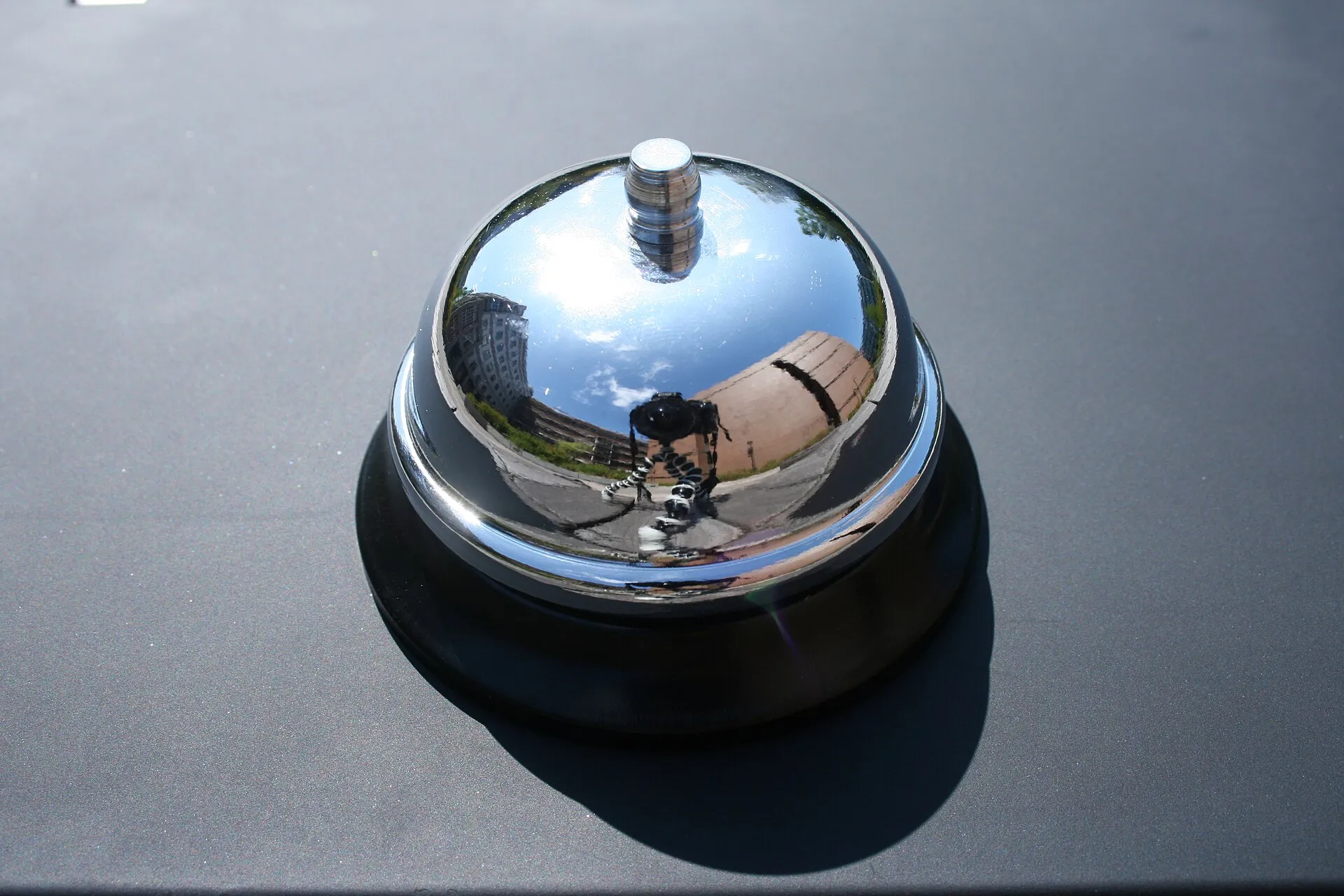

O*NET, the occupation database published by the U.S. Department of Labor, lists 20 tasks for hotel, motel and resort desk clerks, from “Make and confirm reservations” to “Compute bills, collect payments, and make change for guests” [1]. It puts the on-the-job training for work like this anywhere from “a few days to one year” [1].
A small motel has neither a year nor a training department. This plan fits the job into 10 shifts, and it is worth writing down because you will use it again.
In 2025, workers in accommodation and food services, the government’s group for hotels and restaurants, quit at an average of 4.2% a month, twice the 2.0% rate across all industries [2].
The same pattern shows in the desk clerk numbers. BLS projects about 35,500 desk clerk openings a year through 2035, while total employment grows by only about 4,900 over the whole decade, from 264,600 to 269,500 jobs [3]. Nearly every opening replaces a clerk who left.
The plan below is ours, built from O*NET’s task list. It assumes a small independent property, a trainer who is the owner or a senior clerk, and a new hire who has never worked a hotel desk.
A hotel front desk training plan in 10 shifts
Every day follows one rule. The trainee watches the task once, does it with the trainer beside them, then does it alone while the trainer watches. In week one the trainer runs the desk and the trainee helps. In week two the trainee runs the desk and the trainer stays close.
- Day 1: walk the property. Every room type, the laundry, the breaker panel, the water shut-off, the fire exits and extinguishers. Then keys: how to make one, void one, and what to do when a guest loses one. O*NET’s task is “Issue room keys” [1].
- Day 2: check-in and check-out. ID, the registration card, room assignment and the card authorization, which O*NET describes as “Verify customers’ credit, and establish how the customer will pay for the accommodation” [1]. At check-out, review the bill with the guest and tell housekeeping the room is empty.
- Day 3: phone calls and rate quotes. In O*NET’s survey, 97% of desk clerks said they have telephone conversations every day [1]. The trainee listens to a few calls, then takes calls with the trainer listening. Hand over the rate sheet, the cancellation policy and a short script, such as our phone script templates for greetings and bookings.
- Day 4: reservations, changes and no-shows. “Make and confirm reservations” is the first task on O*NET’s list [1]. Teach the reservation screens, how a Booking.com or Expedia booking arrives, how to change dates, and when your policy charges a no-show.
- Day 5: cash, cards and the shift report. Count the drawer in and out, run a card, refund a card, and fill in the end-of-shift report. Never write a full card number or security code on paper. If the clerk will cover nights, add the audit O*NET describes as “balancing accounts and conducting nightly audits” [1], and read about the overnight calls a night clerk handles.
- Days 6-7: run a busy weekend shift. The trainee runs check-in through the evening rush. The trainer stays out of the way and steps in only when a mistake would cost money or upset a guest.
- Day 8: complaints and refunds. O*NET’s task reads “Record guest comments or complaints, referring customers to managers as necessary” [1]. Write down what the clerk can fix alone: a room move, a late check-out, a refund up to a dollar limit you set. Our complaint call de-escalation scripts cover the words.
- Day 9: police, service animals, emergencies. The three rules in the next section, plus your emergency contacts and who to wake for a fire alarm, a flood or an injured guest.
- Day 10: solo shift, then the sign-off. The trainer leaves the desk and stays reachable by phone. At the end of the shift the trainee works through the sign-off list below.
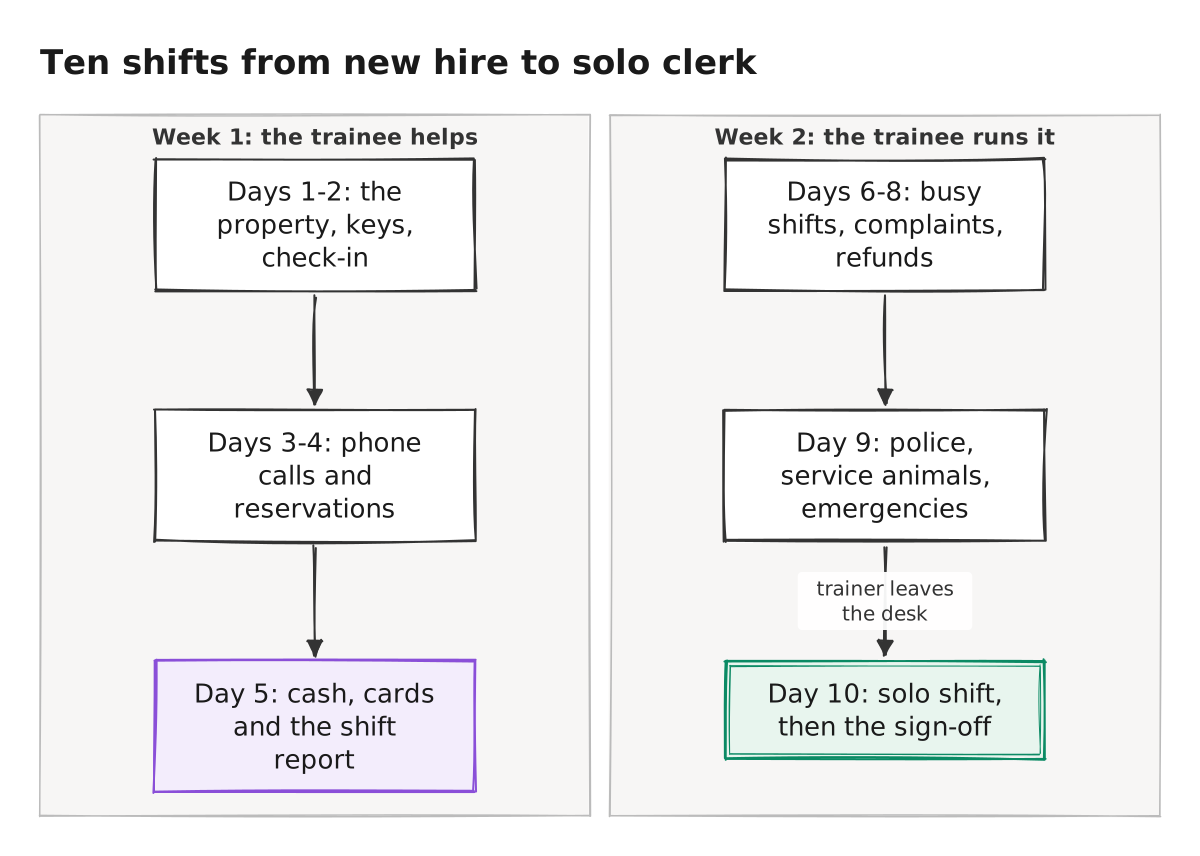
Week 1: the trainee helps. Week 2: the trainee runs it. The split matters more than the exact days: if your busy night is Friday, move the busy-shift days to match.
Three rules a new clerk can break on their first night alone
Most desk mistakes cost a refund. These three can put the business on the wrong side of the law or leave a guest in danger, so they come before the first solo shift.
Service animals: two questions and no pet fee
When it is not obvious what a dog does, the Justice Department says staff may ask only two questions: “(1) is the dog a service animal required because of a disability, and (2) what work or task has the dog been trained to perform” [4].
Staff cannot ask about the disability, ask for medical papers or an ID card for the dog, or ask the dog to show its task [4].
A pet deposit or fee must be waived for a service animal. If you normally charge guests for damage they cause, you may charge for damage the animal causes, and allergies or fear of dogs are not valid reasons to refuse service [4]. Print the two questions on a card and keep it by the register.
Police and the guest register: call the owner
In 2015 the Supreme Court struck down the part of a Los Angeles ordinance that let police inspect hotel guest records on demand, in a case brought by a group of motel operators [5]. It failed because it gave operators no chance for precompliance review before a neutral decisionmaker [5].
The ruling left the record-keeping rules in place, and the Court said officers can still get the records with an administrative subpoena, a warrant, the operator’s consent, or in an emergency [5].
Your clerk should neither refuse an officer nor hand over the register alone. Give them one written line: be polite, note the officer’s name and badge number, and call the owner.
Trafficking: report it, never confront it
The Homeland Security Department’s Blue Campaign tells anyone who suspects trafficking: “Do not at any time attempt to confront a suspected trafficker directly or alert a victim to your suspicions” [6].
It asks you to contact local police or the federal tip line at 1-866-347-2423, and lists the National Human Trafficking Hotline at 1-888-373-7888 [6]. Tape both numbers next to the desk phone.
We could not confirm the rules in your state or city for this post. Ask your state hotel association or your lawyer whether you must give staff a trafficking-awareness course or keep the guest register in a set form, and agree the police-request policy with your lawyer before you print it.
The paired shifts cost about $1,214 in extra wages
For the first nine shifts you pay two people to run one desk. The math below uses the 2025 national median wage for desk clerks [1] and an eight-hour shift.
That comes to $1,213.92 of wages for a trainee the desk does not yet need. This assumes the trainee earns the national median of $16.86 an hour [1]. Your local wage, payroll taxes and the trainer’s own time are not in it, and if you are the trainer, your time only looks free.
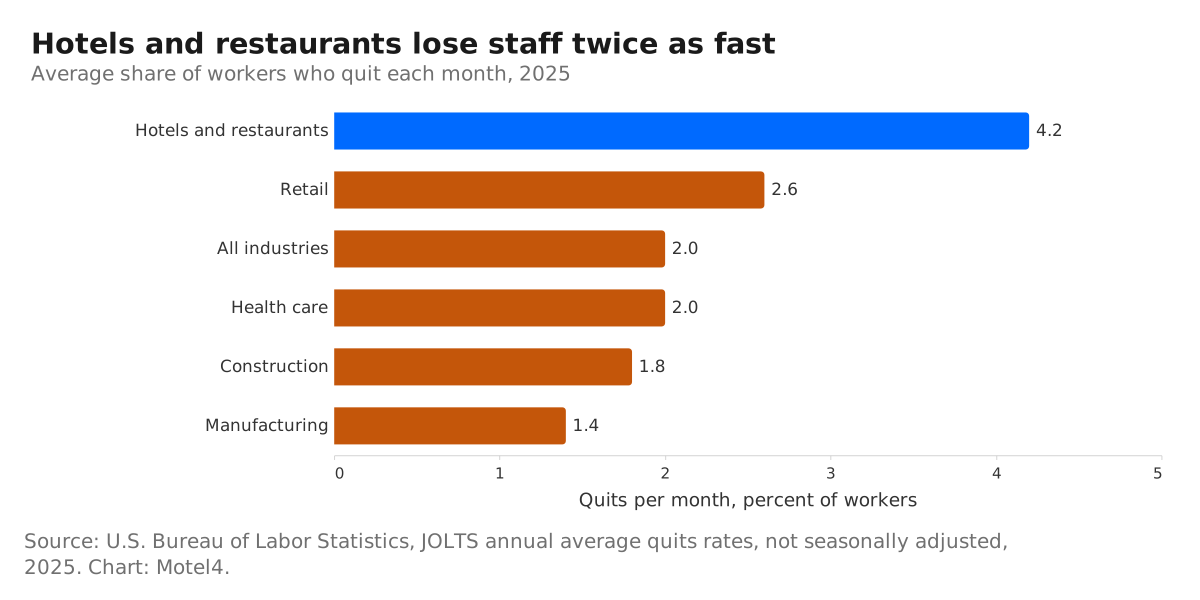
You will likely spend it again. Hotels and restaurants lose staff at about twice the all-industry rate [2], so the second hire costs less only if the plan is written down and the next trainer can follow it without you.
The sign-off: 10 tasks done alone
The clerk passes when they can do each task alone, with the trainer watching and saying nothing:
- Check in a walk-in guest, from the rate quote to the key.
- Check out a guest who disputes a charge, and log the outcome.
- Take a phone reservation, read it back, and send the confirmation.
- Change a reservation, cancel one, and apply the no-show policy correctly.
- Find an online travel agency booking and assign the room.
- Run a card, refund a card, and balance the cash drawer.
- Fill in the end-of-shift report.
- Move a guest to another room after a complaint and note why.
- Ask the two service-animal questions word for word, and say the police-request policy.
- Walk the trainer to the fire exits, extinguishers, breaker panel and water shut-off.
Any task the clerk cannot do yet goes back into a paired shift. One extra shift costs less than finding out on a full Saturday night that a task was never learned.
Verdict
Use the full 10-shift plan if your new clerk has never worked a hotel desk. Cut week one to two paired shifts if they have, but keep Day 9 and the sign-off, because a clerk from another hotel learned that hotel’s policies, not yours.
Pick a written checklist over shadowing alone if you expect to hire again within a year, which the quit rates above suggest you will.
Write the plan once, print the sign-off list, and keep both at the desk. The next time a clerk gives notice, you start at Day 1 with a plan instead of starting from scratch.
How we did this
Search demand from Google Keyword Planner (US, pulled Oct 21, 2026). Desk clerk tasks and the 2025 median wage from O*NET OnLine 43-4081.00; 2025-2035 employment and annual openings from the BLS Employment Projections occupational table; quits rates from the BLS JOLTS annual table for 2025; rules from the Justice Department's ADA guidance, the Supreme Court's 2015 Patel opinion and the Homeland Security Department's Blue Campaign, all read Oct 21, 2026. The 10-shift plan is ours, built from those tasks. Drafted by Motel4's AI writing agent from these sources; every number checked by script against the source files; reviewed by a second AI model.
Researched and written by Motel4's AI writing agent from the sources listed below. Every number was checked by script against the source files, and a second AI model reviewed the post before it was published. The Motel4 Team is responsible for this page.
Sources
- O*NET OnLine, U.S. Department of Labor, Employment and Training Administration, Summary report for 43-4081.00 Hotel, Motel, and Resort Desk Clerks (primary source), accessed Oct 21, 2026.
- U.S. Bureau of Labor Statistics, Job Openings and Labor Turnover Survey, Table 22: annual average quits rates by industry and region (primary source), accessed Oct 21, 2026.
- U.S. Bureau of Labor Statistics, Employment Projections program, Occupational Projections and Worker Characteristics table, row 43-4081 Hotel, motel, and resort desk clerks (primary source), accessed Oct 21, 2026.
- U.S. Department of Justice, Civil Rights Division, ADA Requirements: Service Animals (primary source), accessed Oct 21, 2026.
- Supreme Court of the United States, via Cornell Law School's Legal Information Institute, Los Angeles v. Patel, No. 13-1175, decided June 22, 2015 (primary source), accessed Oct 21, 2026.
- U.S. Department of Homeland Security, Blue Campaign, How to Identify and Report Human Trafficking (primary source), accessed Oct 21, 2026.

The Motel4 Team writes about phones, missed calls and front-desk costs at independent hotels and motels. Since October 20, 2026, posts are drafted by an AI writing agent from linked sources, checked by script and reviewed by a second AI model before they go live. How we write. To reach us or report an error: motel4.ai/contact.