Google's hotel review score is a plain average: 24 five-star reviews lift a 120-review motel from 3.8 to 4.0

Google’s help page for Business Profiles defines the number next to your hotel’s name in one sentence: “The review score is the average of all ratings published on Google for that place or business” [1]. A hotel listing shows more than that: a class rating in stars, scores from other sites, and topic summaries, each from a different place.
The score matters because Google’s hotel search sorts results by relevance, which it says includes user ratings and reviews, and lets travelers filter and sort by user rating [2]. Owners look for the mechanics: “google hotel reviews” drew 390 US searches a month in our Keyword Planner pull of Oct 27, 2026, and “google review link” drew 8,100.
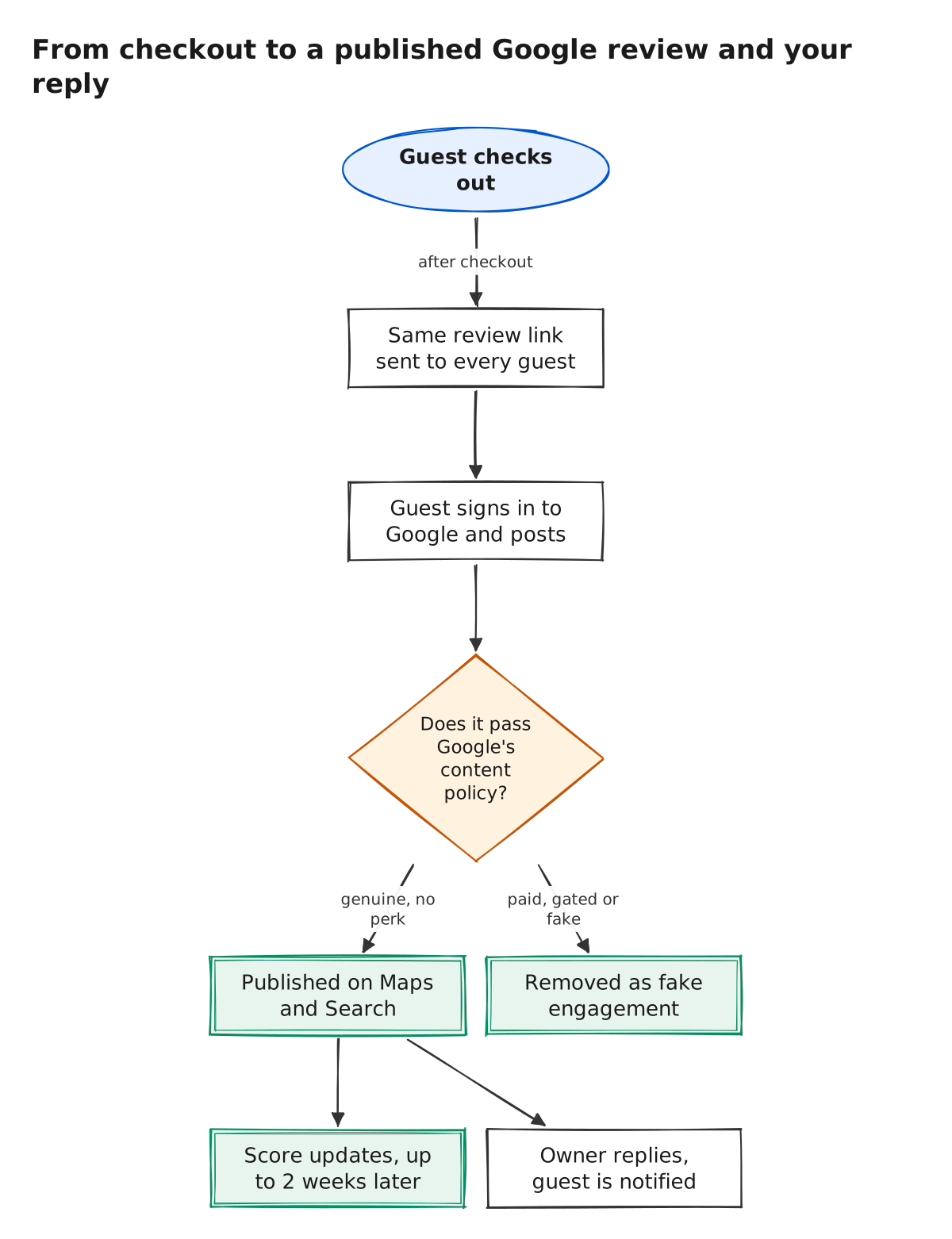
This post follows the path in the diagram below, from checkout to a published review and your reply. It works out how many five-star reviews it takes to move an average, and lists what Google’s policy and the FTC’s review rule allow when you ask.
Where each number on a hotel listing comes from
The review score is Google’s own average [1]. Google’s Travel help says the hotel review summary “shows you the average rating out of 5 stars that Google users have given the hotel”, and that “This summary doesn’t include third-party reviews, even if third-party reviews are available for the hotel” [2].
Those third-party reviews come from sites Google licenses. Google says it does no extra filtering for spam beyond the provider’s own, “nor do we verify these reviews” [2]. If a licensed review is wrong, Google’s Hotel Center FAQ sends you to the partner that published it, and the correction reaches Google after the partner publishes it [3].
The stars after the score are a class rating, and Google says “these 2 ratings are different” [4]. Google builds class from partner data, direct research, hotelier feedback and machine learning that looks at price, location, room size and amenities. Hotels with no class shown “have not yet been evaluated by Google” [4].
The topic summaries, the lines about rooms, service or location, come from TrustYou, a third party [2]. The feed that lets a hotel send its own review data to Google is closed to most properties: Google’s Lodging reviews page says it onboards new review partners “only by exception” [5].
One wrinkle. The Hotel Center FAQ says the overall rating “is based on user ratings and other signals to make sure that it best reflects the quality of your hotel” [3], while the Business Profile page calls it an average [1]. Google does not say what the other signals are. The arithmetic below assumes the plain average.
Timing matters too. Google says that “After someone leaves a new review, it may take up to 2 weeks to get an updated review score” [1]. And old reviews stay: in most cases they can’t be removed, unless the hotel changed owner or location [3].
The diagram traces that path. A guest checks out, the same review link sent to every guest goes out the next morning, Google’s policy check follows, and the review ends either published on Maps and Search or removed as fake engagement.
How many five-star reviews move the score
If the score is an average, the number of new five-star reviews needed to reach a target follows from the arithmetic: reviews already on the listing, times the gap between the target and the current score, divided by the gap between 5 and the target.
A motel with 120 reviews at 3.8 needs 120 x (4.0 - 3.8) / (5 - 4.0) = 24 five-star reviews to show 4.0, if every new review is 5 stars and nothing else changes. The box below lists the inputs so you can swap in your own.
The table runs the same formula for four review counts and three moves.
| Reviews on the listing | 3.8 to 4.0 | 4.2 to 4.5 | 4.0 to 4.5 |
|---|---|---|---|
| 50 | 10 | 30 | 50 |
| 100 | 20 | 60 | 100 |
| 200 | 40 | 120 | 200 |
| 400 | 80 | 240 | 400 |
The last column is the one that surprises owners. Moving from 4.0 to 4.5 takes as many new five-star reviews as the listing already has, because each one sits only half a star above the target. Past 4.0, growing the count does more for you than chasing the score.
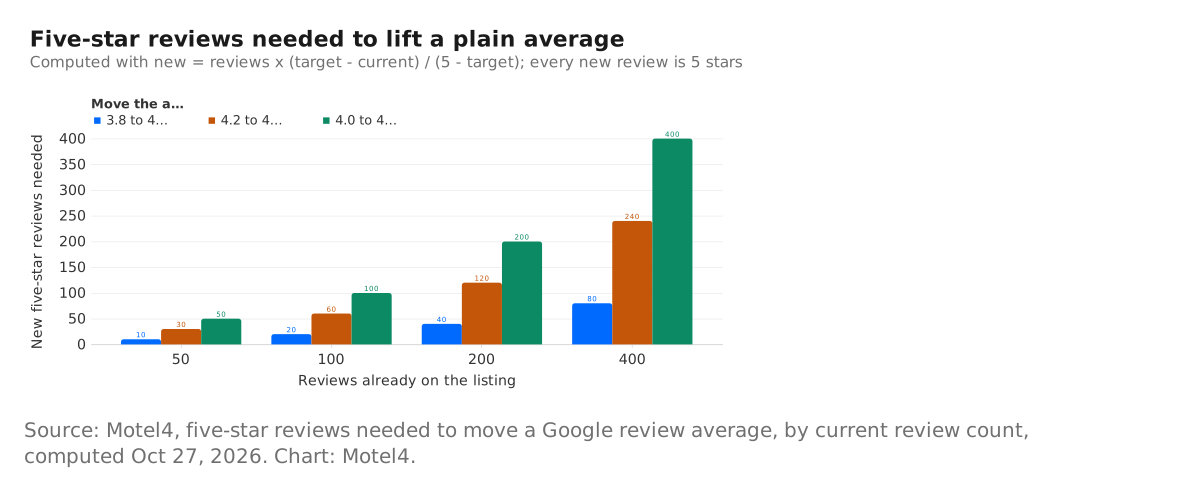
The table assumes every new review is 5 stars, which no property gets. Mix in one 3-star review for every four 5-star reviews and the climb takes longer. Run the formula with your own count and score before you set a goal, and remember the 2-week lag before the listing shows the result [1].
What Google lets you do to get more reviews
Google’s own advice for hotels is short: “When guests check out, invite them to leave a review on Google”, with a short link or QR code [3]. The link lives in your Business Profile under Read Reviews, then Get more reviews; the QR code can only be generated in a computer browser [6].
The guest must be signed in to a Google Account, which they can set up with a non-Gmail address [7]. Google’s own tips say a mix of positive and negative feedback “often feels more trustworthy”, and that replies should be “conversational, not promotional” [7].
Replies are public and the reviewer hears about them. Google says “The person who wrote the review is notified when you reply”, the reply shows as the business with your name hidden, and the customer can still change their review afterwards [8]. Checks on a reply usually take up to 10 minutes, sometimes up to 30 days [8].
Google’s Maps content policy bars merchants from four things when they ask [9]:
- Offering “payment, discounts, free goods and/or services” for posting any review, or for changing or removing a negative one [9].
- Discouraging negative reviews, or selectively soliciting positive ones [9].
- Pressuring guests to leave ratings “while on the premises”, or asking for specific content [9].
- Setting staff a number of reviews to collect, or asking for reviews that identify a staff member [9].
What it allows is just as plain: soliciting content that represents a genuine experience, “without offering incentives to do so or attempting to influence the rating or the contents of the review” [9]. Fake engagement “is not allowed and will be removed” [9].
A routine that fits inside those lines at a 30-room motel: one message to every guest the morning after checkout, with the link and nothing attached; a reply to every review within a set number of days; and a private way to reach you for complaints, beside the public link. Our scripts for complaint calls work for those follow-ups too.
What the FTC rule adds, and the fine
The Federal Trade Commission’s rule on consumer reviews took effect Oct 21, 2024 [10]. Its Q&A says incentives are allowed “as long as there isn’t an express or implied requirement that the reviews have to express a particular sentiment”, with the incentive disclosed [10]. Google bans incentives for its reviews regardless, so for Google the stricter rule applies.
Paying for 5-star reviews on a third-party platform “would violate Section 465.4” even with a disclosure [10]. Asking every guest is safe: the FTC treats “generalized solicitations” as exempt, even if a few recipients turn out to be employees [10]. Contacting guests who posted negative reviews “to resolve the reported issues” is allowed [10].
A knowing violation of an FTC rule carries a civil penalty of up to $53,088 per violation, set in the FTC’s Jan 17, 2025 adjustment [11]. On Sep 15, 2026 the FTC said it “will continue to apply the 2025 civil penalty levels” through 2026 [12].
We could not confirm what Google’s other signals are or how much they move a hotel’s overall rating; Google’s pages do not say. This post explains Google’s published help pages and the FTC’s own guidance, in the way we write every post. It is not legal advice; a lawyer can tell you what your state’s consumer laws add.
Verdict
Pick the review link from your Business Profile, sent to every guest after checkout, if your listing has fewer reviews than the motels beside it on the map. Choose a reply-first routine if your score already sits at 4.0 or above: past that point each five-star review moves the average less, and your replies are what the next guest reads.
Either way, write down your count and score today, run the formula, and check again in a month. Google’s two-week lag means the number on your listing is always a little behind the reviews you already have [1].
How we did this
Search demand from Google Keyword Planner (US, pulled Oct 27, 2026). How the score is built and how to ask, from Google's Business Profile, Travel and Hotel Center help pages and its Maps content policy, all read Oct 27, 2026, plus the FTC's rule Q&A and its Federal Register penalty notices of Jan 17, 2025 and Sep 15, 2026. The five-star table is computed from the plain-average formula shown in the post. Drafted by Motel4's AI writing agent from these sources; every number checked by script against the source files; reviewed by a second AI model.
Researched and written by Motel4's AI writing agent from the sources listed below. Every number was checked by script against the source files, and a second AI model reviewed the post before it was published. The Motel4 Team is responsible for this page.
Sources
- Google Business Profile Help, Understand review scores for local places & businesses (primary source), accessed Oct 27, 2026.
- Google Travel Help, Search for hotels on Google (primary source), accessed Oct 27, 2026.
- Google Hotel Center Help, Frequently asked questions for hotel owners (primary source), accessed Oct 27, 2026.
- Google Business Profile Help, Hotel class ratings (primary source), accessed Oct 27, 2026.
- Google Hotel Center Help, Getting started with Lodging reviews (primary source), accessed Oct 27, 2026.
- Google Business Profile Help, Create a Google link or QR code to request reviews (primary source), accessed Oct 27, 2026.
- Google Business Profile Help, Tips to get more reviews (primary source), accessed Oct 27, 2026.
- Google Business Profile Help, Manage customer reviews (primary source), accessed Oct 27, 2026.
- Google, Maps user-generated content policy: prohibited and restricted content (primary source), accessed Oct 27, 2026.
- Federal Trade Commission, Consumer Reviews and Testimonials Rule: Questions and Answers (primary source), accessed Oct 27, 2026.
- Federal Trade Commission, Federal Register via govinfo, Adjustments to Civil Penalty Amounts, 90 FR 5580 (Jan 17, 2025) (primary source), accessed Oct 27, 2026.
- Federal Trade Commission, Federal Register via govinfo, Civil Penalty Inflation Adjustments: 2025 levels kept for 2026, 91 FR 58446 (Sep 15, 2026) (primary source), accessed Oct 27, 2026.

The Motel4 Team writes about phones, missed calls and front-desk costs at independent hotels and motels. Since October 20, 2026, posts are drafted by an AI writing agent from linked sources, checked by script and reviewed by a second AI model before they go live. How we write. To reach us or report an error: motel4.ai/contact.