Campground reservation software for a 60-site park: $149 a month flat, or about $935 in booking fees

RoverPass charges $3.50 per reservation and Firefly charges $3.50 for each site booked, and both pricing pages say the park can hand that fee to the camper [1][2]. For a 60-site park, that one setting decides whether the reservation software costs about $935 a month or close to nothing.
The $935 comes from the worked example below: 60 sites at the 44.5% average occupancy Campspot reported across its parks for the second quarter of 2026, with campers staying three nights [3]. The lowest published flat monthly price we found, ReservationKey’s plan for up to 70 units, costs $149 a month, or $178 with its channel manager [4].
Google’s Keyword Planner shows 880 US searches a month for “campground reservation software,” and in our pull on Oct 21, 2026, top-of-page bids for that query ran as high as $72.92 a click, so expect ads first. Every price below comes from the vendor’s own pricing page.
We read seven vendors’ pricing pages on Oct 21, 2026 and applied each price to one 60-site park. Motel4 publishes this post. We sell an AI phone receptionist for hotels and motels; none of these reservation systems is ours, and we earn nothing from any of them. You can read how we write these posts.
Prices, checked Oct 21, 2026
Each row is the vendor’s own published price applied to a 60-site park, before card processing, taxes and add-ons.
| Software and plan | Price for 60 sites | How the price is set | Who pays the fee | Source |
|---|---|---|---|---|
| ReservationKey | $149 a month | Flat, up to 70 units | No booking fee | [4] |
| ReservationKey with channel manager | $178 a month | $149 plus a $29 add-on | No booking fee | [4] |
| RoverPass Small parks | $99 a month or $3.50 per reservation, whichever is more | Per reservation, $99 minimum | Park or camper | [1] |
| RoverPass Medium parks | $3.50 per reservation | Per reservation, no minimum | Park or camper | [1] |
| Firefly | $3.50 per site booked | Per unit in each reservation | Park or camper | [2] |
| Checkfront | $99 a month plus 3% of online bookings | Flat plus a share of online sales | Park or guest | [5] |
| Campground Master | $795 once, then $100 a year | Licence for one computer | No booking fee from the vendor | [6] |
| Campspot Growth Package | Not published | Booking fee on online reservations | Camper online; park pays a reservation fee it can offset with a surcharge (amount not published) | [7] |
| Staylist ApexOS | Not published | Quote | Not stated | [8] |
A channel manager pushes your open sites to booking sites and pulls their reservations back into your calendar. Firefly connects to Hipcamp, Vrbo, ReserveAmerica and Airbnb at no charge, though its page says to go to each one for its own pricing [2]. RoverPass includes a channel manager at every tier [1], and ReservationKey charges $29 a month for one [4].
Flat plans start at $149 a month for 60 sites
ReservationKey: the lowest published monthly bill
ReservationKey lists campgrounds among the businesses it serves and prices by unit count, with “No long-term contracts, no booking commissions, and no per-user fees” [4]. Its $149 plan covers up to 70 units and includes a booking engine, website hosting, integrated payments and automated emails [4].
Who it fits: a park that takes most bookings itself, by phone, walk-in or its own website, and wants a bill that never moves. Watch out for the unit tiers: from 71 units the price is $192 a month [4], so count cabins and overflow sites before you pick one.
Checkfront: $99 a month plus 3% of online sales
Checkfront costs $99 a month plus 3% of each online booking, with no fee on bookings you take offline, and you choose whether the guest pays the 3% [5]. It is a general booking system; its accommodation page names campgrounds next to eco-lodges, guest houses and bed and breakfasts [9].
A 3% fee matches a $3.50 fee on a booking worth about $117, so on the booking fee alone Checkfront takes less than RoverPass or Firefly on stays under that amount and more on anything dearer, before its $99 base [5].
It also charges nothing on phone bookings, which matters if campers still call to book; our post on why online guests still pick up the phone covers that habit for hotels.
Campground Master: pay once, add online booking separately
Campground Master costs $795 for a licence on one computer, with no monthly fees, and support and updates are free for the first year and $100 a year after that [6]. Networking extra computers costs $500 for the first three [6]. You set it up yourself: the vendor says hands-on training is not available [6].
Online booking comes from a separate company. The buying page says that at the time of writing it cost “$500 for setup and 4% commission on each reservation”, but the page carries no date, so ask for a current quote [6].
Per-booking plans cost the park nothing only when campers pay
RoverPass: $3.50 a reservation, with a $99 floor for small parks
Small parks pay a $99 monthly minimum, and each $3.50 reservation fee counts toward it, so “you pay the greater of the two and never both” [1]. Past about 30 reservations a month the minimum stops mattering, so a busy 60-site park pays $3.50 a reservation on either tier. Large parks can negotiate from $1.50 [1].
The fee buys the full platform at every tier, including the channel manager, point of sale and dynamic pricing [1]. RoverPass says passing the fee to campers at checkout “is how many parks run with no software cost of their own” [1].
Firefly: $3.50 for every site in a booking
Firefly charges “$3.50/per unit service fee for each new unit booked in a reservation”, so a group that books three sites pays three fees, and each long-term guest costs $3.50 a month [2].
It has no setup fees or contracts, card processing runs through the processor you connect, and its FAQ goes further: you “can even charge a higher fee and pocket the difference” [2].
Campspot and Staylist: no published price
Campspot says it serves more than 3,500 parks, and its Growth Package lists a “Guest-paid booking fee for online reservations only”, no setup fees, no long-term contracts and no per-site charge [7]. But Campspot’s own FAQ on that page says many parks add a surcharge to offset the Campspot reservation fee [7]; without that surcharge, the park pays. Its service agreement leaves the fees to each park’s order form and lets Campspot give guests discounts out of its own booking fee [10].
On Campspot’s guest FAQ, the fee “will appear as a separate charge from Campspot on your credit card statement” [11]. We found no page that states the amount, so get it in writing before a demo. Staylist’s pricing page for its ApexOS platform is a quote form, “priced to your portfolio” [8].
At 60 sites, $3.50 a booking adds up to about $935 a month
The inputs are 60 sites, the 44.5% average occupancy Campspot reported for April to June 2026 [3], a 30-night month, three-night average stays, and RoverPass’s $3.50 fee [1]. Swap in your own occupancy and average stay.
That is $934.50 a month if the park pays every fee. Stay length matters as much as occupancy, because the fee is charged per reservation, not per night:
| Average stay | Reservations a month | Fees if the park pays |
|---|---|---|
| 2 nights | 401 | $1,402 |
| 3 nights | 267 | $935 |
| 5 nights | 160 | $561 |
| 7 nights | 114 | $401 |
ReservationKey with its channel manager costs $178 in every row [4]. A park-paid $3.50 fee only costs less below about 51 reservations a month, which at this occupancy means average stays of about 16 nights. That describes a park of mostly long-stay RV guests, not a weekend campground.
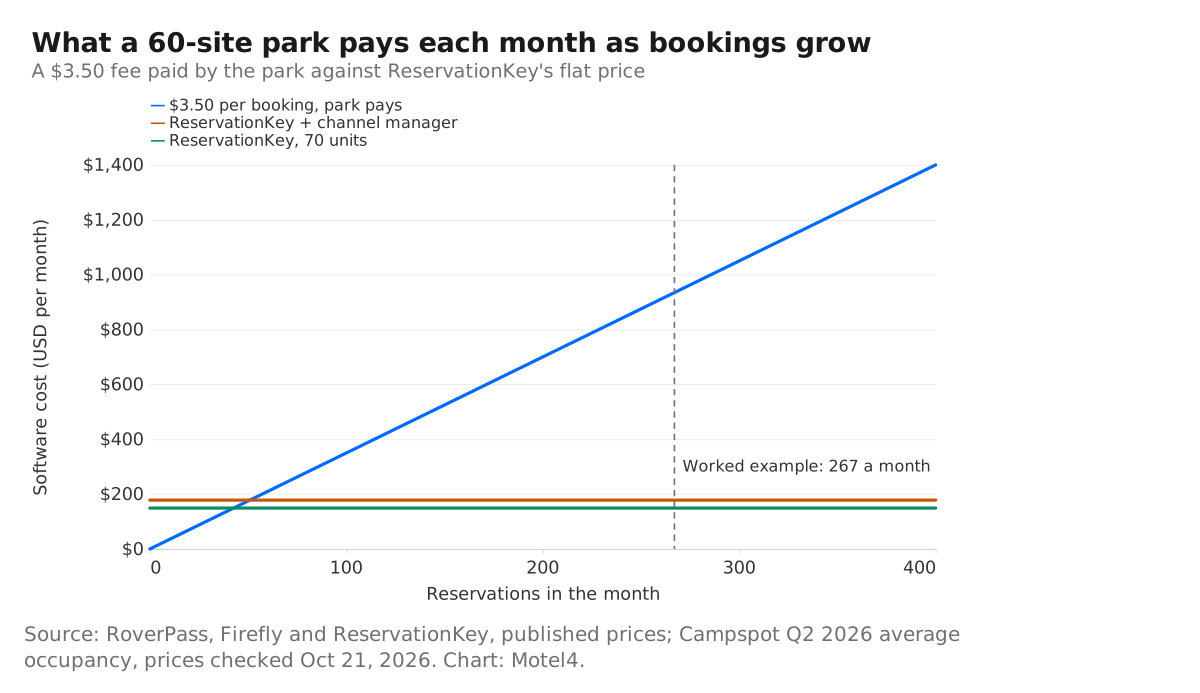
To be fair, the two prices do not buy the same tools. RoverPass’s fee includes a point of sale and dynamic pricing [1], while the included-features list on ReservationKey’s pricing page names neither [4]. A park that would pay for a camp store register or pricing tool elsewhere should add that cost to the flat column.
Passing the fee to campers changes the price you must show
If campers pay the fee, it becomes part of your price. The FTC’s Rule on Unfair or Deceptive Fees, in force since May 12, 2025, requires a business that advertises short-term lodging to show the total price “more prominently than any other pricing information” [12][13].
A booking fee every online camper pays is one of the “fees or charges a consumer must pay” that the rule puts in that total [12].
The rule covers “temporary sleeping accommodations at a hotel, motel, inn, short-term rental, vacation rental, or other place of lodging” [12].
We could not confirm whether the FTC treats a tent or RV site as lodging. The rule’s Federal Register notice never mentions campgrounds [12], and the staff guide lists hotels, motels, inns, vacation rentals and home shares without them [13]. A cabin or glamping tent rented by the night fits the wording more plainly.
The guide does cover fees like these: an intermediary that charges a fee the seller passes on must “give the seller accurate information about the fee so the seller can include this mandatory fee in the total price” [13].
If the rule applies to your sites, Firefly’s suggestion to charge more than the fee and keep the difference changes nothing: the camper still has to see the full amount up front.
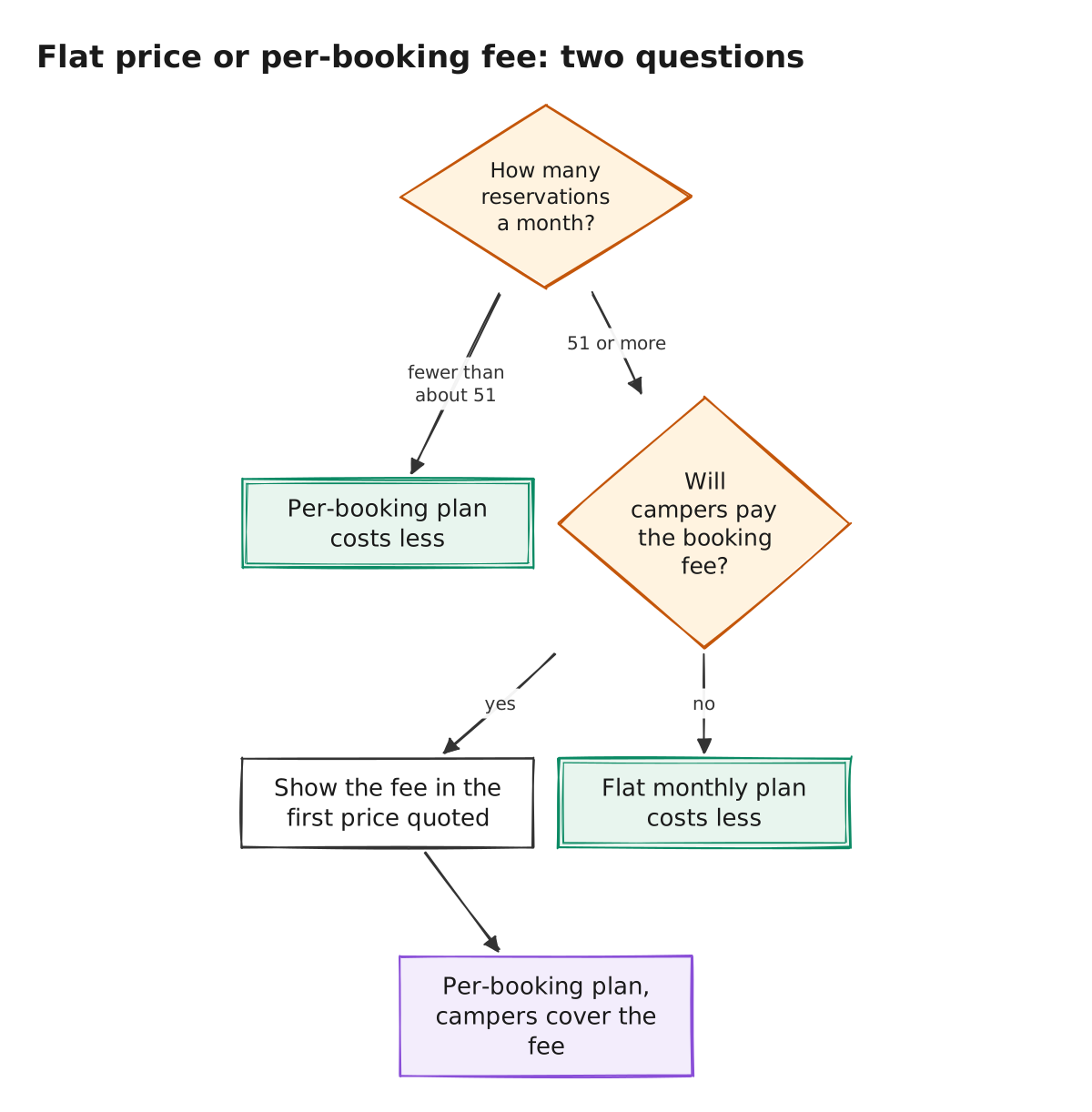
The safe habit costs nothing: show the fee in the first price quoted, on your website and on the phone, instead of adding it at checkout. And if campers will not pay the booking fee, the flat monthly plan costs less at 60 sites.
Verdict
Pick ReservationKey if you take most bookings yourself and want the lowest published monthly bill at 60 sites: $149, or $178 with the channel manager [4]. Choose RoverPass or Firefly if you will pass the $3.50 fee to campers and show it in the first price they see, or if most of your guests stay for weeks.
Pick Campground Master if one office computer runs the park and you would rather pay once. Choose Checkfront if many campers book by phone, since offline bookings carry no fee. Ask Campspot and Staylist for the booking fee in writing before you sit through a demo.
Whatever you pick, rerun the math with your own numbers before you sign: sites times occupancy times 30, divided by your average stay, times the fee. If the answer sits above the flat price, the real question is whether your campers will pay the difference.
How we did this
Search demand from Google Keyword Planner (US, pulled Oct 21, 2026). Prices from each vendor's public pricing page, checked Oct 21, 2026; occupancy from Campspot's Q2 2026 Data Dig post; fee rules from the FTC's final rule (16 CFR Part 464) in the Federal Register and the FTC's staff guide, read Oct 21, 2026. Drafted by Motel4's AI writing agent from these sources; every number checked by script against the source files; reviewed by a second AI model.
Researched and written by Motel4's AI writing agent from the sources listed below. Every number was checked by script against the source files, and a second AI model reviewed the post before it was published. The Motel4 Team is responsible for this page.
Sources
- RoverPass, RoverPass pricing, plans and per-reservation fees (primary source), accessed Oct 21, 2026.
- Firefly Reservations, Firefly Reservations pricing (primary source), accessed Oct 21, 2026.
- Campspot, Mid-Year Booking Trends: What the Data Says about the Rest of 2026, accessed Oct 21, 2026.
- ReservationKey, ReservationKey pricing table and calculator (primary source), accessed Oct 21, 2026.
- Checkfront, Checkfront pricing (primary source), accessed Oct 21, 2026.
- Cottonwood Software, Campground Master: where do I start (buying guide and prices) (primary source), accessed Oct 21, 2026.
- Campspot, Campspot software pricing (primary source), accessed Oct 21, 2026.
- Staylist, Hospitality property management software pricing (primary source), accessed Oct 21, 2026.
- Checkfront, Accommodation booking software, accessed Oct 21, 2026.
- Campspot, Campspot Service Agreement, updated Dec 20, 2024 (primary source), accessed Oct 21, 2026.
- Campspot, Campspot frequently asked questions: fees and payments, accessed Oct 21, 2026.
- Federal Trade Commission, in the Federal Register via GPO govinfo, Trade Regulation Rule on Unfair or Deceptive Fees (16 CFR Part 464), final rule, Jan 10, 2025 (primary source), accessed Oct 21, 2026.
- Federal Trade Commission, via the Internet Archive Wayback Machine, Rule on Unfair or Deceptive Fees: Frequently Asked Questions (Wayback Machine capture) (primary source), accessed Oct 21, 2026.
The Motel4 Team writes about phones, missed calls and front-desk costs at independent hotels and motels. Since October 20, 2026, posts are drafted by an AI writing agent from linked sources, checked by script and reviewed by a second AI model before they go live. How we write. To reach us or report an error: motel4.ai/contact.