A motel pool is a public pool under the federal drain law, so every drain needs a certified cover
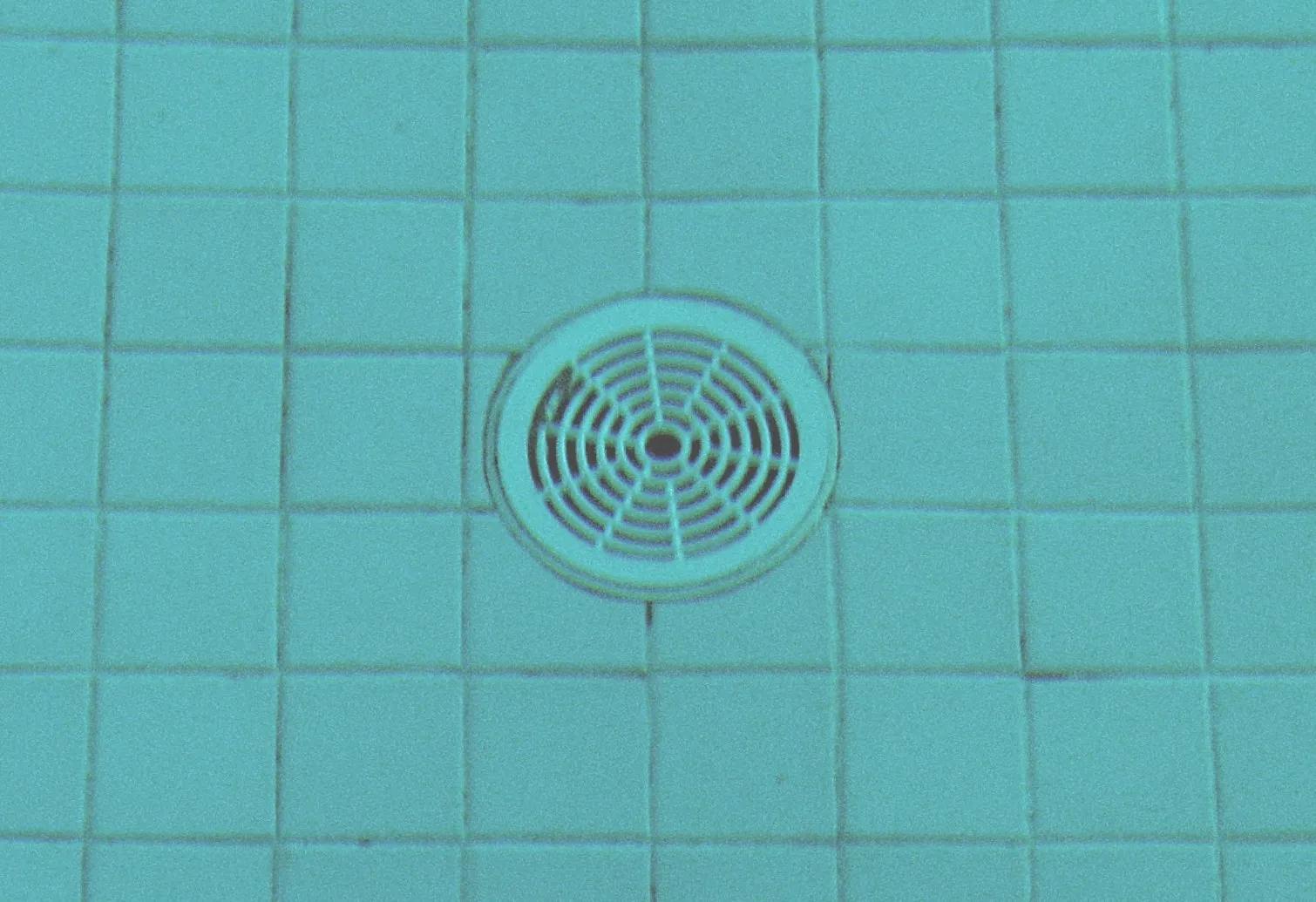

Federal law treats a motel pool as a public pool. The Virginia Graeme Baker Pool and Spa Safety Act names pools and spas open to “patrons of a hotel or other public accommodations facility” among the public pools that must carry anti-entrapment drain protection [1]. That rule has applied since December 19, 2008 [2].
The hazard it targets is rare and sits where the public swims. Staff at the U.S. Consumer Product Safety Commission (CPSC) counted 33 victims of drain and suction entrapment from 2009 through 2013, and 21 of them were in public settings [3]. From 2014 through 2018 they counted 11 more, all children under 15; two died in home spas [4].
For an owner the risk is also practical. The CDC’s Model Aquatic Health Code, voluntary guidance written for the agencies that regulate public pools, lists a “broken, unsecured, or missing main drain grate” among the imminent health hazards that let an inspector order an immediate fix or close the pool on the spot [5].
This post covers what the federal law requires, the paperwork an inspector can ask for, and what CPSC’s incident files show about hotels and motels. It is not legal advice, and your state or county code may add rules. How we research and check posts like this one is on how we write.
A motel pool or hot tub counts as a public pool under the Act
The definition in 15 U.S.C. § 8003(c)(2) has three parts: pools open to the public, for a fee or free; pools open only to members, residents or “patrons of a hotel or other public accommodations facility”; and pools the federal government runs for service members, federal employees and their families [1]. A motel pool fits the second part even when only registered guests may swim.
Hot tubs count too. The Act defines “swimming pool” and “spa” to include hot tubs, spas, portable spas and non-portable wading pools, indoors or out [6]. That matters because spas accounted for 7 of the 11 victims CPSC counted from 2014 through 2018, and 57 percent of those spa victims were hurt at nonresidential locations, such as a hotel or motel [4].
Every drain needs a certified cover, and a single drain needs a backup
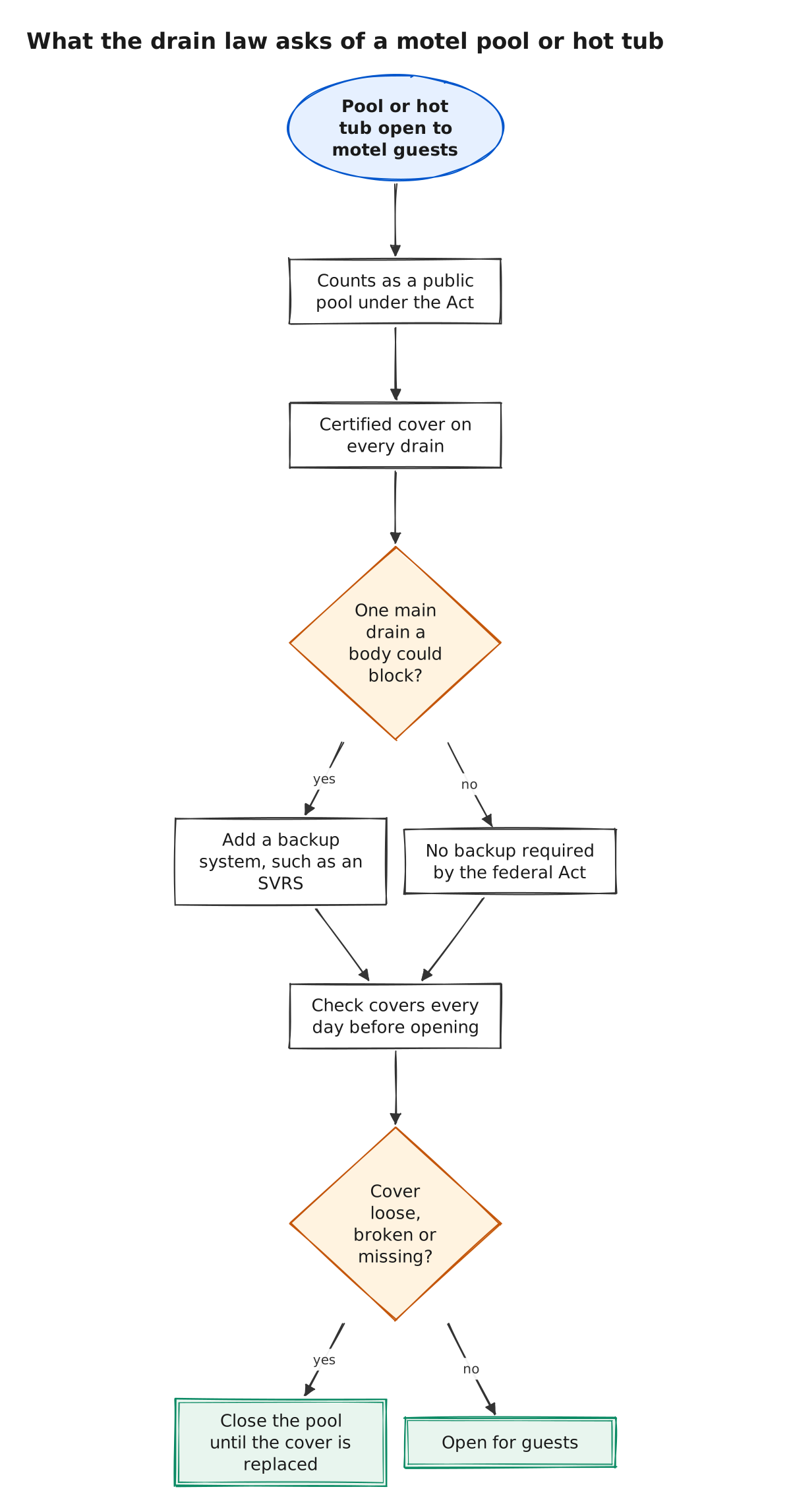
The Act asks two things of a public pool or spa. First, every drain must have anti-entrapment covers or devices that meet the federal standard [1]. That standard began as ASME/ANSI A112.19.8, and the federal rule now points to its successor, ANSI/APSP/ICC-16 2017 [7].
Second, a pool or spa with a single main drain, other than an unblockable one, needs at least one more layer of protection [1]. The statute lists six options:
- a safety vacuum release system (SVRS), which stops the pump, reverses the flow or breaks the vacuum when a drain is blocked
- a suction-limiting vent system with a tamper-resistant opening to the air
- a gravity drainage system that uses a collector tank
- an automatic pump shut-off system
- a device or system that disables the drain
- any other system CPSC finds equally effective [1]
An unblockable drain is one that a human body cannot block enough to create a suction hazard, whatever its size and shape [6]. A pool with two or more main drains, or with an unblockable drain, still needs certified covers, but there is no backup required by the federal Act.
The Act treats a violation as a violation of section 19(a)(1) of the Consumer Product Safety Act, so CPSC can enforce it like any other product-safety rule [1].
Drain covers wear out, and inspectors can ask for their rated life
Florida’s health department asks pool owners to report the rated life of each drain cover. Its form DH 4157 asks for every suction outlet cover’s make and model, installation date, approved flow in gallons per minute and “Life Years” [8]. The same form asks which backup system is installed and which licensed contractor installed it [8].
The CDC model code covers the daily side. Loose, broken or missing suction outlet covers must be secured or replaced immediately, the pool stays closed until the repair is done, and the maker’s documents for every cover and sump go into the facility’s permanent records [5].
Its operator training list includes a daily check that drain and other suction outlet covers “are in place, secure, and unbroken” and that entrapment prevention systems work [5].
As a routine at a small motel, that comes down to five habits:
- Before the pool opens, look at every drain, skimmer equalizer and vacuum fitting cover; each must be in place, secure and unbroken [5].
- If one is loose, broken or missing, close the pool until the cover is replaced [5].
- Keep one folder with each cover’s make, model, installation date, flow rating and rated life, plus the backup system’s manual [8].
- Replace a cover before its rated life runs out, and test the SVRS or shut-off as its manual says; Florida’s form has owners commit to that testing [8].
- When the pool closes, change what the front desk and the phone greeting say about it, and use a checklist for finding gaps in how your phones are answered to catch the places it still says “open”.
What went wrong in the hotel and motel cases
CPSC’s two most recent public entrapment reports describe every incident in a short narrative, and we read all of them. Of the 44 victims from 2009 through 2018, six were caught in a hotel or motel pool, hot tub or indoor lazy river, and three more in whirlpool bathtubs in hotel rooms [3][4]. Three of the six:
- In 2010 a 4-year-old girl sat on a spa filter intake at a motel. The drain was lacking a cover, and the spa pump had no vacuum safety release system [3].
- In 2018 a 12-year-old boy lifted a grate off a drain sump in a hotel’s indoor lazy river. His leg was caught, and he was underwater for almost eight minutes [4].
- In 2014 a 12-year-old girl’s hair caught in a hotel hot tub’s filter, and her grandfather had to cut her hair to pull her out [4].
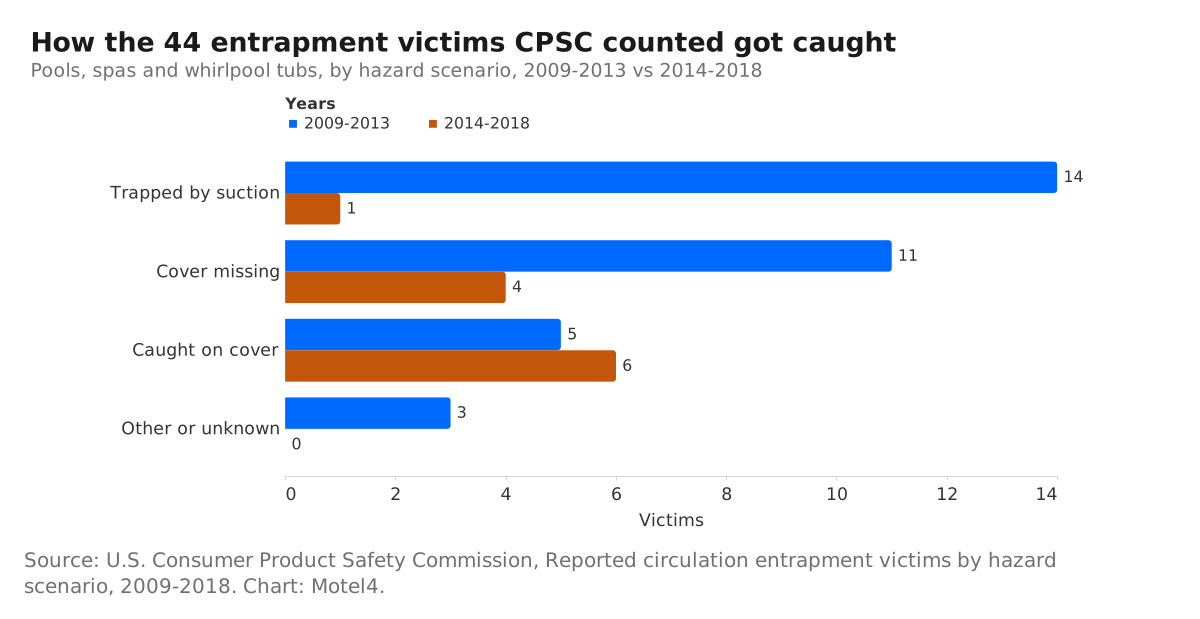
Across all 44 victims, a missing or removed cover played a part in 15, the same number as victims held by suction alone [3][4]. In 2014-2018 the most common pattern was hair caught on a cover: 6 of the 11 victims [4].
On December 19, 2017, CPSC said the law’s first decade had passed with zero drain entrapment deaths of children in public pools and spas [9]. The injuries above show the limit of that record: a certified cover protects swimmers only while it is on, screwed down and within its rated life.
We could not confirm what your state adds to the federal rule. Florida, for example, requires the backup device to be installed by a licensed pool contractor [8], and CPSC’s newest public entrapment report we found ends in 2018. Before you buy covers or a backup system, ask your state or county health department which ones it accepts.
Verdict
Do a cover audit this week if you cannot name the make, installation date and rated life of every drain cover in your pool and hot tub; that is the record Florida’s form asks for and the CDC model code tells operators to keep [5][8].
Add a backup system, such as an SVRS, if your pool or spa has one main drain a body could block.
Graeme Baker was 7 when she died after a hot tub drain entrapment in 2002 [9]. In CPSC’s latest report, 10 of the 11 victims were caught at a drain whose cover was missing or snagged their hair [4]. The cover is the part of the pool an owner can check every morning.
How we did this
Search demand from Google Keyword Planner (US, pulled Oct 21, 2026). Law text from 15 U.S.C. §§ 8002-8003 and 16 CFR 1450.3; incident counts and narratives from the CPSC entrapment reports published in 2014 and 2019, with the hotel and motel cases counted by us; inspection rules from the CDC Model Aquatic Health Code (2024) and Florida form DH 4157; all accessed Oct 21, 2026. Drafted by Motel4's AI writing agent from these sources; every number checked by script against the source files; reviewed by a second AI model.
Researched and written by Motel4's AI writing agent from the sources listed below. Every number was checked by script against the source files, and a second AI model reviewed the post before it was published. The Motel4 Team is responsible for this page.
Sources
- Legal Information Institute, Cornell Law School, 15 U.S. Code § 8003, Federal swimming pool and spa drain cover standard (primary source), accessed Oct 21, 2026.
- U.S. Consumer Product Safety Commission, Pool Safely, About Pool Safely and the Virginia Graeme Baker Pool & Spa Safety Act (primary source), accessed Oct 21, 2026.
- U.S. Consumer Product Safety Commission, 2009-2013 Reported Circulation/Suction Entrapment Incidents Associated with Pools, Spas, and Whirlpool Bathtubs, 2014 Report (primary source), accessed Oct 21, 2026.
- U.S. Consumer Product Safety Commission, 2014-2018 Reported Circulation/Suction Entrapment Incidents Associated with Pools, Spas, and Whirlpool Bathtubs, 2019 Report (primary source), accessed Oct 21, 2026.
- U.S. Centers for Disease Control and Prevention, Model Aquatic Health Code, 5th Edition (2024) (primary source), accessed Oct 21, 2026.
- Legal Information Institute, Cornell Law School, 15 U.S. Code § 8002, Definitions (primary source), accessed Oct 21, 2026.
- Legal Information Institute, Cornell Law School, 16 CFR § 1450.3, Incorporation by reference (primary source), accessed Oct 21, 2026.
- Florida Department of Health, Form DH 4157, Pool Owner/Operator Verification of Entrapment Safety Features (primary source), accessed Oct 21, 2026.
- U.S. Consumer Product Safety Commission, CPSC Hails Successes of Virginia Graeme Baker Pool & Spa Safety Act as Law Hits 10-Year Mark (primary source), accessed Oct 21, 2026.

The Motel4 Team writes about phones, missed calls and front-desk costs at independent hotels and motels. Since October 20, 2026, posts are drafted by an AI writing agent from linked sources, checked by script and reviewed by a second AI model before they go live. How we write. To reach us or report an error: motel4.ai/contact.