Preventive maintenance for a 30-room motel: the monthly round alone is about 76 hours a year

GE Appliances says the most important thing an owner can do for its Zoneline wall units is to clean the filters at least every 30 days [1]. That one line is a better start for a hotel preventive maintenance checklist than most templates online, because it comes from the company that built the machine, and it tells you how often.
The rest of the calendar is written down in the same way: by your fire code, by a federal statute on guest-room smoke detectors and by the manuals for what you own. It matters because a fire official can ask for the logs. Minnesota’s State Fire Marshal inspects every lodging building with six or more guest rooms every three years [2].
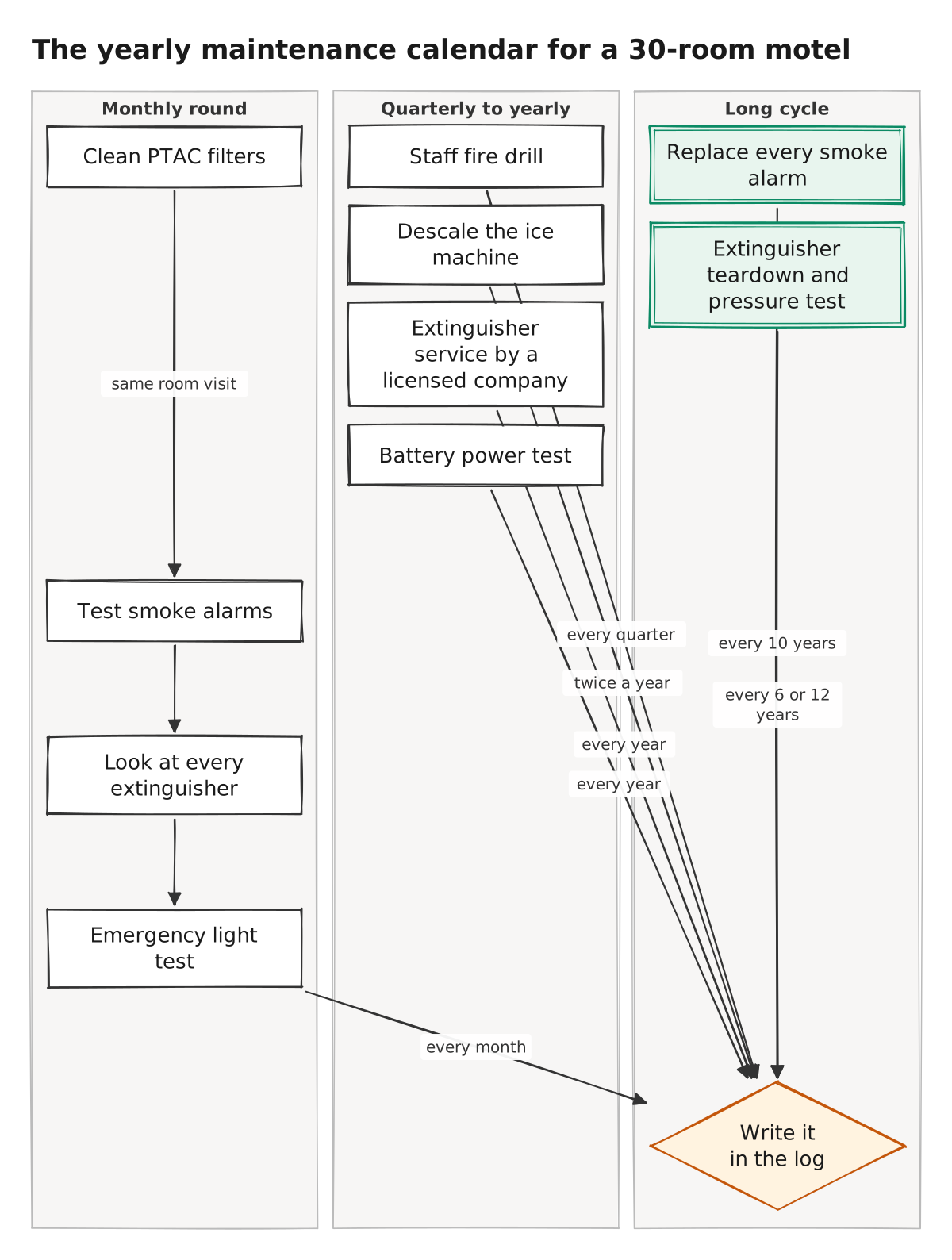
The monthly round covers filters, smoke alarms, extinguishers and exit lights
Four checks come around every month, and three of them sit in or near guest rooms, so they fit in one walk. Schedule it for mid-morning, after checkout and well before the evening check-in rush, when rooms are empty and the desk is quiet.
- Clean PTAC filters. GE’s Zoneline units typically have 2 air filters, and GE says to check them weekly and clean them monthly [1]. Other makers print their own intervals, so use the manual for your model.
- Test smoke alarms. The U.S. Fire Administration says to test the alarm monthly [3]. Federal law, 15 U.S.C. 2225, calls for hard-wired, single-station smoke detectors in each guest room of a place of public accommodation [4].
- Look at every extinguisher. The OSHA rule for employers, 29 CFR 1910.157, says portable extinguishers “shall be visually inspected monthly” [5].
- Run the emergency light test. Seattle’s fire department wants a monthly activation test in which battery lighting stays on for at least 30 seconds [6].
Minnesota’s hotel guidance spells out what the extinguisher look means: each one is in its designated place, the safety seal is intact, fullness is checked by weighing or lifting, and a tag carries the date and the inspector’s initials [7]. Staff can do it; it does not need a contractor.
Minnesota sets the same monthly 30-second test for battery emergency lights and EXIT signs, and wants written records kept for the fire code official [8]. Seattle adds that the record should name the light’s location, pass or fail, the date and the person who tested it [6].
The monthly round takes about 75.6 hours a year at 30 rooms
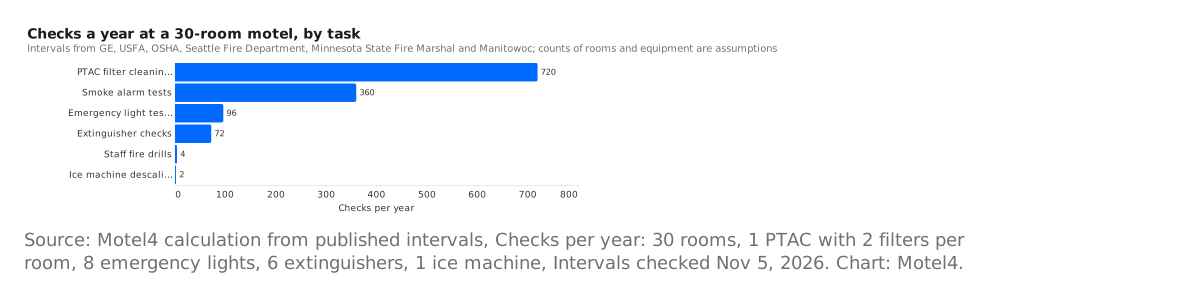
For a 30-room motel with one PTAC unit and one smoke alarm per room, the round is two filters and one alarm test in every room, plus the extinguishers. With the minutes per task we assumed below, it comes to 75.6 hours a year, a little over six hours a month.
That is 720 filter cleanings and 360 smoke alarm tests a year before anyone touches an extinguisher. Add an assumed 8 emergency lights and 6 extinguishers and the monthly round adds 96 light tests and 72 extinguisher checks. The chart further down shows how lopsided the year is: the in-room tasks are most of the work.
The minutes are our assumptions, not measurements. If your filters are disposable rather than washable, or your alarms are interconnected and tested from one panel, the time falls. Time yourself on one floor next month and replace our numbers with yours.
Quarterly, twice-yearly and yearly tasks are drills, ice and the contractor visit
Between the monthly round and the 10-year replacements sit a handful of tasks, and most of them need either a log entry or an outside company.
- Quarterly: staff fire drills. Minnesota’s fire code asks for fire drills quarterly for all employees, held at unexpected times, with a record of who ran the drill, when, who took part and how long the evacuation took [9].
- Twice a year: the ice machine. Manitowoc’s manual for its NEO undercounter machines says to “De-scale and sanitize the ice machine every six months” and to clean the condenser at least every six months [10].
- Yearly: extinguisher service. OSHA requires an annual maintenance check [5], and Minnesota says it must be performed by an approved extinguisher servicing company [7].
- Yearly: emergency light battery test. Seattle’s annual power test runs battery lighting for at least 90 minutes [6].
- Yearly: smoke alarm batteries. The U.S. Fire Administration says to replace the batteries at least once every year in alarms that use them [3].
Skipping the ice machine shows up as slow failure rather than a sudden one. A dirty condenser, Manitowoc warns, raises operating temperatures, cuts ice production and shortens component life [10]. Put the two descaling dates on the calendar in spring and fall, before the busy seasons rather than during them.
Long-cycle items most hotel preventive maintenance checklists leave out
Some tasks come around only every 6, 10 or 12 years [3] [5], and they are the ones a monthly template never shows. They need a written install date, or nobody will know they are due.
- Smoke alarms: replace the entire alarm every 10 years, according to the U.S. Fire Administration [3]. A motel that put alarms in all 30 rooms in the same year will need all 30 again in the same year.
- Dry chemical extinguishers: emptied and serviced every 6 years, and hydrostatic tested every 12 years, under 29 CFR 1910.157 [5].
- Water extinguishers: hydrostatic tested every 5 years [5].
- Nonrechargeable extinguishers: Minnesota says to remove them from service 12 years from the date of manufacture [7].
Sprinklers are the item many motel owners can skip on the federal side. The federal guideline in 15 U.S.C. 2225 asks for an automatic sprinkler system except in places that are 3 stories or lower [4], which leaves out the typical one- or two-story motel. If your building has sprinklers anyway, get the inspection schedule in writing from your sprinkler contractor.
The same test has different rules in different cities
Two fire officials publishing guidance for the same kind of building disagree on one of the yearly tests. Seattle’s annual emergency light test runs at least 90 minutes [6]. Minnesota’s hotel page asks for an annual 30-minute power test [8]. A battery that passes in Minneapolis can fail the same test in Seattle.
On records the two agree. Seattle says test records should stay on the premises for at least three years [6], and Minnesota recommends keeping emergency light logs for at least three years [8]. Seattle’s memo also lists sleeping units in hotels and motels among the places where emergency lighting is recommended but not required; the rule is for corridors, stairways and exits [6].
We could not confirm which fire code edition your city or county has adopted, and that choice decides several intervals on this calendar. This post is not legal advice.
Before you print the calendar, call your local fire marshal’s office and ask three things: how long the annual emergency light test must run, whether staff fire drills are required and how often, and how long logs must be kept.
Verdict
Pick the in-house monthly round if someone on staff can give it about six hours a month; at 30 rooms that is the 75.6-hour year worked out above. Choose an approved extinguisher servicing company for the yearly service even if staff do everything else: OSHA requires the annual check [5], and Minnesota, for one, says only a servicing company may do it [7].
Then do the one thing the generic lists skip: write the install year of every smoke alarm and the last test date of every extinguisher into the log this month. The 10-year alarm replacement [3] and the 12-year extinguisher test [5] are the dates that arrive without warning.
How we did this
Search demand from Google Keyword Planner (US, pulled Nov 5, 2026). Intervals from 15 U.S.C. 2225, 29 CFR 1910.157, the U.S. Fire Administration, the Minnesota State Fire Marshal, the Seattle Fire Department, GE Appliances and Manitowoc, each page checked Nov 5, 2026. Room counts, equipment counts and minutes per task are stated assumptions. Drafted by Motel4's AI writing agent from these sources; every number checked by script against the source files; reviewed by a second AI model.
Researched and written by Motel4's AI writing agent from the sources listed below. Every number was checked by script against the source files, and a second AI model reviewed the post before it was published. The Motel4 Team is responsible for this page.
Sources
- GE Appliances, Zoneline Air Conditioner - Cleaning Filter (primary source), accessed Nov 5, 2026.
- Minnesota State Fire Marshal, Hotels and motels inspections (primary source), accessed Nov 5, 2026.
- U.S. Fire Administration, Smoke alarms (primary source), accessed Nov 5, 2026.
- Legal Information Institute, Cornell Law School, 15 U.S. Code 2225, Fire prevention and control guidelines for places of public accommodation (primary source), accessed Nov 5, 2026.
- Legal Information Institute, Cornell Law School (OSHA regulation), 29 CFR 1910.157, Portable fire extinguishers (primary source), accessed Nov 5, 2026.
- Seattle Fire Department, Client Assistance Memo 5974: Emergency lighting requirements, testing and inspection (primary source), accessed Nov 5, 2026.
- Minnesota State Fire Marshal, Hotel fire extinguishers (primary source), accessed Nov 5, 2026.
- Minnesota State Fire Marshal, Hotel emergency lights (primary source), accessed Nov 5, 2026.
- Minnesota State Fire Marshal, Hotel fire drills (primary source), accessed Nov 5, 2026.
- Manitowoc Ice, NEO UnderCounter Ice Machines: Installation, Operation and Maintenance Manual (040005890 Rev 07) (primary source), accessed Nov 5, 2026.

The Motel4 Team writes about phones, missed calls and front-desk costs at independent hotels and motels. Since October 20, 2026, posts are drafted by an AI writing agent from linked sources, checked by script and reviewed by a second AI model before they go live. How we write. To reach us or report an error: motel4.ai/contact.