Credit card surcharges at a motel: a 3% cap, three state bans and a script for phone bookings

Visa’s rulebook, in its April 18, 2026 edition, settles the size question for US merchants in one line: “The Credit Card Surcharge maximum amount is 3.00%” [1]. The same rules say that on a booking taken by phone, the clerk must tell the caller the surcharge amount out loud, and the caller must get the chance to cancel after hearing it [1].
For a small motel the fee is real money. At $40,000 of card sales a month with 60% on credit cards, a 3% surcharge brings in $720 a month, as the math below shows. Three states ban the fee outright, others set caps of their own, and the federal fee rule can push it into the rate you advertise.
In our Google Keyword Planner pull from Oct 21, 2026, credit card surcharge laws drew about 90 US searches a month, and is it legal to charge a credit card fee about 480.
This post covers the three sets of rules a US motel has to clear, what to say at the desk, online and on the phone, and what the fee is worth. It explains the rule texts and is not legal advice.
Three sets of rules decide whether you can add the fee
Three layers apply at once. The card networks set the cap, the notice and the cards you may charge it on [1][2]. Your state can ban the fee or cap it lower, and Mastercard’s own page says its rules do not change what state law requires [2].
The Federal Trade Commission’s fee rule then decides where the fee has to sit in the price you advertise [3].
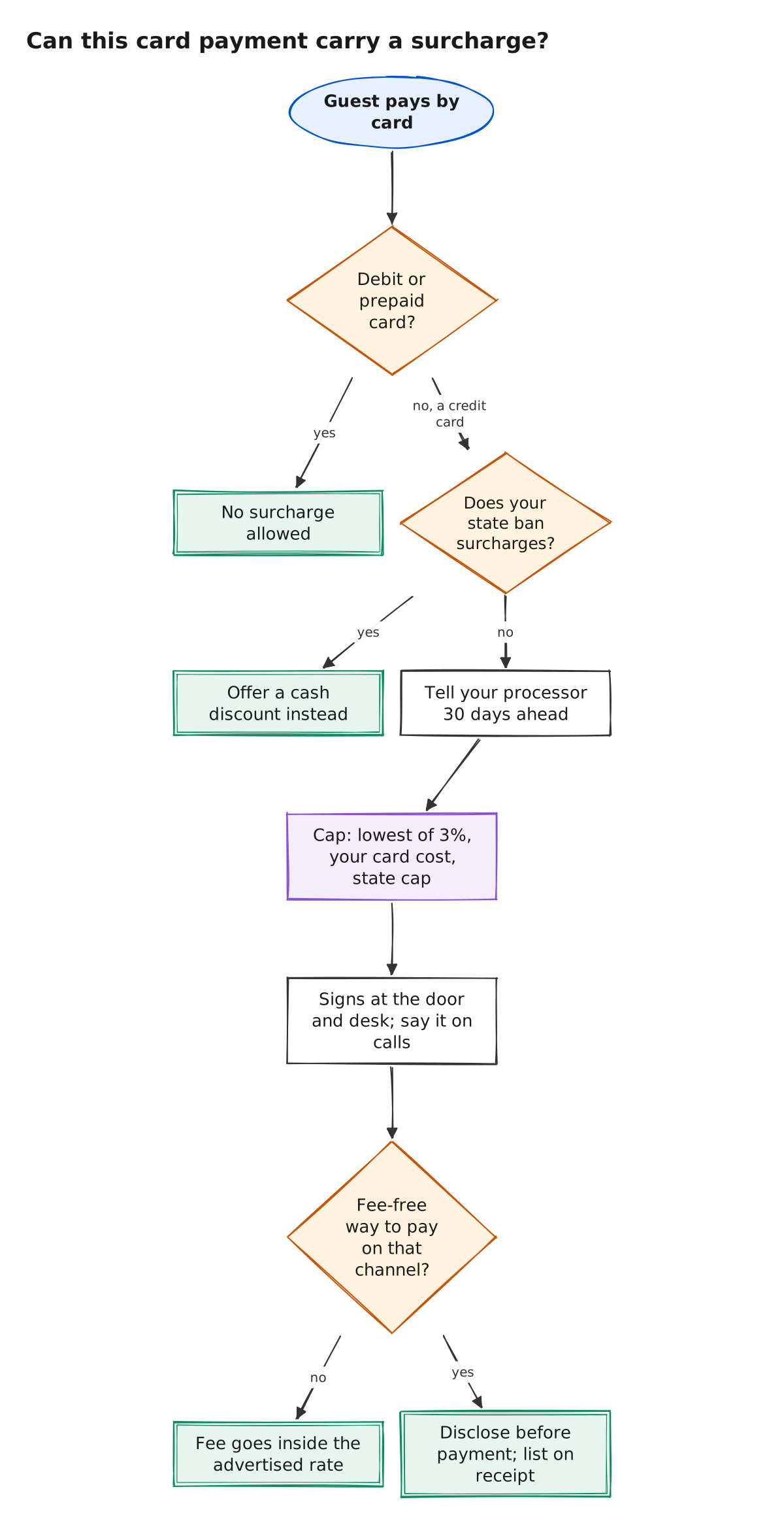
The diagram walks one card payment through all three layers. A debit or prepaid card stops at the first box: no surcharge allowed. A credit card in a state that bans surcharges stops at the second, where the legal move is to offer a cash discount instead.
Visa and Mastercard cap it at 3% and 4%, on credit cards only
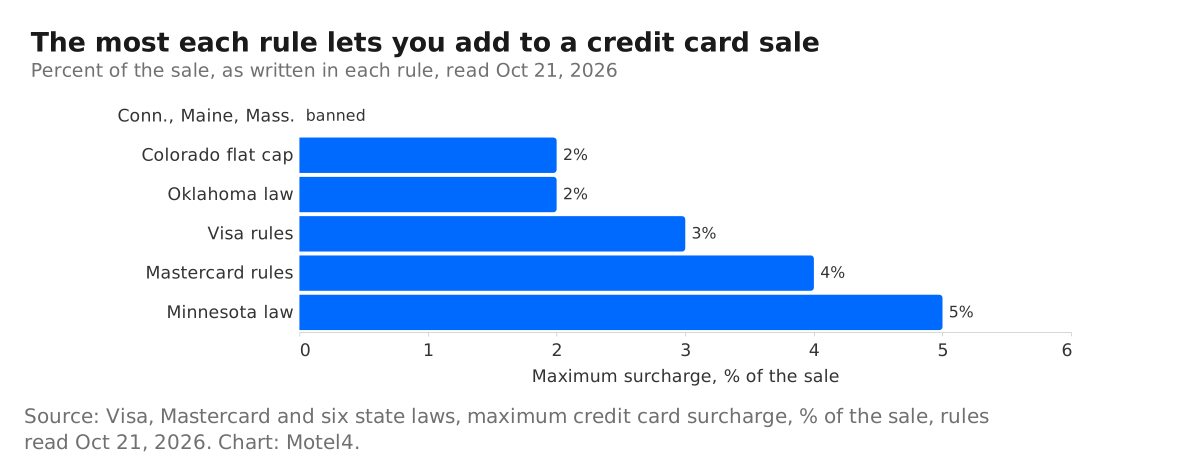
Visa’s US maximum is 3.00%, and the surcharge may not exceed what you actually pay to accept Visa credit cards [1]. Visa’s merchant Q&A puts the test in plain words: your merchant discount rate “or 3% whichever is lowest” [4]. Mastercard’s Maximum Surcharge Cap is 4%, also limited to your average effective merchant discount rate for Mastercard credit cards [2].
Most of the other rules are the same at both networks:
- Tell your processor 30 days ahead. Visa wants written notice to your acquirer, the bank or processor that settles your card sales, at least 30 calendar days before you publicly announce the surcharge or before you first charge it, whichever is earlier [1]. Mastercard wants the same 30 days’ notice, to both Mastercard and your acquirer, before you start charging it [2].
- Credit cards only. Debit and prepaid cards cannot carry a surcharge at either network [1][2][4]. Visa adds that a debit card stays a debit card even when the guest presses the credit button on the terminal [1].
- One rate per brand or per card type. Visa lets you surcharge all its credit cards at one rate, or one credit product type at one rate, but not both [1].
- Put it on the receipt. Visa wants the surcharge as a separate charge on the receipt [4], and Mastercard wants its dollar amount there [2].
- Refund it with the room. When you refund a stay, the surcharge goes back too, and on a partial refund it is pro-rated [1].
Visa says it enforces these rules with a yearly mystery-shopping program run by outside auditors, and the acquirer of a merchant caught surcharging improperly may face an immediate US $1,000 fine [4].
Credit card surcharge laws by state: three bans and four caps
We read the statute or the state’s own guidance for seven states on Oct 21, 2026. Three ban the fee for private businesses, and four allow it with their own limits.
| State | Surcharge on credit cards | Cap | What else it says | Source |
|---|---|---|---|---|
| Connecticut | Banned for any payment type | None allowed | A cash discount is allowed if you post it, or list cash and card prices side by side | [5] |
| Maine | Banned on credit and debit cards | None allowed | A discount from the regular price is not a surcharge | [6] |
| Massachusetts | Banned | None allowed | A cash discount offered to all buyers is allowed | [7] |
| Colorado | Allowed | 2% of the total, or your merchant discount fee under a second option | Sign on the premises; notice before an online sale is completed | [8] |
| Minnesota | Allowed | 5% of the price | Tell the caller out loud | [9] |
| New York | Allowed | What your card company charges you | Post the total price for paying by credit card, surcharge included | [10] |
| Oklahoma | Allowed since Nov 1, 2025 | 2% or your actual cost, whichever is less | Say it out loud on the phone | [11][12] |
Renaming the fee does not get around a ban. Connecticut’s Department of Consumer Protection says a card fee shown on the receipt as a “transaction fee”, “processing fee” or “non-cash adjustment” is still a surcharge [5].
Minnesota: a civil penalty of up to $500 plus a refund of the surcharge to every buyer [9]. New York: up to $500 per violation [10].
Oklahoma is the reminder that these laws move. Senate Bill 677, which repeals the state’s old ban on credit and debit card surcharges, became law on May 28, 2025 without the governor’s signature [11]. The Oklahoma Bar Association’s summary says the fee is allowed from Nov 1, 2025, capped at 2% or your cost [12].
Visa’s own Q&A, dated Feb 15, 2024, still lists Oklahoma among the states that prohibit surcharging [4].
Phone and online bookings need the notice before the charge
A motel takes many payments away from the terminal, and Visa’s rules set a notice for each channel [1]:
- At the front desk: a notice at the main entrance in at least 32-point Arial, and another at the payment point in at least 16-point [1].
- Online: on the first page that mentions the card brands you accept and on the checkout page, in at least 10-point type [1]. Oklahoma also names your home page [12].
- On the phone: in Visa’s words, “Verbal notice from the telephone order clerk, including Credit Card Surcharge amount”, and then the caller may cancel [1].
Minnesota and Oklahoma put the spoken notice into state law as well [9][12]. On a call it can be one short script, using Visa’s 3% cap [1]:
We add a 3% fee to credit card payments, which is $9 on tonight’s $300 total. Debit cards and cash have no fee. Would you like to book with that card?
Add it to your front desk phone scripts next to the rate quote.
Whoever answers after hours needs the same sentence. If that is an answering service or an AI receptionist (Motel4 sells one), put the surcharge wording into the information it answers from.
The FTC’s fee rule decides where the fee shows up in your price. Its guide says a card fee is mandatory, and belongs in the total price, when a credit card is the only way to pay [3].
If another payment method with no fee works “at the same location or platform”, the fee can stay out of the first price, but it must be disclosed and added before the guest pays [3].
For a motel the platform test bites hardest online. If your booking engine takes credit cards and nothing else, the fee goes inside the advertised rate there [3]. If it also takes debit cards with no fee, the FTC’s own example treats that as a real alternative [3].
Two states point the same way. Under Oklahoma’s new law, a business that accepts only credit cards may not treat the card fee as the guest’s choice [12], and New York asks every seller that surcharges to post the total credit card price [10].
What a 3% surcharge recovers at a 30-room motel
This assumes a 30-room motel that takes $40,000 a month on cards, with 60% of it on credit cards. Both numbers are ours, picked for illustration; use your own from last month’s processor statement. The rate is Visa’s 3% ceiling.
The result is $720 a month. The credit card share moves it more than anything else:
| Case | Credit cards’ share of card sales | Surcharge collected a month |
|---|---|---|
| Low | 40% | $480 |
| Mid | 60% | $720 |
| High | 80% | $960 |
Under Oklahoma’s cap, or Colorado’s flat 2% option, the mid case drops to $480 a month [8][12]. Against that, count the work: every sign, booking page, phone script and receipt changes, and your terminal and booking engine have to skip debit cards every time [1].
This assumes your processor charges you at least 3% on credit cards. If it charges less, Visa holds the surcharge to your actual rate [4], and the $720 shrinks with it.
We could not confirm the law in every other state for this post. Visa’s Q&A lists New Jersey as having its own surcharge requirements and Puerto Rico as banning the fee [4]; we did not read those texts.
Check your state attorney general’s site, or ask a lawyer, before you turn a surcharge on. Our call-recording consent guide shows how much state rules for the phone can differ.
Verdict
Do not surcharge if your motel is in Connecticut, Maine or Massachusetts; a posted cash discount is the legal route there [5][6][7].
Choose a surcharge if most of your card sales are on credit cards, your processor can leave debit cards alone automatically, and everyone who answers your phone will say the fee before taking a card.
Pick a higher room rate instead if your booking engine takes only credit cards, because the FTC rule puts the fee into the advertised rate anyway [3].
If you surcharge, send the 30-day notice, to your acquirer and to Mastercard too if you take Mastercard, before you announce it or first charge it, whichever is earlier [1][2]. Recheck your state’s statute once a year regardless: Oklahoma’s flipped in 2025 [11], and the next change will not come with a letter. Read how we write these posts if you want to see how we checked the rules.
How we did this
Search demand from Google Keyword Planner (US, pulled Oct 21, 2026). Card network rules from the Visa Core Rules (April 18, 2026 edition), Visa's merchant surcharge Q&A and Mastercard's merchant surcharge page; state rules from the statute texts of Maine, Massachusetts, Colorado, Minnesota and New York, Oklahoma's Senate Bill 677 and Connecticut's consumer protection department; the FTC's fee rule guide. All read Oct 21, 2026. Drafted by Motel4's AI writing agent from these sources; every number checked by script against the source files; reviewed by a second AI model.
Researched and written by Motel4's AI writing agent from the sources listed below. Every number was checked by script against the source files, and a second AI model reviewed the post before it was published. The Motel4 Team is responsible for this page.
Sources
- Visa, Visa Core Rules and Visa Product and Service Rules, 18 April 2026 edition (primary source), accessed Oct 21, 2026.
- Mastercard, Merchant surcharge rules (primary source), accessed Oct 21, 2026.
- Federal Trade Commission, The Rule on Unfair or Deceptive Fees: Frequently Asked Questions (primary source), accessed Oct 21, 2026.
- Visa, U.S. Merchant Surcharge Q and A (version Feb 15, 2024) (primary source), accessed Oct 21, 2026.
- Connecticut Department of Consumer Protection, Credit card surcharge (Connecticut General Statutes section 42-133ff as amended by Public Act 24-142) (primary source), accessed Oct 21, 2026.
- Maine Legislature, Title 9-A, section 8-509, credit card and debit card surcharge prohibition (primary source), accessed Oct 21, 2026.
- Massachusetts Legislature, General Laws chapter 140D, section 28A, cardholder discounts and surcharges (primary source), accessed Oct 21, 2026.
- Colorado General Assembly, Colorado Revised Statutes 2024, Title 5, section 5-2-212, surcharges on credit transactions (primary source), accessed Oct 21, 2026.
- Minnesota Office of the Revisor of Statutes, Minnesota Statutes section 325G.051, surcharges on credit cards (primary source), accessed Oct 21, 2026.
- New York State Senate, General Business Law section 518, credit card surcharge notice requirement (primary source), accessed Oct 21, 2026.
- Oklahoma Legislature, Bill information for SB 677 (2025): surcharges, repealing the prohibition on credit and debit card surcharges (primary source), accessed Oct 21, 2026.
- Oklahoma Bar Association, Client credit card fees: what lawyers need to know about Oklahoma's new law, accessed Oct 21, 2026.

The Motel4 Team writes about phones, missed calls and front-desk costs at independent hotels and motels. Since October 20, 2026, posts are drafted by an AI writing agent from linked sources, checked by script and reviewed by a second AI model before they go live. How we write. To reach us or report an error: motel4.ai/contact.