IRS data: owner-run hotels, motels and B&Bs lost 11.6% of receipts in 2023; the profitable 44% kept 17.8%
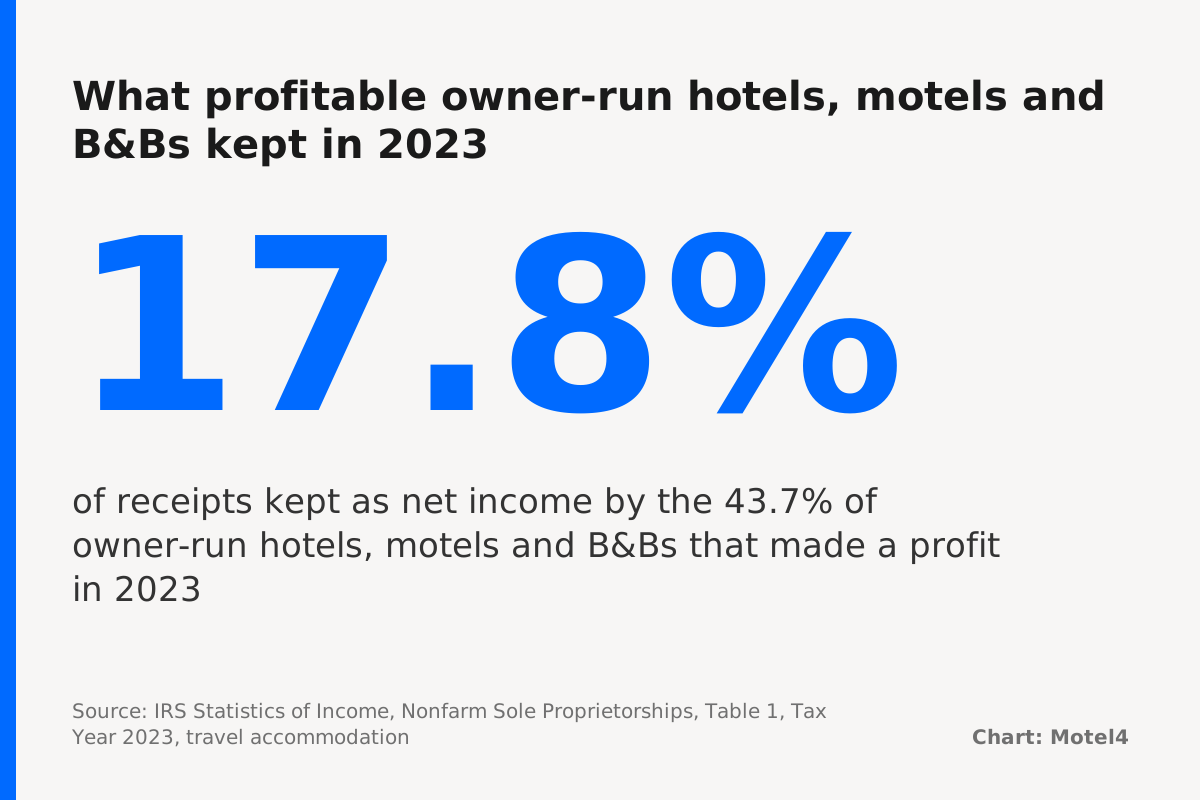
Hotels, motels and bed-and-breakfasts run as sole proprietorships reported $5.9 billion in receipts for tax year 2023 and a combined net loss of $682 million, according to the IRS Statistics of Income division [1]. That is a margin of minus 11.6%.
The average hides two groups. Of 53,829 returns, 43.7% showed a profit, and those owners kept 17.8 cents of every dollar of receipts [1]. The rest lost $1.27 billion between them. If you are asking about hotel profit margin, the profitable group is the benchmark worth using.
Owners with a profit kept 16 to 23 cents per dollar in every year from 2014 to 2023
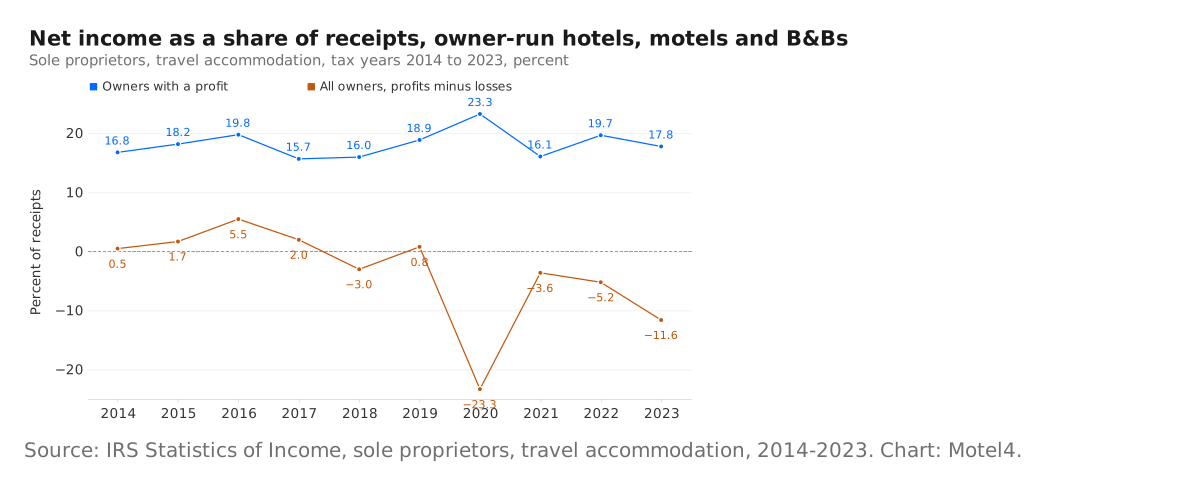
Across the ten tax years from 2014 to 2023, owners with a profit kept between 15.7% and 23.3% of receipts [1]. The group as a whole swung from plus 5.5% in 2016 to minus 23.3% in 2020, the pandemic year, and has stayed below zero since [1].
The share of owners showing a profit moved between 41.4% and 77.4%, which is why the combined line jumps around [1]. In 2023 it was 43.7%, the second-lowest of the ten years.
Depreciation and interest explain most of the loss
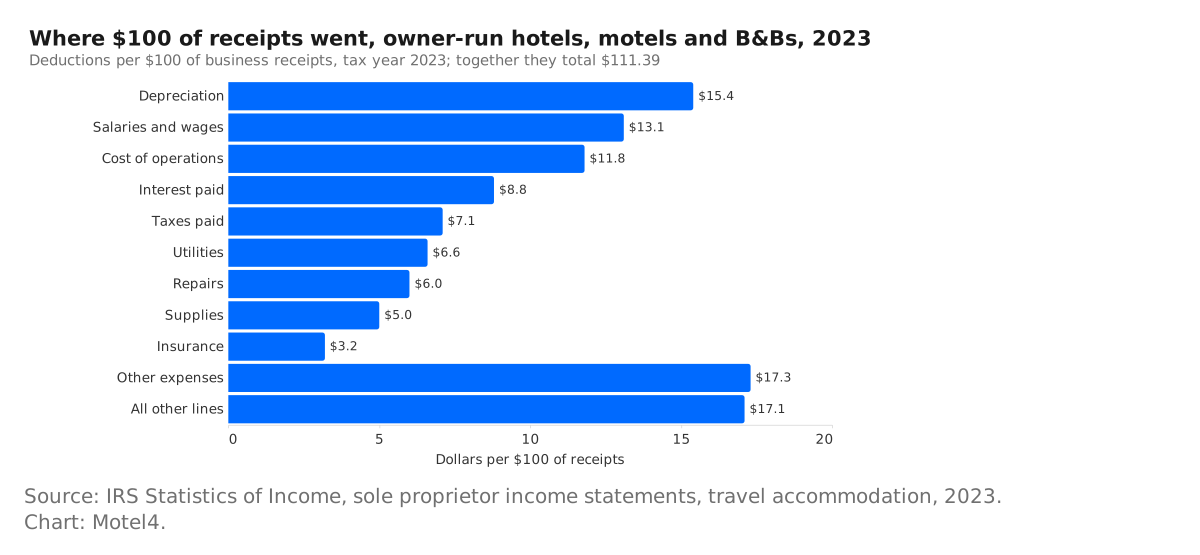
For every $100 of receipts in 2023, the group deducted $15.44 of depreciation, $13.12 of wages, $8.83 of interest, $7.05 of taxes and $6.63 of utilities [1]. All deductions together came to $111.39.
Depreciation is a yearly deduction that recovers, over time, the cost of property used for more than a year [2]. Add it back and the group’s loss becomes a profit of 3.9% of receipts. Add interest back too and it is 12.7%, the figure to compare with a seller’s cash flow before loan payments [1].
One cost is missing on purpose. The Schedule C instructions say not to count “amounts paid to yourself” as wages [2]. So the 17.8% kept by profitable owners also has to pay for the owner’s own hours at the front desk.
To run the same test on your own Schedule C:
- Divide line 31, net profit or loss, by line 1, gross receipts [2]. Compare the result with 17.8%.
- Add back line 13, depreciation, and lines 16a and 16b, interest, then divide by line 1 again [2]. Compare that with the 12.7% the whole group showed in 2023 [1].
Corporations across the industry reported 13.6%, but they are a different group
Corporations in the whole accommodation industry reported net income, after losses, of 13.6% of total receipts in tax year 2022, the newest corporate year in the IRS tables [3]. Their margin was 12.8% in 2014 and minus 14.1% in 2020 [3].
That industry also covers casino hotels, RV parks and rooming houses, which the federal industry codes place in the same accommodation group as hotels and motels [4]. Use the corporate figure as context, not as a target for a small property.
How we got the numbers
We downloaded the IRS sole proprietorship Table 1 for each tax year from 2014 to 2023 and kept the row for travel accommodation, which the IRS labels as including hotels, motels and bed-and-breakfast inns [1]. Margin is net income less deficit divided by business receipts. For 2023 we also used Table 2, the full income statement.
The corporate figures come from the Corporation Complete Report, Table 1, row Accommodation [3]. The data files are published with this post, and our notes on how we write explain how every number was checked.
What the numbers do not tell you
To be fair, these are sample-based estimates of tax figures, not audited hotel accounts. The average return showed $109,532 of receipts in 2023, which points to small businesses [1]. A tax return’s bottom line also follows tax rules, such as depreciation, rather than a buyer’s view of cash flow [2].
Hotels owned through partnerships are not in either set: the IRS partnership tables group lodging with restaurants [5]. And the sole proprietorship row mixes motels with bed-and-breakfasts, so it cannot isolate a 30-room roadside motel.
Verdict
Use 17.8% as your benchmark if you own and run a hotel, motel or B&B yourself: it is what the profitable owners kept in 2023, after depreciation and interest but before paying themselves [1][2].
Do the add-back if a seller shows you a tax loss, because the same 2023 group goes from minus 11.6% to plus 12.7% once depreciation and interest are put back [1].
The combined margin has been below zero for four years running, and the IRS has not yet posted 2024 tables [1]. When it does, check whether the profitable share climbs back above half.
How we did this
Data from IRS Statistics of Income: Nonfarm Sole Proprietorships Table 1 (tax years 2014 to 2023) and Table 2 (2023), and the Corporation Complete Report Table 1 (2014 to 2022), downloaded Oct 21, 2026; the data files are published with this post. Search demand from Google Keyword Planner (US, pulled Oct 21, 2026). Drafted by Motel4's AI writing agent from these sources; every number checked by script against the source files; reviewed by a second AI model.
Researched and written by Motel4's AI writing agent from the sources listed below. Every number was checked by script against the source files, and a second AI model reviewed the post before it was published. The Motel4 Team is responsible for this page.
Sources
- Internal Revenue Service, Statistics of Income, Nonfarm Sole Proprietorship Statistics, Tables 1 and 2, tax years 2014 to 2023 (primary source), accessed Oct 21, 2026.
- Internal Revenue Service, Instructions for Schedule C (Form 1040) (primary source), accessed Oct 21, 2026.
- Internal Revenue Service, Statistics of Income, Corporation Complete Report, Table 1 by minor industry, tax years 2014 to 2022 (primary source), accessed Oct 21, 2026.
- U.S. Census Bureau, NAICS 2017 industry descriptions (primary source), accessed Oct 21, 2026.
- Internal Revenue Service, Statistics of Income, Partnership Statistics by Sector or Industry, Table 1, tax year 2023 (primary source), accessed Oct 21, 2026.

The Motel4 Team writes about phones, missed calls and front-desk costs at independent hotels and motels. Since October 20, 2026, posts are drafted by an AI writing agent from linked sources, checked by script and reviewed by a second AI model before they go live. How we write. To reach us or report an error: motel4.ai/contact.