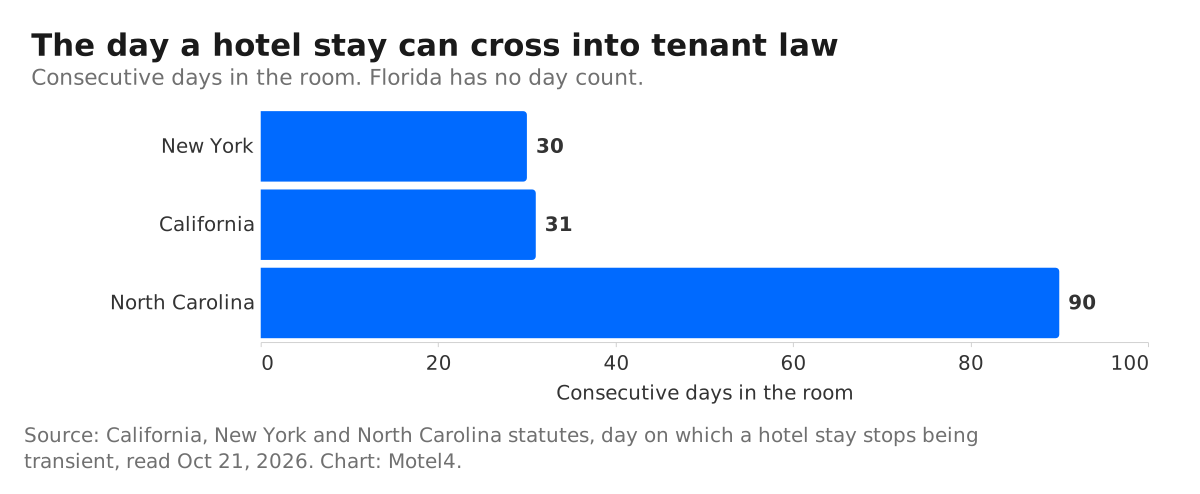
A motel guest can become a tenant after 30 days in California and New York, and 90 in North Carolina

California Civil Code section 1940 covers “tenants, lessees, boarders, lodgers, and others, however denominated,” but leaves out “transient occupancy in a hotel, motel” that is subject to the local hotel tax [1]. That tax only applies to stays of 30 days or less [2]. So a paid-up guest who stays past day 30 can step into tenant law.
That line decides how you get a room back. On the guest side, Florida lets an operator hand over a written notice and ask the police to remove a guest who will not go [3]. On the tenant side, New York says no tenant may be removed “except in a special proceeding,” which means court [4].
People search for this. Google Keyword Planner shows 40 US searches a month for “hotel tenant rights” and 30 for “hotel eviction laws” (pulled Oct 21, 2026).
This post covers four states whose statutes draw the line clearly: California, New York, North Carolina and Florida. It quotes each one, shows where the line sits, and ends with the paperwork a front desk can set up this week. If long stays are a big part of your business, our guide to extended-stay guest calls covers the phone side.
The line is a day count in three states and a lease clause in Florida
Three of the four states count days in the room. Florida does not count days; it asks what the written agreement says.
| State | Where the line sits | Statute | Source |
|---|---|---|---|
| California | Day 31: the local hotel tax covers stays of 30 days or less | Civil Code 1940, Revenue and Taxation Code 7280 | [1] [2] |
| New York | 30 consecutive days in a hotel room | RPAPL 711 | [4] |
| North Carolina | 90 consecutive days | General Statutes 72-1(c) | [5] |
| Florida | No day count; a written agreement that names the room the guest’s sole residence | Statutes 509.013(12) and 83.42(3) | [6] [7] |
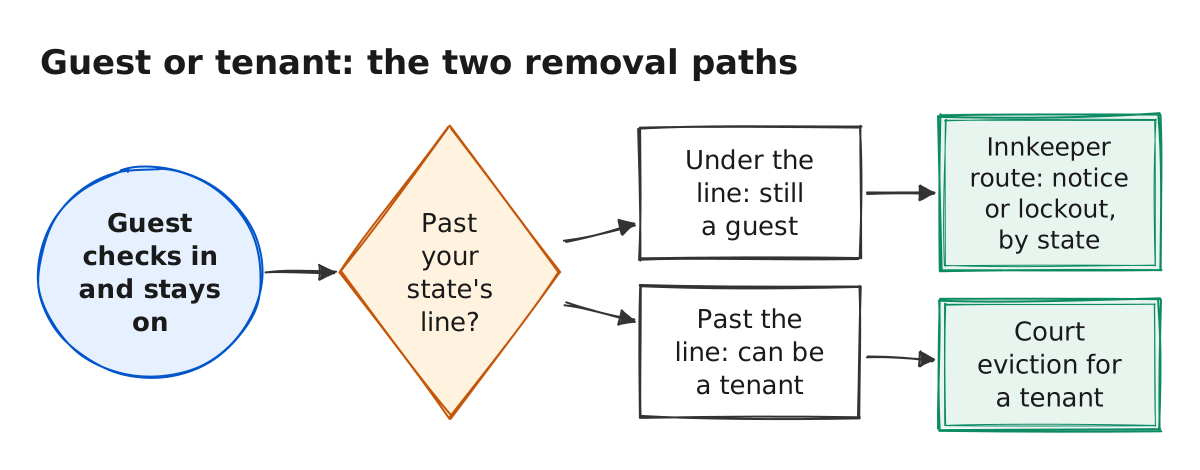
Either side of the line, the removal path changes. Short of the line, the person is a guest under innkeeper law, and the faster path is the innkeeper route: notice or lockout, by state. Florida’s is a written notice to leave, then police if the guest refuses [3]. Past your state’s line, the person can be a tenant, and a court eviction for a tenant is the path; New York allows no other [4].
California: day 31, and only for a guest who has paid
Section 1940 adds a condition that matters at the front desk. A guest who has not paid all room charges owed as of the last taxed day still does not count as a person who hires the room [1]. A long-stay guest who is behind on payment at day 30 does not pick up tenant status by staying on.
A second exclusion covers hotels that keep a right of access to the room and offer every resident five things: safekeeping for valuables, central phone service, maid, mail and room service, occupancy for periods of less than seven days, and food service from a restaurant on or next to the property tied to the owner [1].
A motel without that restaurant cannot use this second exclusion.
California also blocks the obvious workaround in one kind of property. Section 1940.1 says no one may make an occupant of a residential hotel move, or check out and re-register, before 30 days if a purpose is to keep them transient [8]. A violation carries a $500 civil penalty, and the winning side gets reasonable attorney’s fees [8].
A residential hotel, for that rule, is a building with six or more guest rooms that is also the primary residence of its guests [9]. A highway motel that mostly sells nightly stays is outside that definition, but a property that houses monthly residents may be inside it.
For ordinary guests, Civil Code section 1865 lets an innkeeper remove a guest who will not leave at the posted checkout time, on two conditions [10]. The guest signed a written notice at check-in saying the room is needed for an arriving guest, and an arriving guest really does hold a booking for that room.
Then the innkeeper may enter, take possession of the guest’s belongings, re-key the door and re-let the room. The guest gets the belongings back on request, subject to the innkeeper’s rights under sections 1861 to 1861.28 [10].
New York and North Carolina count consecutive days
New York’s Real Property Actions and Proceedings Law section 711 defines a tenant to include “a resident, not including a transient occupant, of one or more rooms in a hotel who has been in possession for thirty consecutive days or longer” [4].
The same section says no tenant or lawful occupant may be removed except in a special proceeding, which is a court case [4].
North Carolina drew its line in 2023. General Statutes section 72-1 now defines transient occupancy as a stay by the same guest “for fewer than 90 consecutive days” [5].
The same section makes a written statement of the stay period, signed or initialed by the guest, a valid contract. When that period ends, the guest may be kept out of the room and their belongings removed without liability, except for damage the removal causes [5].
The change took effect on March 19, 2023, according to a University of North Carolina School of Government blog post that advises magistrates [11]. The same session law keeps transient stays out of the state’s landlord-tenant chapter, and says an agreement for one does not create a tenancy unless it expressly provides for one [11].
That post also flags two loose ends. North Carolina has no ban on forced check-outs like California’s, and housing advocates worry “that hotel owners will force long-term residents to check out every 89 days” [11]. The session law also leaves open whether a stay of 90 days or more falls under the landlord-tenant chapter automatically [11].
Florida looks at the paperwork, not the calendar
Florida’s definitions section, last amended in 2025, says “transient occupancy” includes any stay in a hotel or motel room “unless a written rental or lease agreement expressly states that the dwelling unit is the sole residence of the guest” [6]. Florida’s landlord-tenant act does not apply to transient occupancy in a motel [7].
By the statute’s own words, the paperwork decides. Florida does use 30 days elsewhere in the same section, to sort licensed properties into transient and nontransient establishments by how they rent rooms [6].
Removal has its own rules. When a guest fails to pay or check out on time, the operator must give the notice in writing, by email, text message or printed paper [3]. The statute supplies the wording: “You are hereby notified that this establishment no longer desires to entertain you as its guest, and you are requested to leave at once” [3].
If the guest paid ahead, you must hand back the unused part of the payment, keeping payment for each day the guest has used [3]. A guest who stays after the notice commits a second-degree misdemeanor, and police must remove that guest on the operator’s request [3].
Four habits that keep the line clear
The statutes reward the same habits in every state: dates in writing, signatures at check-in, and a running count of consecutive days.
- Count consecutive days for every stay longer than two weeks, and flag each one a week before your state’s line.
- Put the stay dates in writing at check-in and get the guest’s signature or initials. In North Carolina that paper is the contract that ends the stay [5]. In California a signed checkout notice at check-in is what opens the section 1865 lockout route [10].
- In California, remember that a guest who is fully paid at day 30 and stays on can become a tenant [1], so decide before then whether you are offering a tenancy. Never make a residential-hotel occupant check out and re-register to reset the count [8].
- In Florida, keep the words “sole residence” out of weekly-rate paperwork unless you mean to create a tenancy [6], and keep the statutory notice text ready to send [3].
When a conversation about leaving turns tense at the desk, the scripts in our guide to de-escalating complaint calls can help. They do not change the legal path above.
We could not confirm how courts in each state apply these lines to unusual facts, such as a guest who checks out for one night and returns, or a room paid for by a third party. Cities can add their own rules, too: California’s section 1940.1 says its penalty comes on top of any local ordinance remedies [8].
Treat this as a map, and call a local landlord-tenant lawyer before you remove anyone near the line.
Verdict
Use the innkeeper route if the stay is short of your state’s line and you hold the paperwork your state asks for: a signed checkout notice in California, a signed stay period in North Carolina, the statutory written notice in Florida.
Choose a written lease from the first night if you want residents to stay past 30 days in California or New York, or past 90 in North Carolina. Past the line you can face a court eviction.
The checks cost almost nothing: a date on a form, a signature, a day count. North Carolina’s law leaves open what happens at day 90 [11], so that is the state to watch for the next court ruling or amendment.
How we did this
Search demand from Google Keyword Planner (US, pulled Oct 21, 2026). Statute text read on Oct 21, 2026 from the California, New York, North Carolina and Florida statute pages linked below, plus a University of North Carolina School of Government blog post. Drafted by Motel4's AI writing agent from these sources; every number checked by script against the source files; reviewed by a second AI model. Not legal advice.
Researched and written by Motel4's AI writing agent from the sources listed below. Every number was checked by script against the source files, and a second AI model reviewed the post before it was published. The Motel4 Team is responsible for this page.
Sources
- California Legislature, via California.Public.Law, California Civil Code section 1940 (persons who hire; hotel exclusions) (primary source), accessed Oct 21, 2026.
- California Legislature, via California.Public.Law, California Revenue and Taxation Code section 7280 (local transient occupancy tax) (primary source), accessed Oct 21, 2026.
- The Florida Senate, Florida Statutes section 509.141 (2026): ejection of undesirable guests (primary source), accessed Oct 21, 2026.
- New York Legislature, via NewYork.Public.Law, New York Real Property Actions and Proceedings Law section 711 (primary source), accessed Oct 21, 2026.
- North Carolina General Assembly, North Carolina General Statutes section 72-1 (innkeepers; transient occupancy) (primary source), accessed Oct 21, 2026.
- The Florida Senate, Florida Statutes section 509.013 (2026): definitions (primary source), accessed Oct 21, 2026.
- The Florida Senate, Florida Statutes section 83.42 (2026): exclusions from the landlord-tenant act (primary source), accessed Oct 21, 2026.
- California Legislature, via California.Public.Law, California Civil Code section 1940.1 (residential hotels; forced check-out) (primary source), accessed Oct 21, 2026.
- California Legislature, via California.Public.Law, California Health and Safety Code section 50519 (residential hotel defined) (primary source), accessed Oct 21, 2026.
- California Legislature, via California.Public.Law, California Civil Code section 1865 (innkeeper eviction at checkout) (primary source), accessed Oct 21, 2026.
- UNC School of Government, On the Civil Side blog, How Does New Legislation Addressing 'Transient Occupancy' Impact the Landlord-Tenant Analysis in Summary Ejectment? (Melanie Crenshaw), accessed Oct 21, 2026.

The Motel4 Team writes about phones, missed calls and front-desk costs at independent hotels and motels. Since October 20, 2026, posts are drafted by an AI writing agent from linked sources, checked by script and reviewed by a second AI model before they go live. How we write. To reach us or report an error: motel4.ai/contact.