Motel insurance: which line pays each claim, and the clause that can cut a fire payout by a fifth

The California Department of Insurance puts the trap in its Commercial Insurance Guide in two sentences: “If a building is not insured to value, you can be subject to a monetary penalty at the time of a loss. This penalty is commonly referred to as ‘coinsurance’” [1]. Most owners buy motel insurance as a package of six or more lines and never learn which line pays which claim, or that the property line can pay less than its limit suggests.
The money is real. Florida’s insurance regulator shows the penalty on a $1,000,000 building insured for $700,000 under an 80% clause: a $100,000 loss pays $87,000 [2]. Scale that to a 30-room motel with a $300,000 fire, and the worked example below pays $229,375, leaving $70,625 with the owner.
This post maps each line of a motel package to the claim it pays, using two state regulators’ guides, the SBA’s definitions and six state innkeeper statutes. The query is small: “motel insurance” drew 70 US Google searches a month in our Keyword Planner pull of Oct 31, 2026, against 390 for “hotel insurance”. The insurer pages we opened for both list the coverages and stop before the clauses that decide the payout.
Each line pays one kind of claim
The U.S. Small Business Administration describes general liability as protection against “bodily injury, property damage, medical expenses, libel, slander, defending lawsuits, and settlement bonds or judgments”, and commercial property as cover for loss from “fire, smoke, wind and hailstorms, civil disobedience and vandalism” [3]. A business owner’s policy bundles those two with business income, and the SBA says the bundle “can save you money” [3].
The table takes the claims a small motel is most likely to see and names the line that pays each one.
| The claim | The line that pays | What decides the payout | Source |
|---|---|---|---|
| Guest slips on the pool deck | General liability | The per-occurrence limit and any medical payments sub-limit | [3] |
| Kitchen fire closes a wing | Commercial property, then business income | The coinsurance clause, the deductible and the waiting period | [1] |
| Jewelry stolen from a room | Innkeeper’s liability, usually inside general liability | A state cap that applies only if you offer a safe and post the notice | [4] |
| Fired clerk files a discrimination charge | Employment practices liability | Not in a standard package; the EEOC took 88,531 such charges in FY 2024 | [5] |
| Card data stolen from the property system | Cyber liability | Not in a standard package; insurers price the controls you have in place | [6] |
| Bar guest injures a driver on the way home | Liquor liability | Excluded from general liability and sold as its own line | [1] |
| Housekeeper hurt on the job | Workers’ compensation | Required in most states; Texas does not require it of most private employers | [7] |
| River floods the ground floor | A separate NFIP flood policy | Excluded from property; the NFIP pays up to $500,000 for the building and $500,000 for contents | [8] |
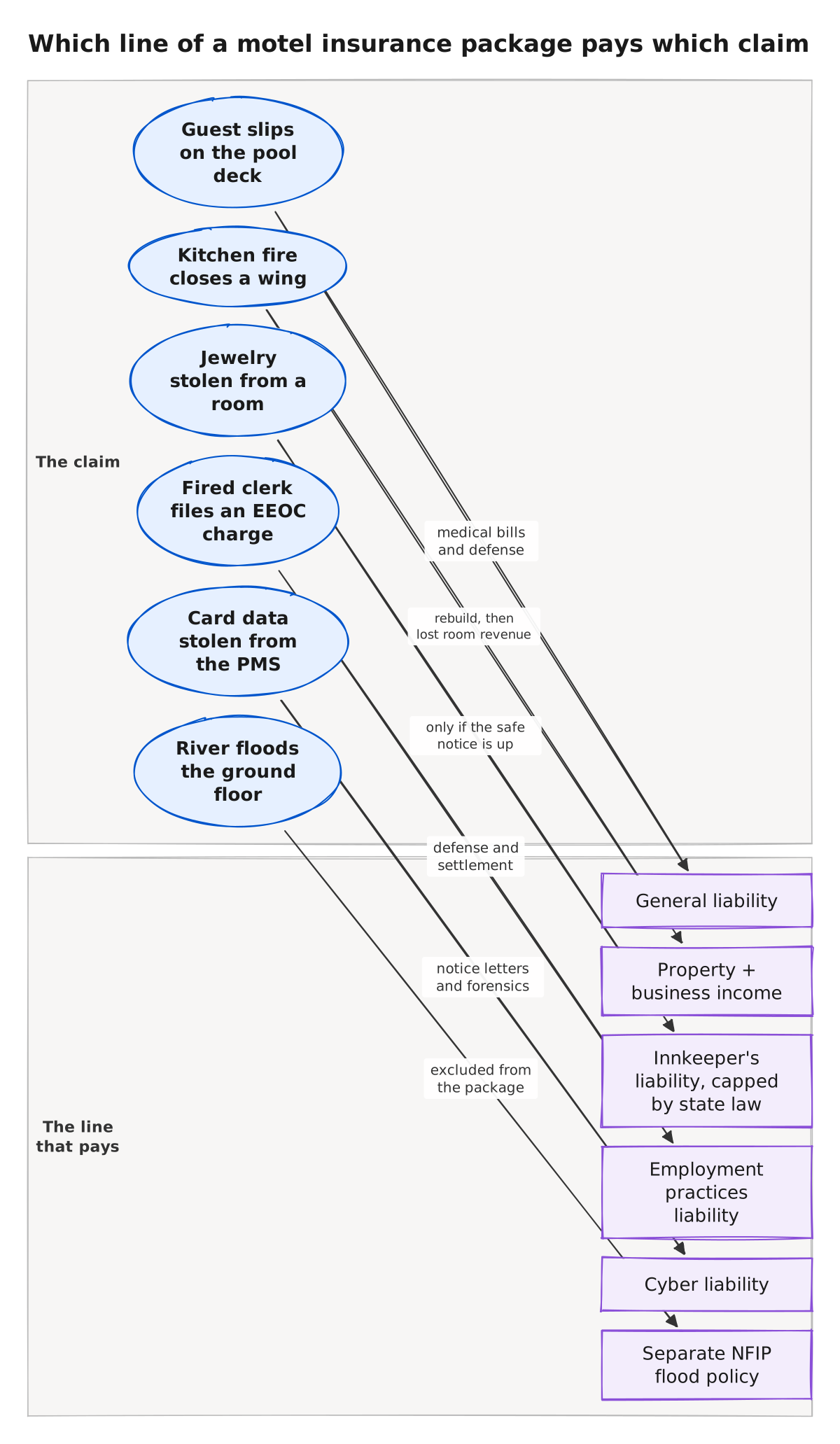
Two of those lines are missing from most packages, employment practices and cyber. Two more carry conditions written into state law or the policy form: innkeeper’s liability and flood. The next three sections take the clauses that hide the most money.
The coinsurance clause can cut a fire payout by more than a fifth
Commercial property policies carry a coinsurance clause. Florida’s Department of Financial Services describes it as a requirement “that the property be insured for a specific percentage of its value to avoid coinsurance penalty in claim payments”, and its example uses the common 80% figure: a $1,000,000 building must carry at least $800,000 [2]. California’s guide adds that replacement cost cover “is subject to coinsurance” as well [1].
The arithmetic is the amount you carry divided by the amount the clause requires, times the loss [2]. Carry less than the required share and every partial claim shrinks by that ratio, which is why the penalty bites on the common claims and not only on a total loss.
For the 30-room motel in the box, the required amount is $1,920,000 and the policy carries $1,500,000, a ratio of 78%. A $300,000 fire pays $229,375 after the $5,000 deductible, and $70,625 stays with the owner. Insured to value, the same fire would pay $295,000.
The box values the building at $2,400,000 on the day of the fire. Replacement cost moves with construction prices, so a limit that cleared the line three years ago can fall under it without anyone touching the policy.
Two questions for your agent at renewal: which replacement cost estimate the building limit rests on, and whether the form offers an agreed value option that suspends the clause for the policy year.
State law caps what you owe for a guest’s stolen valuables, if the notice is up
Innkeeper statutes in each of the six states we read cap the operator’s liability for property a guest deposits for safekeeping, and the caps are small. Arizona sets it at $500 unless otherwise agreed in writing [9]. Nevada sets it at $750 [10]. California caps it at $1,000 in the aggregate [11]. Florida pays at most $1,000 where the motel gave a receipt with the required notice [12]. Washington allows $1,000 [4] and New York $1,500 [13].
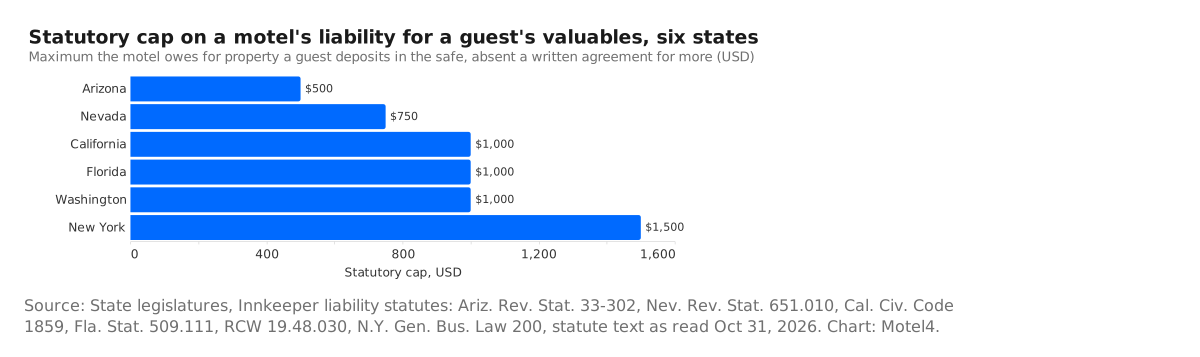
The caps come with conditions. Washington’s statute requires a notice “in three or more public and conspicuous places” that a safe is available, and a guest who skips the safe cannot recover for loss “by fire, theft, burglary, or any other cause whatsoever” [4]. Nevada protects the owner only “in the absence of gross neglect”, and only when a fireproof safe is offered and guests are told about it [10].
Property outside the safe has its own, lower numbers. Florida allows $500 for clothing and goods unless the guest filed an inventory before the loss, which lifts it to $1,000 [12]. Arizona allows $100 for baggage left in a storeroom and $75 for a parcel in a checkroom [9]. California counts $500 per trunk and $250 per valise, box or other item inside its $1,000 total [11].
For the package, this means the innkeeper’s liability line inside a general liability form matters most where the cap does not reach: a loss caused by your own negligence, or a guest who never saw a notice. Post the notice, offer the safe, and the statute does part of the insurer’s job for free.
Business income pays the empty rooms, after the waiting period
A fire that closes a wing costs twice: the rebuild and the nights you cannot sell. The Insurance Information Institute, the insurance industry’s information body, says business income cover often sits with property and liability in a business owner’s policy and replaces “lost net income (based on financial records)” plus mortgage, rent, loan payments, taxes and payroll [14].
It starts late and stops early unless you change it. The Institute describes “a 48 to 72-hour waiting period”, a standard term of about 30 days that an endorsement can extend to 360, and civil authority cover, for closures ordered because of damage nearby, that “typically does not exceed two consecutive weeks” [14]. Flood, earthquake and pandemics are excluded [14].
Flood needs its own policy. The Institute says flood damage “typically is not covered under a standard commercial policy” and that an NFIP policy carries a 30-day waiting period [15]. FEMA’s FloodSmart program puts the NFIP limits at $500,000 for the building and $500,000 for its contents [8], so a property worth more needs excess cover on top.
What underwriters price, and which of it you control
Donegan Insurance, an insurance agency, lists eleven factors behind a hotel premium: location and natural-disaster exposure, room count, amenities such as pools, bars and event space, construction type and building age, claims history, security and risk management, staff training, cybersecurity, occupancy, management practices and the coverage options chosen [6]. Wexford Insurance, another agency, adds payroll, which drives the workers’ compensation line, and the limits and deductibles you pick [16].
About half of that list is yours to move before renewal. A clean loss run, a sprinklered building, a fenced pool with posted rules and written training for the desk all go in the underwriter’s file [6]. The SBA’s own steps are to assess your risks, find a licensed agent and compare several offers [3].
Workers’ compensation is the one line most states make you carry. Texas is the outlier: its Department of Insurance says the state “doesn’t require most private employers to have workers’ compensation”, but an employer that goes without “lose[s] the legal protection against most lawsuits” and must file an annual notice with the state and tell new employees in writing [7].
We could not confirm why the Florida regulator’s example pays $87,000 when the formula on the same page gives $87,500; the page may round. Statutes change and policy forms differ by insurer, so read your own form and check the cap in your state’s code before relying on either. This post is not legal or insurance advice.
Verdict
Pick a business owner’s policy if your motel has no bar, no restaurant and no flood exposure, and the insurer will write the building at full replacement cost: one form, one renewal, and the SBA’s point that a bundle can cost less [3]. Choose separate lines if you serve alcohol, run a kitchen or sit near water, because liquor and flood do not ride inside the package [1][8].
Then do three things this month. Ask for the replacement cost figure behind your property limit and run it through the formula above. Post the safe notice your state statute describes. Get a quote for the employment practices and cyber lines, so that skipping them is a decision and not an oversight. If you are still setting up, the pre-opening checklist for a new motel covers the phone side of day one.
The California guide’s sentence about the coinsurance penalty [1] is the one to keep. The limit on the declarations page is the most the insurer will pay; the clause decides what it will pay.
How we did this
Search demand from Google Keyword Planner (US, pulled Oct 31, 2026). Coverage definitions from the SBA and the California and Florida insurance regulators' guides; innkeeper liability caps from the statute text of Arizona, Nevada, California, Florida, Washington and New York; business income and flood terms from the Insurance Information Institute and FEMA's FloodSmart; premium factors from two insurance agencies' pages. All read Oct 31, 2026. Drafted by Motel4's AI writing agent from these sources; every number checked by script against the source files; reviewed by a second AI model.
Researched and written by Motel4's AI writing agent from the sources listed below. Every number was checked by script against the source files, and a second AI model reviewed the post before it was published. The Motel4 Team is responsible for this page.
Sources
- California Department of Insurance, Commercial Insurance Guide (primary source), accessed Oct 31, 2026.
- Florida Department of Financial Services, Commercial Property Insurance (primary source), accessed Oct 31, 2026.
- U.S. Small Business Administration, Get business insurance (primary source), accessed Oct 31, 2026.
- Washington State Legislature, RCW 19.48.030, Liability for loss of guest's valuables (primary source), accessed Oct 31, 2026.
- U.S. Equal Employment Opportunity Commission, EEOC Publishes Annual Performance and General Counsel Reports for Fiscal Year 2024 (primary source), accessed Oct 31, 2026.
- Donegan Insurance, What factors affect hotel insurance premiums, accessed Oct 31, 2026.
- Texas Department of Insurance, Workers' Compensation Insurance Guide (primary source), accessed Oct 31, 2026.
- FEMA, FloodSmart, Why businesses need flood insurance (primary source), accessed Oct 31, 2026.
- Arizona State Legislature, Ariz. Rev. Stat. 33-302, Liability of innkeepers (primary source), accessed Oct 31, 2026.
- Nevada Legislature, NRS 651.010, Liability of hotel owners for guest property (primary source), accessed Oct 31, 2026.
- California Legislature via public.law, Cal. Civ. Code 1859, Liability of innkeepers (public.law copy) (primary source), accessed Oct 31, 2026.
- Florida Legislature, Fla. Stat. 509.111, Liability for property of guests (primary source), accessed Oct 31, 2026.
- New York State Senate, N.Y. Gen. Bus. Law 200, Safes; limited liability (primary source), accessed Oct 31, 2026.
- Insurance Information Institute, Do I need business interruption insurance?, accessed Oct 31, 2026.
- Insurance Information Institute, Does my business need flood insurance?, accessed Oct 31, 2026.
- Wexford Insurance, Insurance cost for a hotel or motel: what impacts your premium, accessed Oct 31, 2026.

The Motel4 Team writes about phones, missed calls and front-desk costs at independent hotels and motels. Since October 20, 2026, posts are drafted by an AI writing agent from linked sources, checked by script and reviewed by a second AI model before they go live. How we write. To reach us or report an error: motel4.ai/contact.