

Handling Spanish-Speaking Guest Calls at Your Motel (Without a Bilingual Clerk)
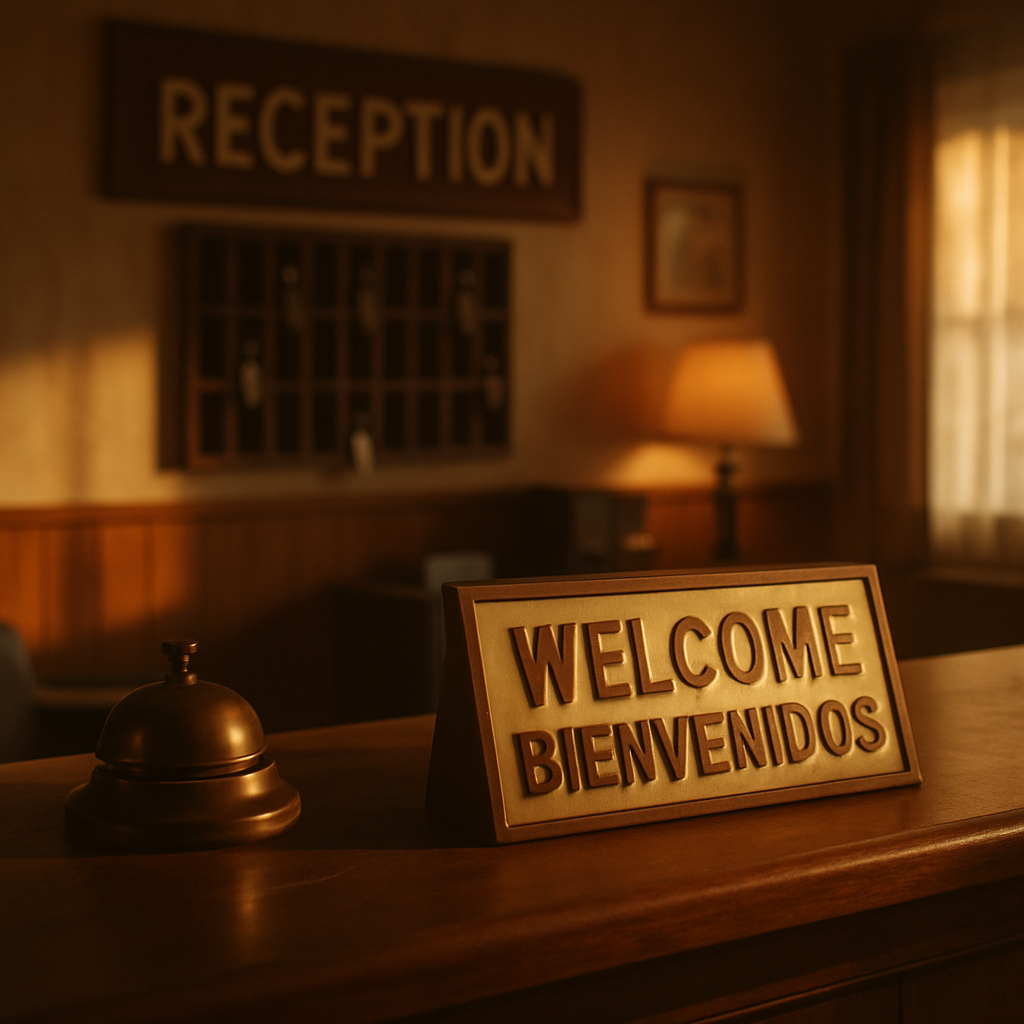
If you run an independent motel, you already know what happens when the phone rings during check-in rush, housekeeping questions, and late arrivals. Now add a caller who is more comfortable speaking Spanish than English, and a simple reservation call can turn into a missed booking, a bad review, or a frustrated guest before they even arrive.
For many small properties, hiring a bilingual front desk clerk for every shift is not realistic. But that does not mean you have to keep losing calls from Spanish-speaking guests or force your staff to struggle through conversations they are not equipped to handle.
Why Spanish-speaking guest calls matter more than many motel owners think
Section titled “Why Spanish-speaking guest calls matter more than many motel owners think”If your property serves travelers in the US, there is a good chance you already receive calls from Spanish-speaking guests motel phone inquiries every week, even if you are not tracking them. These calls are not niche. They are part of normal demand.
Spanish is the second most spoken language in the United States, and millions of households use it at home. In many states and travel corridors, Spanish-speaking travelers include construction crews, road trippers, family groups, seasonal workers, event travelers, and international visitors. For motels, hostels, and B&Bs, that means phone calls about rates, vacancy, pet policies, parking, late check-in, and directions are increasingly likely to happen in Spanish.
The missed-call problem gets worse when language is involved
Section titled “The missed-call problem gets worse when language is involved”A regular missed call is already expensive. A language-mismatch call is even more fragile.
When a caller hears confusion, long pauses, or staff passing the handset around asking, “Does anyone speak Spanish,” three things often happen:
- The caller hangs up and tries the next property
- The booking shifts to an OTA instead of direct
- The guest arrives with the wrong expectations
That last issue matters more than owners sometimes realize. If the guest thought breakfast was included, thought there was truck parking, or misunderstood the check-in deadline, the problem starts on the phone but shows up later as an operations headache.
ESL guests often need clarity, not a perfect conversation
Section titled “ESL guests often need clarity, not a perfect conversation”Many owners assume they need fluent, natural Spanish service to handle these calls properly. In practice, most guests do not need a polished concierge-level experience. They need accurate answers, patience, and a clear next step.
That means your motel does not need to become fully bilingual overnight. It needs a reliable way to:
- answer basic booking and property questions
- collect reservation details correctly
- explain policies in plain language
- avoid misunderstandings around arrival and payment
- make the guest feel welcome instead of stuck
That is a much more achievable goal.
What Spanish-speaking guests usually call about
Section titled “What Spanish-speaking guests usually call about”Most phone calls are not complicated. They are repetitive, operational, and tied directly to booking conversion. Once you understand the common call types, it becomes easier to build a system that handles them without depending on one bilingual employee.
Reservation and rate questions
Section titled “Reservation and rate questions”These are the highest-value calls. Guests may ask:
- Do you have rooms tonight
- How much is a room with two beds
- Do you charge a deposit
- Can I pay in cash
- Is tax included
- Do you have weekly rates
If your staff cannot answer confidently, the booking often disappears. Even if the guest later books online, you may lose the direct relationship and pay commission.
Arrival, check-in, and late-night calls
Section titled “Arrival, check-in, and late-night calls”Spanish-speaking guests often call from the road. They are trying to confirm:
- how late they can check in
- whether the office is still open
- whether they can arrive after midnight
- where the property is located
- whether parking is available for trailers or larger vehicles
These are exactly the calls that come in when your front desk is busiest or closed.
Policy clarification
Section titled “Policy clarification”Policy confusion creates avoidable friction. Common examples include:
- pet fees
- smoking rules
- ID requirements
- incidental holds
- number of guests allowed per room
- children staying free or not
- cancellation deadlines
If these are explained badly on the phone, you often end up with front desk disputes at arrival.
Local and practical questions
Section titled “Local and practical questions”Not every call is about the room. Guests also ask practical, pre-arrival questions:
- Is there food nearby
- Is the neighborhood safe
- Do you have ground-floor rooms
- Is breakfast included
- Do you have Wi-Fi
- Is there a laundromat nearby
These questions are usually simple, but they still influence whether someone books.
Why “just ask a staff member who knows some Spanish” breaks down
Section titled “Why “just ask a staff member who knows some Spanish” breaks down”A lot of small properties handle Spanish-speaking calls informally. Someone on staff speaks enough Spanish to get by, so the team relies on that person. It works until it does not.
It creates coverage gaps
Section titled “It creates coverage gaps”Your part-time housekeeper may speak Spanish well, but she is not always near the phone. Your night clerk may know a few phrases, but not enough to explain deposit policy. Your manager may be bilingual, but cannot take every call while handling operations.
This leads to a fragile setup where service quality depends on who happens to be on shift.
It increases mistakes on basic reservation details
Section titled “It increases mistakes on basic reservation details”Phone reservations are detail-heavy. Dates, room types, guest counts, payment terms, and arrival times need to be captured correctly. When staff are guessing their way through another language, errors go up.
Those errors are expensive because they show up later as:
- overbooked room types
- wrong arrival dates
- missed guarantees
- no-shows that should not have been no-shows
- angry guests claiming they were told something different
It puts unfair pressure on staff
Section titled “It puts unfair pressure on staff”Even helpful employees can get burned out when they become the default translator for the whole property. They get interrupted constantly, pulled away from their actual role, and expected to solve every language issue.
That is not a staffing plan. It is a patch.
A better system for handling Spanish-speaking guest calls
Section titled “A better system for handling Spanish-speaking guest calls”The practical solution is not to wait until you can afford a bilingual clerk on every shift. It is to design your phone process so Spanish-speaking guests get consistent answers any time they call.
Start with the highest-frequency call flows
Section titled “Start with the highest-frequency call flows”You do not need to solve every possible conversation first. Start with the calls that matter most:
- availability and rates
- check-in and late arrival
- pet and parking policies
- directions and property basics
- reservation confirmation and callback collection
If these are handled well, you solve a large share of the real business problem.
Standardize property information
Section titled “Standardize property information”Before any tool or process works well, your information has to be clean and consistent. Create a clear internal reference for:
- room types and occupancy limits
- taxes and fees
- pet rules
- office hours
- late check-in process
- deposit and payment policy
- parking details
- amenities
- cancellation terms
This protects you from the bigger issue, which is not language alone. It is inconsistent answers.
Use bilingual call handling that does not depend on shift luck
Section titled “Use bilingual call handling that does not depend on shift luck”If your front desk cannot reliably answer Spanish calls, you need a layer between the guest and your staffing limitations. That could be a bilingual answering workflow, a hospitality-focused phone system, or an AI receptionist built around motel operations.
The key is that it should do more than translate. It should actually handle lodging calls in context by:
- understanding booking intent
- answering common policy questions
- collecting reservation details accurately
- passing urgent matters to staff when needed
- working after hours
- keeping responses consistent
That is the difference between a novelty language tool and something that protects revenue.
If you want to understand the operational side of this, see how it works.
Offer a clear path to a human when needed
Section titled “Offer a clear path to a human when needed”Not every call should stay automated. Some guests have special circumstances, group requests, or complicated payment questions. A good system should know when to escalate and route the call, take a message, or trigger a callback.
The win is not eliminating human involvement. The win is making sure your staff only step in for the calls that actually require them.
The ROI of answering Spanish-speaking guest calls properly
Section titled “The ROI of answering Spanish-speaking guest calls properly”Owners usually ask the right question: how much is this really costing me today, and what is it worth to fix it?
Here is a simple way to think about it.
Example: one small property, modest call volume
Section titled “Example: one small property, modest call volume”Say your motel gets:
- 20 calls per day
- 15 percent of them from guests who prefer Spanish or are more comfortable in Spanish
- 3 Spanish-language calls per day
Now assume:
- 40 percent of those calls are booking-related
- that is 1.2 booking-intent calls per day
- your average direct booking value is $110
- your current team fails to convert or mishandles half of those calls
That means you may be losing about:
- 0.6 bookings per day
- 18 bookings per month
- $1,980 per month in direct booking revenue
That is before counting repeat stays, upsells, or OTA commission savings.
OTA leakage adds another layer of cost
Section titled “OTA leakage adds another layer of cost”Some guests who do not get help on the phone will still book, but through an online travel agency instead of directly. If that booking carries a 15 to 20 percent commission , the cost of poor phone coverage keeps growing.
Using the same $110 booking example:
- 18 shifted bookings x $110 = $1,980
- at 15 percent commission, that is $297 per month
- at 20 percent commission, that is $396 per month
So even if those guests still stay with you, weak phone handling can quietly erode margin.
Staff time also has value
Section titled “Staff time also has value”There is also the labor side. If your team spends 10 to 15 minutes scrambling on each Spanish call, looking for a translator, repeating themselves, and fixing misunderstandings later, that adds up.
At 3 such calls per day and 10 extra minutes each, that is:
- 30 minutes per day
- around 15 hours per month
At a fully loaded labor cost of $18 to $25 per hour, that is another:
- $270 to $375 per month
This is why phone handling is not just a customer service topic. It is a revenue and labor topic.
Small conversion gains can justify the change
Section titled “Small conversion gains can justify the change”You do not need a huge transformation to get a return. If better Spanish call handling helps recover even:
- 6 direct bookings per month at $110 each = $660
- plus reduced staff time and fewer front desk disputes
the improvement can pay for itself quickly.
For many independent properties, this is one of those operational fixes that looks small from the outside but touches bookings, reviews, staff stress, and guest satisfaction all at once.
What to look for in a solution for Spanish-speaking motel phone calls
Section titled “What to look for in a solution for Spanish-speaking motel phone calls”Not every phone tool is built for lodging. And not every bilingual tool is useful at the front desk level. If you are considering a solution, focus on practical fit.
It should understand hospitality questions
Section titled “It should understand hospitality questions”General phone tools often fail on travel-specific issues. You need something that can correctly handle questions like:
- Do you have two queen beds tonight
- Can I check in at 1 a.m.
- Is the pet fee per night or per stay
- Can my truck and trailer fit in your lot
- Do you have a room on the first floor
That sounds basic, but it is where many systems break.
It should be easy to update
Section titled “It should be easy to update”Your rates, office hours, seasonal rules, and room availability change. If updating the system is slow or technical, staff stop trusting it. Choose something that lets you quickly maintain current information.
It should protect guest experience, not just answer calls
Section titled “It should protect guest experience, not just answer calls”A guest who speaks Spanish should not feel like they reached a dead-end answering machine. The interaction should feel useful, respectful, and clear. That means natural pacing, correct property details, and a clean handoff when needed.
It should work after hours
Section titled “It should work after hours”A lot of valuable calls happen outside front desk hours, especially for roadside motels and late-arrival properties. If your Spanish support only exists during the day, you are still missing a meaningful share of demand.
It should help you measure results
Section titled “It should help you measure results”You should be able to see:
- how many calls were answered
- how many were in Spanish
- how many led to booking intent
- what common questions were asked
- where escalation happened
This is how you move from guessing to managing.
FAQ: Spanish-speaking guest calls at motels
Section titled “FAQ: Spanish-speaking guest calls at motels”Do I need a fully bilingual front desk team to serve Spanish-speaking guests well
Section titled “Do I need a fully bilingual front desk team to serve Spanish-speaking guests well”No. You need reliable coverage for common call types and a clear escalation path for complex issues. A fully bilingual team is helpful, but most small properties can improve a lot with a better phone workflow.
Are Spanish-speaking callers mostly asking for discounts
Section titled “Are Spanish-speaking callers mostly asking for discounts”Not usually. Most are asking the same practical questions any guest asks: rates, room availability, check-in times, parking, pet policy, and payment terms. Treat these calls as standard booking opportunities, not exceptions.
Can translation apps solve this problem
Section titled “Can translation apps solve this problem”They can help with one-off situations, but they are not a good front-line phone process. Live phone calls move quickly, require property-specific answers, and often involve dates, fees, and policies that need to be communicated accurately.
Will better Spanish phone coverage really increase direct bookings
Section titled “Will better Spanish phone coverage really increase direct bookings”In many cases, yes. If a guest can get a clear answer in the language they are comfortable with, they are more likely to book directly instead of hanging up or going to an OTA. The impact depends on your market and call volume, but the revenue effect is real.
What if only a small percentage of my callers prefer Spanish
Section titled “What if only a small percentage of my callers prefer Spanish”Even a small percentage can matter because these are often high-intent callers. If you lose just a handful of direct bookings each month due to language friction, the cost adds up faster than most owners expect.
If your property is missing bookings because staff cannot consistently handle Spanish-speaking guest motel phone calls, the problem is fixable without hiring a bilingual clerk for every shift. A better phone process can help you capture more direct bookings, reduce front desk friction, and give ESL guests a smoother first interaction with your property. Review what you are losing today, then compare it to a system built for lodging. You can start with pricing.